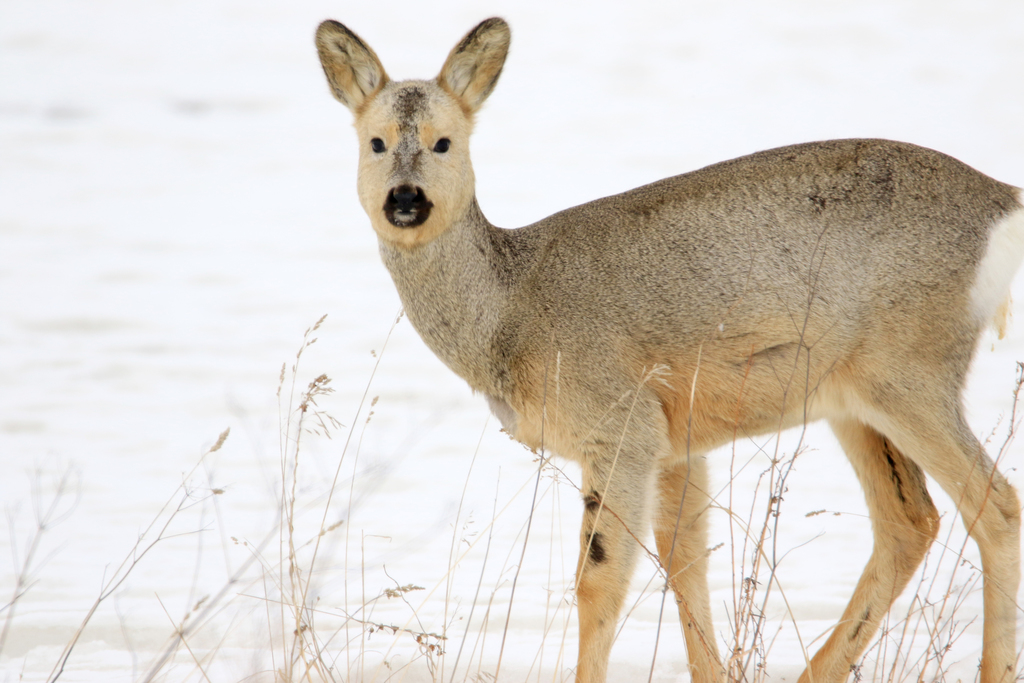
Eastern Roe Deer
Photo © Нурхайдарова Татьяна
Photo © Нурхайдарова Татьяна — CC BY 4.0 — Source: iNaturalist photo #183729233Identification
The Eastern roe deer is a medium-sized deer with a distinctly slender, graceful build and long neck. Adults typically reach up to 146 cm in body length and weigh around 59 kg, making them noticeably larger than their European cousins. Males carry impressive three-tined antlers that are widely spaced and slant upward—larger and more branched than those of European roe deer—which are shed in autumn or early winter. The species gets its scientific name pygargus, meaning "white-rumped," from the conspicuous white caudal patch that contrasts sharply against their seasonal coat colors.
Coloration varies with season and geography. In winter, northern populations display light gray fur, while southern populations are grayish-brown with ochraceous tones. Summer brings reddish coloring, and young deer are identifiable by their spotted coat. The belly is creamy-white across all seasons. Their large ears and long neck give them an alert, elegant appearance distinctive among roe deer species.
Range & Habitat
Found across northeastern Asia, the Eastern roe deer inhabits Siberia, Mongolia, Kazakhstan, the Tian Shan Mountains of Kyrgyzstan, eastern Tibet, the Korean Peninsula, and forested regions of northern China. Their range once extended further west to the northern Caucasus and eastern Ukraine, but overhunting in the late 19th and early 20th centuries significantly diminished their distribution across Eastern Europe, northern Kazakhstan, western Siberia, and northern eastern Siberia. Today, populations meet the European roe deer at the Caucasus Mountains, with the Eastern species occupying the northern flank.
These deer are highly adapted to their temperate-zone habitats, thriving in forest and steppe environments. They develop particularly high densities in tall-grass meadows and floodplains, where their light, slender build is ideally suited for navigating dense vegetation. They are remarkably resilient to severe weather extremes, making them well-suited to the climatic challenges of their range.
Behaviour & Diet
Eastern roe deer are herbivorous generalists, consuming over 600 plant species including herbaceous dicotyledons, monocotyledons, and woody species. In summer, they regularly visit natural salt licks to meet their sodium requirements, and they typically obtain water through moisture-rich foods rather than drinking directly. During harsh winters, their metabolic rate lowers to compensate for reduced food availability.
Socially, males are highly territorial and mark their domains using scent glands on their head skin, rubbing against trees and shrubs, or by fraying vegetation with their antlers. They communicate through six distinct vocal signals: squeaking, whistling, rasping, barking, whining, and screaming, plus nonvocal sounds. Mating occurs in August and September. Females are notably unique among ungulates in undergoing embryonic diapause; implantation occurs in January with a gestation of 280–300 days. Typically giving birth to two fawns, which are weaned after 4–5 months. These deer are capable jumpers, reaching distances up to 15 meters, and some populations undertake mass migrations seasonally.
Best Time & Places to See It
Eastern roe deer are most visible during their active seasons in tall-grass meadows and floodplain habitats, particularly in Mongolia, Siberia, and the forested regions of northern China and the Korean Peninsula. Early morning and late evening offer the best viewing opportunities when deer are most active. Mating season in August and September increases visibility as males become more active and vocal while defending territories.
Winter offers an additional viewing opportunity for northern populations, when their light gray coloration contrasts clearly against snowy backgrounds. The Tian Shan Mountains region provides habitat for the distinctive tianschanicus subspecies, while mainline Siberian populations are found across the broader temperate zone of Central and East Asia.
Photography Tips
Capture the Eastern roe deer's elegant proportions by photographing from low angles that emphasize their long neck and slender build. Males' impressive antlers are best photographed in clear sidelight that highlights their branching structure and spacing. The distinctive white caudal patch provides an excellent focal point—photograph rear views to showcase this defining characteristic against darker vegetation.
Seasonal color changes offer rich photographic opportunities: the reddish summer coat provides vibrant warm tones, while winter's light gray northern populations create striking contrast in snowy landscapes. During mating season (August-September), position yourself to capture territorial behaviors such as antler fraying on trees. The spotted coat of young fawns, particularly in summer, makes for compelling wildlife imagery. Use patient stalking techniques during dawn and dusk when deer are most active, and consider tall-grass meadow habitats where their slender frame stands out distinctly against vegetation.
Baikal National Park
Ольхонский район, Russia
+184 birds+11 mammals
Where the world's deepest freshwater lake meets ancient Siberian taiga, Baikal National Park sprawls across 66,203 square kilometers of one of Earth's most singular ecosystems. The…
VIEW NATIONAL PARKTransbaikal National Park
Barguzinsky Rayon, Russia
+83 birds+7 mammals
Where the eastern shore of Lake Baikal meets the Barguzinsky Range, a vast wilderness of boreal forest, alpine tundra, and rocky shoreline unfolds across more than…
VIEW NATIONAL PARKGiant Panda National Park
Mianyang, China
+447 birds+47 mammals
Where the eastern slopes of China's Sichuan plateau descend into cloud-wrapped valleys, one of Asia's most biodiverse landscapes unfolds across more than 350,000 square kilometres. This…
VIEW NATIONAL PARKHuanglong Scenic and Historic Interest Area
Ngawa Tibetan and Qiang Autonomous Prefecture, China
+194 birds+7 mammals
Across the high plateau of northwestern Sichuan, a geological wonder unfolds where limestone terraces and mineral-rich springs have sculpted one of China's most distinctive natural monuments.…
VIEW NATURAL MONUMENTLand of the Leopard National Park
Khasansky District, Russia
+83 birds+11 mammals
Where coniferous and mixed forests sweep across the rolling terrain of Russia's Far East, Land of the Leopard National Park embraces a landscape shaped by the…
VIEW NATIONAL PARKNortheast China Tiger and Leopard National Park
Mu Dan Jiang Shi, China
+202 birds+19 mammals
Across the temperate forests of northeastern China, where winters grip the landscape in subzero silence and summers remain cool and brief, the Mudanjiang region supports a…
VIEW NATIONAL PARKNo community photos yet. Log in to add the first one.
No community observations of this species yet.