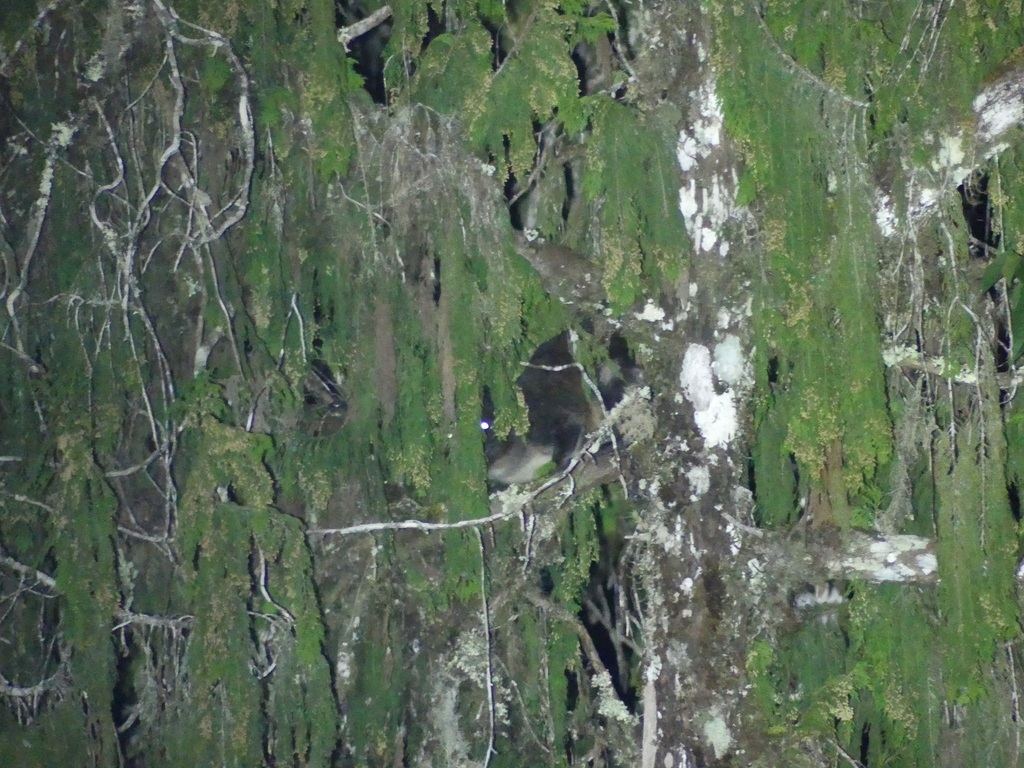
Eastern Tree Hyrax
Photo © Valentin Moser
Photo © Valentin Moser — CC BY 4.0 — Source: iNaturalist #251251791Identification
The eastern tree hyrax is a small, rotund mammal resembling a guinea pig, weighing around 2.75 kilograms (6.1 pounds) with a head-body length of 470 to 558 millimetres (18.5 to 22.0 inches). It has no discernible tail. These creatures possess dense, soft fur with variable coloration: dorsal surfaces range from cinnamon brown to blackish, while undersides are paler. A distinctive feature is the dorsal scent gland, marked by a contrasting patch of light-colored hairs. The rostrum is relatively long and well-haired, unlike the related western tree hyrax. Considerable variation exists between subspecies, and eastern tree hyraxes can be difficult to distinguish from the closely related southern tree hyrax, though the latter typically has more grizzled fur.
Range & Habitat
The eastern tree hyrax is endemic to East Africa, distributed patchily across Kenya and Tanzania, along with the islands of Zanzibar and Pemba. This species is the most localized of all tree hyrax species, predominantly inhabiting the foothills and montane forests of Mount Kilimanjaro, Mount Meru, and the Eastern Arc Mountains—an ancient chain of isolated, relict forests stretching from the Taita Hills of southern Kenya to the Udzungwa Mountains of Tanzania. Coastal populations occur between the Tanga Region of Tanzania and Mombasa, Kenya.
Eastern tree hyraxes are largely restricted to montane forests but also occur in adjacent lowland forests and even tropical dry forests on coral in Zanzibar and Pemba. They are most abundant at lower elevations but can be found as high as 3,070 metres on Mount Kilimanjaro, though in reduced densities where large trees are scarce. In some locations, particularly along the Kenyan coast, they inhabit rocky boulders and caves resembling rock hyrax habitats, demonstrating flexibility in shelter preferences despite their arboreal nature.
Behaviour & Diet
The eastern tree hyrax is a solitary, highly vocal species, living in tree holes and communicating with other individuals through repetitive calls and scent marking. Most roosts are occupied by a single animal, except for females with young. These are skilled climbers that feed predominantly in the canopy on tree leaves, forming large middens adjacent to their roost trees. They feed on leaves from various trees and bushes but do not consume exotic species grown in tree plantations.
Remarkably, the eastern tree hyrax is one of few mammal species that can sing. Singing is most common in February and June. The species produces numerous high-energy calls that may be combined and graded, creating a complex vocal repertoire. Subspecific populations display considerable vocal variation, with some researchers suggesting that eastern tree hyraxes may represent a complex of distinct species rather than a single species.
Best Time & Places to See It
The best opportunities to encounter eastern tree hyraxes occur in February and June, when singing is most frequent and the animals are more vocal and active. Prime locations include the montane and lowland forests of Mount Kilimanjaro, Mount Meru, and the Eastern Arc Mountains. The Taita Hills of southern Kenya and the Udzungwa Mountains of Tanzania are particularly promising. Coastal areas between Tanga, Tanzania, and Mombasa, Kenya, as well as the islands of Zanzibar and Pemba, also support populations. Since these animals are solitary and arboreal, listen for their distinctive calls and look for large middens beneath trees where they roost.
Photography Tips
Eastern tree hyraxes are challenging photographic subjects due to their solitary, nocturnal habits and arboreal lifestyle high in the canopy. Focus on February and June when increased vocal activity makes locating individuals easier. Early morning and dusk offer the best light for canopy photography. Position yourself near roost trees and watch for the large middens that accumulate beneath them—these are reliable indicators of hyrax presence. A telephoto lens is essential for capturing these small, distant subjects in their tree holes without disturbance. Exercise patience and remain quiet, as these vocal creatures are sensitive to noise. In coastal and mountain areas where they inhabit rock crevices, scout suitable boulder and cave formations at dawn.
No community photos yet. Log in to add the first one.
No community observations of this species yet.