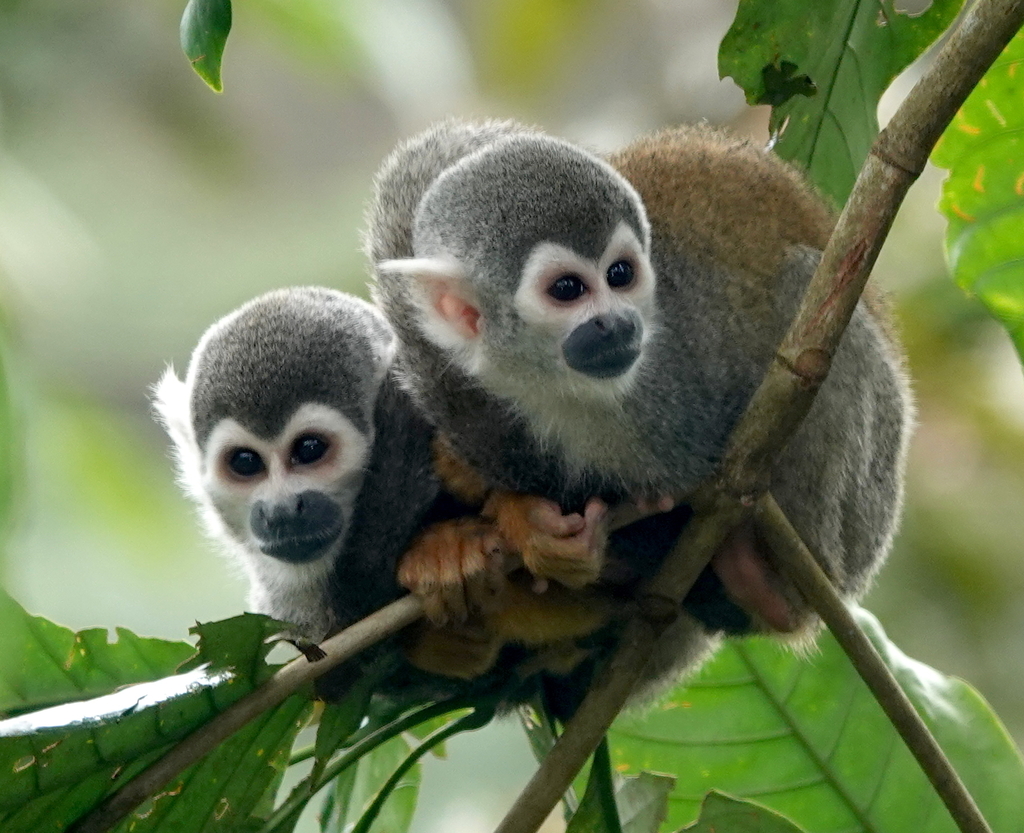
Ecuadorian Squirrel Monkey
CC BY 4.0
CC BY 4.0 — Source: iNaturalist photo #167442353Identification
The Ecuadorian squirrel monkey is a diminutive primate with a head and body length of 25 to 32 centimetres and a distinctively long tail measuring 34 to 44 centimetres—often longer than the body itself. Males are noticeably larger than females, weighing between 885 and 1,380 grams compared to females' 590 to 1,150 grams. The species displays dark fur coloration, which distinguishes it from closely related squirrel monkeys, particularly the Guianan squirrel monkey. Despite taxonomic reclassifications over recent decades—moving from subspecies to full species status and back again—the Ecuadorian squirrel monkey remains recognizable by its compact size and darker coat among Amazonian primates.
Range & Habitat
This species is found across a broad swath of northwestern South America, inhabiting the western Brazilian Amazon as well as southern Colombia, eastern Ecuador, and northern and eastern Peru. The Ecuadorian squirrel monkey thrives in humid tropical and subtropical forests, showing a marked preference for dense forest canopy but demonstrating considerable adaptability to secondary and disturbed forest habitats. While the species can tolerate elevations up to 1,200 metres, populations studied in Ecuador show a preference for lower elevations below 500 metres, where forest conditions are typically more humid and undisturbed.
Behaviour & Diet
Like other squirrel monkeys, Saimiri macrodon is a highly social and active primate, though detailed behavioural accounts specific to this subspecies remain limited in scientific literature. These diminutive monkeys are characteristically arboreal, spending most of their time moving through the forest canopy where their long tails aid in balance and manoeuvrability. They are generally diurnal, active throughout daylight hours as they forage through the trees. While specific dietary preferences for the Ecuadorian squirrel monkey are not extensively documented, squirrel monkeys as a group are omnivorous, feeding on insects, small vertebrates, and fruits, making them important seed dispersers within their forest ecosystems.
Best Time & Places to See It
The Ecuadorian squirrel monkey can be encountered throughout its range, though sightings are most reliable in protected forest areas and wildlife reserves within Ecuador, Peru, and Colombia. The species' preference for lower elevations and dense forest means that lowland rainforest reserves offer the best opportunities for observation. Year-round presence suggests that visits during any season may yield sightings, though local conditions and fruiting cycles may influence activity patterns and visibility.
Photography Tips
Photographing these diminutive primates requires patience and a good telephoto lens, as squirrel monkeys are active and acrobatic, moving rapidly through the canopy. Early morning hours typically offer the best light and highest activity levels. A fast shutter speed is essential to capture their quick movements among branches. The species' dark coloration demands careful exposure metering to retain detail in both highlights and shadows. Working with a local guide familiar with monkey behaviour and forest trails will significantly improve your chances of locating and photographing these elusive forest dwellers.
Yasuní National Park
Aguarico, Ecuador
+601 birds+43 mammals
Where the western Amazon basin converges with Ecuador's Orellana Province, lowland rainforest reaches toward the horizon in an unbroken canopy of staggering botanical density. Yasuní National…
VIEW NATIONAL PARKSangay National Park
Cebadas, Ecuador
+320 birds+10 mammals
High in Ecuador's Andean spine, where the Western Cordillera rises to touch perpetual snow, a landscape of volcanic drama and ecological intensity unfolds across Sangay National…
VIEW NATIONAL PARKNatural Sierra de la Macarena National Park
Vista Hermosa, Colombia
+566 birds+15 mammals
Across nearly 20,000 square kilometres of Colombia's Meta Department, the terrain rises from lowland savanna into Andean foothills through a mosaic of gallery forests, palm-fringed wetlands,…
VIEW NATIONAL PARKAmacayacu National Park
Leticia, Colombia
+567 birds+25 mammals
Where the Rio Amazonas curves through the tri-border region where Colombia, Peru, and Brazil converge, Amacayacu National Park sprawls across more than 5,250 square kilometres of…
VIEW NATIONAL PARKNo community photos yet. Log in to add the first one.
No community observations of this species yet.