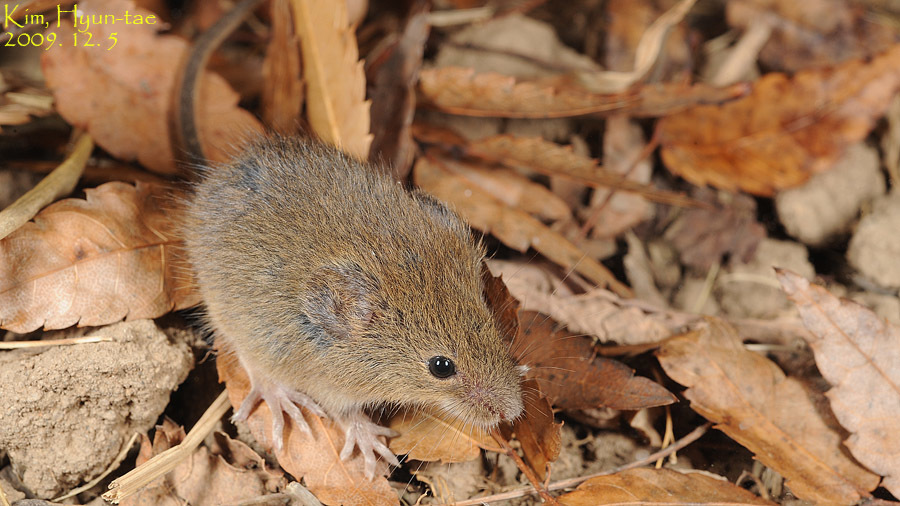
Eurasian Harvest Mouse
Photo © Kim, Hyun-tae
Photo © Kim, Hyun-tae — CC BY 4.0 — Source: iNaturalist photo #2813442Identification
The Eurasian harvest mouse is Europe's smallest rodent, weighing just 4–11 grams—roughly half the weight of a house mouse. Its body measures 55–75 mm long, with an equally impressive tail of 50–75 mm. Look for reddish-brown fur on the upper body (sometimes with yellow or red tints) contrasting sharply with white to cream-colored underparts. The tail is distinctive: naked at the tip, bicoloured, and highly prehensile—used as a fifth limb for climbing. Relatively large eyes and ears, a small nose with short whiskers, and broad feet adapted for gripping round out this diminutive but distinctive profile.
The harvest mouse's climbing adaptations are remarkable: its hind feet have somewhat opposable outer toes that grip stems, while its prehensile tail provides balance and support, leaving the forepaws free for feeding and grooming. This combination of features makes it instantly recognizable once spotted, though its tiny size and preference for dense vegetation make encounters challenging.
Range & Habitat
Native to Europe and Asia, the harvest mouse is common across England's east coast, reaching north to the North York Moors, though it also inhabits less favorable western woodlands and forests. These mice show a strong preference for tall vegetation: cereal crops (wheat, rice, and oats), reed beds, hedgerows, railway banks, and grasslands. They favor wetland habitats for nesting and show particular affinity for monocotyledons like common reed and Siberian iris. In Japan, populations demonstrate regional habitat preferences linked to grassland structure and seasonal vegetation availability.
Behaviour & Diet
Harvest mice are highly skilled climbers, spending most of their lives navigating long grasses and reed beds. Their diet consists primarily of seeds and insects, supplemented with nectar and fruit. Their most remarkable behavior is nest construction: they weave perfectly spherical nests from grass blades, attaching them to stems well above ground—so compact that historical accounts describe them rolling across tables intact. Females have a short lactation period of 15–16 days, during which pups develop climbing skills with remarkable speed: they learn hand-grasping by day 3–7, food-grasping by day 6–9, and achieve tail prehension by day 10–11. Thought to be solitary, harvest mice are preyed upon by barn owls, tawny owls, kestrels, and domestic cats.
Best Time & Places to See It
Harvest time (hence the name) is prime viewing season, when mice are most abundant and active in cereal fields. Focus your search on reed beds, hedgerows, and wetland margins where tall vegetation provides cover and nesting material. Early morning and dusk offer the best chances of observation. Look for their distinctive woven nests hanging from reed stems or grass—Gilbert White famously described them as the size of cricket balls, perfectly round and intricately plaited.
Photography Tips
Patience is essential: position yourself quietly near reed beds or tall grassland margins during harvest season or late summer. Use a macro lens to capture the mouse's remarkable facial features and prehensile tail in action. Photograph nests in situ when possible—they are architectural marvels and tell the story of this mouse's ingenuity. Early morning light filtering through vegetation creates excellent atmosphere. Be prepared for waiting; these tiny, solitary mice are elusive but rewarding subjects for dedicated wildlife photographers.
Avesnois Regional Nature Park
Bannau Brycheiniog National Park
Biebrza National Park
Boucles de la Seine Normande Regional Nature Park
Camargue Regional Nature Park
Caps et Marais d’Opale Regional Nature Park
Cévennes National Park
Chartreuse Regional Nature Park
Dartmoor National Park
Nothing matches these filters.
No community photos yet. Log in to add the first one.
No community observations of this species yet.