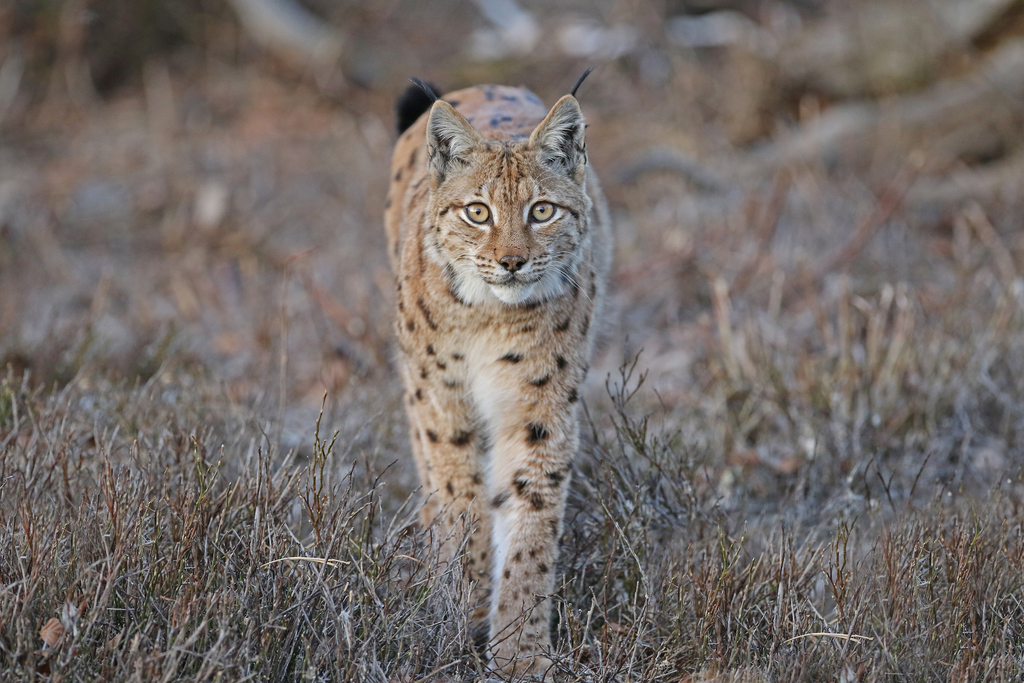
Eurasian Lynx
Photo © Christoph Moning
Photo © Christoph Moning — CC BY 4.0 — Source: iNaturalist photo #186702055Identification
The Eurasian lynx is the largest of the four lynx species, with males measuring 76–106 cm in body length and females 73–99 cm, standing 55–75 cm at the shoulder. Its most distinctive features include a relatively short reddish or brown coat marked with highly variable black spots, powerful long legs with large webbed and furred paws that function like snowshoes, and a characteristic short "bobbed" tail with an all-black tip. Look for prominent black ear tufts and a long grey-and-white ruff around the neck and chin. The underparts are whitish, and some animals display dark brown stripes on the forehead and back. Winter coat is much thicker, ranging from silver-grey to greyish brown, while animals from the southern end of the range show brighter coloration with more numerous spots.
Weight varies considerably by region, with Russian populations ranging from 12 to 32 kg, while those in Fennoscandia and westwards are considerably smaller at 7–26 kg. Individuals in the Carpathian Mountains may be notably larger.
Range & Habitat
The Eurasian lynx is widely distributed from Northern, Central and Eastern Europe to Central Asia, Siberia, the Tibetan Plateau and the Himalayas, inhabiting temperate and boreal forests up to an elevation of 5,500 m. It favours rugged terrain providing plenty of hideouts and stalking opportunities, including rocky-steppe, mixed forest-steppe, boreal forest, and montane forest ecosystems. In mountainous regions, lynx descend to lowlands in winter to follow prey and avoid deep snow. Despite its snow adaptations, the species struggles with loose, deep snow and cannot survive where snow depths exceed 100 cm. Lynx populations tend to be less common where grey wolves are abundant.
In Europe, the species was persecuted to local extinction in western and southern lowlands by the early 19th century, surviving only in mountainous areas and Scandinavian forests. By the 1950s it was extinct across most of Western and Central Europe, though scattered and isolated populations persist today. Fennoscandia now supports three subpopulations, with Finland home to approximately 2,200–2,300 individuals, Sweden to around 1,250–1,400, and Norway to about 452 mature individuals.
Behaviour & Diet
The Eurasian lynx is an adapted predator of forested and mountainous terrain, with specialized features for hunting in challenging environments. Its large webbed and furred paws provide exceptional traction in snow, allowing it to pursue prey that would flounder in deep conditions. The species follows seasonal movements, descending from higher elevations in winter to track prey populations to lower altitudes where snow is less problematic.
Best Time & Places to See It
Fennoscandia offers the best opportunities for observing Eurasian lynx in Europe, with established populations in Norway, Sweden, and Finland. Finland's growing population represents one of the healthiest populations in the world. Sightings are challenging due to the species' elusive nature and preference for rugged, forested terrain. Winter may offer better viewing opportunities as lynx descend to lower elevations following prey.
Photography Tips
The lynx's camouflaged colouration and preference for dense forest habitat make photography challenging. Focus on capturing the species' distinctive features: the prominent ear tufts, facial ruff, spotted coat pattern, and characteristic short tail with black tip. Winter photography may be more productive when lynx are at lower elevations. Early morning and dusk offer the best light for capturing this elusive forest predator in its natural habitat.
Vadvetjåkka National Park
Norrbottens län, Sweden
+41 birds+5 mammals
Subarctic plateaus and deep river valleys define this remote corner of Swedish Lapland, where boreal forest gives way to open moorland and montane tundra across a…
VIEW NATIONAL PARKRago National Park
Nordland, Sweden
+36 birds+2 mammals
Where granite gorges slice through boreal forest in Nordland's remote interior, Rago National Park preserves one of Scandinavia's most dramatic mountain landscapes. The park's deeply incised…
VIEW NATIONAL PARKJunkerdal National Park
Nordland, Sweden
+81 birds+8 mammals
Where deep river gorges slice through the high plateaus of northern Scandinavia, Junkerdal National Park reveals the raw architecture of boreal wilderness. The park's defining feature…
VIEW NATIONAL PARKMuddus / Muttos National Park
Norrbottens län, Sweden
+128 birds+7 mammals
Where boreal forest meets wetland across the high plateaus of Swedish Lapland, Muddus National Park unfolds as one of northern Europe's most pristine wilderness sanctuaries. Vast…
VIEW NATIONAL PARKØvre Dividal National Park
Troms, Norway
+78 birds+3 mammals
Where granite plateaus rise above the Arctic tundra in northernmost Troms, Øvre Dividal National Park unfolds across a landscape shaped by ice-age geology and subarctic climate.…
VIEW NATIONAL PARKHarz National Park
Harz (LK Goslar), Germany
+141 birds+38 mammals
Where granite peaks rise above beech and spruce forests, the Harz unfolds as one of Germany's most biodiverse upland landscapes. Straddling the border between Lower Saxony…
VIEW NATIONAL PARKBavarian Forest National Park
Germany
+127 birds+18 mammals
Where ancient spruce and fir forests rise across the Bohemian plateau, the Bavarian Forest National Park unfolds as one of central Europe's most intact temperate woodland…
VIEW NATIONAL PARKŠumava National Park
Germany
+137 birds+12 mammals
Where the Bohemian Forest rises along the border between Czech and German territories, Šumava National Park unfolds across a landscape of ancient woodlands, glacial valleys, and…
VIEW NATIONAL PARKKurjenrahka National Park
Nousiainen, Finland
+114 birds+3 mammals
Across the forests and wetlands of southwestern Finland, Kurjenrahka National Park spans 112 square kilometres of the kind of landscape that defines the boreal transition zone—a…
VIEW NATIONAL PARKNuuksio National Park
Espoo, Finland
+135 birds+12 mammals
Across the forested plateaus and rocky shorelines of southern Finland, where granite bedrock pierces through boreal woodland just twenty kilometers northwest of Helsinki, lies a landscape…
VIEW NATIONAL PARKStora Sjöfallet
Norrbotten County, Sweden
+150 birds+10 mammals
Where granite plateaus rise above boreal forest and ice-carved valleys plunge toward rushing rivers, Stora Sjöfallet unfolds across nearly 3,300 square kilometres of pristine subarctic wilderness…
VIEW NATIONAL PARKSarek
Norrbotten County, Sweden
+119 birds+8 mammals
Where granite gorges cut through boreal wilderness and meltwater streams cascade across weathered plateaus, Sarek National Park sprawls across nearly 3,100 square kilometres of Swedish Lapland's…
VIEW NATIONAL PARKSoomaa National Park
Viljandi County, Estonia
+172 birds+20 mammals
Across the boglands of south-central Estonia, where water dominates more than half the landscape, lies one of northern Europe's most hydrologically dynamic national parks. The terrain…
VIEW NATIONAL PARKLahemaa National Park
Lääne-Viru County, Estonia
+237 birds+25 mammals
Where the Baltic coast meets temperate forest in northwestern Estonia, Lahemaa National Park sprawls across more than 1,300 square kilometers of deeply character-filled terrain. Coastal wetlands…
VIEW NATIONAL PARKHemis National Park
Raigahar Dhar, India
+131 birds+13 mammals
Where granite gorges cleave through the Himalayas at dizzying altitudes, a vast wilderness of alpine desert unfolds across the rain shadow of Ladakh. Hemis sprawls across…
VIEW NATIONAL PARKMagura National Park
Kotań, Poland
+133 birds+14 mammals
Where the Pieniny Mountains rise in soft folds across the Subcarpathian landscape, Magura National Park spans 635 square kilometres of mixed deciduous and coniferous woodland, limestone…
VIEW NATIONAL PARKBieszczady National Park
Bieszczady County, Poland
+131 birds+16 mammals
Where the Carpathian foothills roll across southeastern Poland, a vast upland wilderness of beech and spruce forest unfolds across nearly 1,575 square kilometres, sheltering one of…
VIEW NATIONAL PARKTable Mountains National Park
Karłów, Poland
+86 birds+10 mammals
Granite outcrops and beech forests define this modest yet ecologically rich protected landscape in Lower Silesia, where rolling terrain between 400 and 600 metres elevation creates…
VIEW NATIONAL PARKKampinos National Park
Roztoka, Poland
+183 birds+18 mammals
Sandy pine forests and wetland mosaics spread across the glacial plains northwest of Warsaw, where Kampinos National Park protects one of central Europe's most distinctive lowland…
VIEW NATIONAL PARKBiebrza National Park
Goniądz, Poland
+242 birds+33 mammals
Where the Narew River sprawls across northeastern Poland's flatlands, Biebrza National Park unfolds as one of Europe's largest and most ecologically vital wetland complexes. Encompassing roughly…
VIEW NATIONAL PARKSanjiangyuan National Park
Nagqu, China
+187 birds+25 mammals
Where the headwaters of three great Asian rivers emerge from a high alpine plateau, the landscape unfolds in tundra and dwarf shrubland—a world of austere beauty…
VIEW NATIONAL PARKNo community photos yet. Log in to add the first one.
No community observations of this species yet.