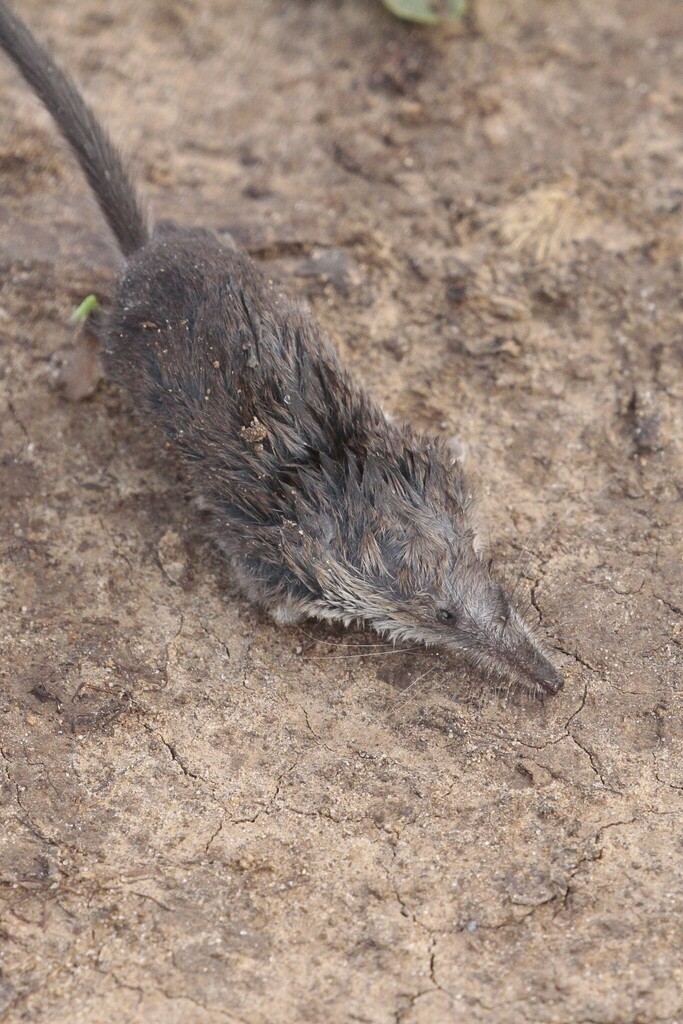
Eurasian Pygmy Shrew
Photo © Константин Селивёрстов
Photo © Константин Селивёрстов — CC BY 4.0 — Source: iNaturalist photo #557955479Identification
The Eurasian pygmy shrew is one of Europe's tiniest mammals, measuring just 5 cm in body length with a 3.5 cm tail and weighing a mere 4 grams. Despite its diminutive size, it has a proportionally large head compared to other shrews. Its back is covered in very dense, shiny fur ranging from blackish with reddish to purplish tones, contrasting sharply with a whitish belly, throat, and jaw. The periocular area and lower tail are also pale. Its small ears, half-hidden by fur, are dark flesh-coloured and semicircular in shape. The muzzle and legs bear sparse white hair, and the skin is flesh-coloured.
Range & Habitat
This widespread shrew inhabits the northern Palearctic region. It favours areas of dense vegetation across a broad range of elevations, adapting to various landscapes throughout its extensive distribution. The species typically occupies habitats with sufficient cover and vegetation density to support its active lifestyle.
Behaviour & Diet
The pygmy shrew is a solitary creature, active both day and night without clear rest periods. It feeds on seeds, small insects, and other invertebrates, consuming up to 125% of its body weight daily—roughly 4 grams. This extraordinary appetite is driven by one of the highest metabolic rates in the animal kingdom; it must eat every two hours to maintain its body temperature. The shrew establishes trackways through its territory of a few hundred square metres, often using burrows and tunnels created by other rodents beneath tree stumps and in similar microhabitats.
Best Time & Places to See It
The breeding season runs from April through August, when increased activity may make the species slightly easier to encounter. Look for pygmy shrews in areas of dense vegetation and woodland edges with plenty of cover. Their active nature means they can be encountered throughout the day, but their tiny size and preference for dense vegetation make them challenging to observe. Disturbing leaf litter and fallen logs in suitable habitat may reveal their presence or their characteristic trackways.
Photography Tips
Photographing this species demands patience, macro equipment, and a willingness to work in low light conditions where the shrew forages. A macro lens, external flash diffused softly, and a fast shutter speed are essential to freeze the animal's rapid movements. Early morning or dusk may offer the best opportunities. Focus on capturing detail of the contrasting fur coloration and the distinctive large head relative to body size. Avoid disturbing the animal excessively; a single successful frame is more valuable than repeated intrusions into its habitat.
Avesnois Regional Nature Park
Bannau Brycheiniog National Park
Bavarian Forest National Park
Biebrza National Park
Cairngorms National Park
Cape Clear Island
Caps et Marais d’Opale Regional Nature Park
Causses du Quercy Regional Nature Park
Cévennes National Park
Nothing matches these filters.
No community photos yet. Log in to add the first one.
No community observations of this species yet.