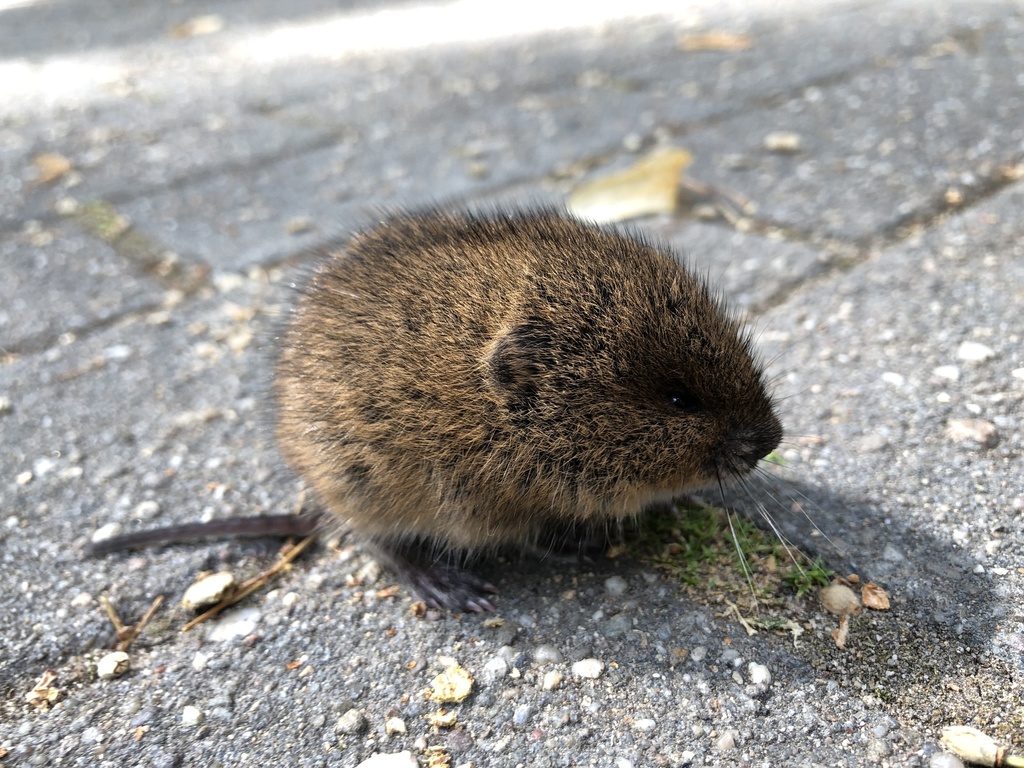
Eurasian Water Vole
Photo © Marius Faiß
Photo © Marius Faiß — CC BY 4.0 — Source: iNaturalist photo #84533420Identification
The Eurasian water vole is a semi-aquatic rodent often mistakenly called a water rat, though it differs markedly from true rats. Water voles have distinctly rounder noses, deep brown fur, and chubby faces with short fuzzy ears. Unlike rats, their tails, paws, and ears are completely covered with hair. Adults measure 14–22 centimetres in body length, with a tail roughly half that length. They weigh on average around 140 grams, though optimal individuals can reach 225–386 grams. Their uniform dark brown pelage with slightly paler underside provides excellent camouflage in vegetated wetland habitats. The thick fur covering their entire body, including tail, is a key distinguishing feature from rats.
Range & Habitat
Eurasian water voles are found throughout most of Europe, Russia, West Asia, and Kazakhstan. They inhabit a diverse range of wetland environments, from lowland areas dominated by rank marginal vegetation to upland peatlands in Scotland at elevations up to 1,000 metres. In Britain, they excavate burrows in riverbanks, ditches, ponds, and streams, preferring slow-moving, calm water. They also nest in reed beds, weaving ball-shaped structures above ground where suitable banks are unavailable. Water voles favour lush riparian vegetation that provides essential cover; they avoid heavily grazed or trampled habitats and generally prefer open wetland areas away from dense tree cover. In mainland Europe and Russia, they venture into woods, fields, and gardens, and survive winter by living beneath snow.
Behaviour & Diet
Water voles are expert swimmers and divers, typically living solitary lives with each adult maintaining its own territory marked by fecal latrines—reliable field indicators of presence. They scent-mark using flank glands and will defend their territories aggressively. The species breeds from March through late autumn, with females carrying young for approximately 21 days and producing up to 8 pups per litter. Young voles open their eyes three days after birth and are half-grown by weaning.
Water voles are primarily herbivorous, grazing on grasses, sedges, rushes, and herbs near water. They also consume fruits, seeds, bulbs, twigs, buds, and roots opportunistically. In some English populations, they occasionally supplement their diet with water snails, freshwater mussels, frogs, and tadpoles, possibly addressing protein deficiencies. In optimal conditions, populations can reach plague proportions, causing extensive crop damage across entire fields. In the wild, water voles live on average only about five months, though captive animals can survive up to two and a half years.
Best Time & Places to See It
Water voles are most reliably observed during the breeding season from March through autumn, when they are more active above ground. Search along slow-moving rivers, streams, ditches, and pond margins with lush riparian vegetation. Reed beds and areas of open wetland habitat away from woodland offer good opportunities. Look for their distinctive burrow entrances in riverbanks, typically positioned adjacent to calm water. Evidence of presence—fecal latrines at water's edge platforms or near nests—may be easier to spot than the voles themselves. Upland peatland habitats in northern regions, particularly Scotland, support healthy populations. Early morning or dusk provides the best viewing conditions when water voles are most active.
Photography Tips
The water vole's dark brown coloration provides natural camouflage in vegetated wetland settings, so patient observation and positioning are essential. Use a telephoto lens to maintain distance and avoid disturbing these territorial animals. Position yourself low and still near water's edge platforms where voles predictably enter and exit water. Early morning or overcast days provide softer lighting that avoids harsh shadows on their fur. Focus on capturing their distinctive rounded nose, fuzzy ears, and fully furred tail—key features differentiating them from rats. Photograph burrow entrances and latrines to document habitat and behavioural evidence alongside portraiture.
Picos de Europa National Park
Posada de Valdeón, Spain
+166 birds+26 mammals
Where limestone massifs rise abruptly from the Castilian plateau, the Picos de Europa create one of Spain's most dramatic mountain wilderness areas. The park's jagged peaks,…
VIEW NATIONAL PARKHarz National Park
Harz (LK Goslar), Germany
+141 birds+38 mammals
Where granite peaks rise above beech and spruce forests, the Harz unfolds as one of Germany's most biodiverse upland landscapes. Straddling the border between Lower Saxony…
VIEW NATIONAL PARKHamburgisches Wattenmeer National Park
Hamburg, Germany
+206 birds+6 mammals
Where the North Sea exhales across the Elbe estuary, the tidal mudflats of Hamburgisches Wattenmeer National Park emerge twice daily in a landscape of extraordinary ecological…
VIEW NATIONAL PARKSchleswig-Holsteinisches Wattenmeer National Park
Germany
+378 birds+49 mammals
Where the North Sea ebbs and flows across a vast expanse of exposed mud and sand, the Schleswig-Holsteinisches Wattenmeer National Park reveals one of Europe's most…
VIEW NATIONAL PARKOrdesa y Monte Perdido National Park
Sobrarbe, Spain
+162 birds+13 mammals
Where limestone cliffs soar a thousand metres above cascading rivers, the Pyrenean massif reveals itself in its most dramatic form. Ordesa y Monte Perdido National Park…
VIEW NATIONAL PARKPembrokeshire Coast National Park
Pembrokeshire, United Kingdom
+250 birds+41 mammals
Where the Cambrian coastline meets the Celtic Sea, cliff-top moorland and hidden coves define a landscape carved by 300 million years of geological drama. Pembrokeshire Coast…
VIEW NATIONAL PARKEryri National Park
Gwynedd, United Kingdom
+199 birds+36 mammals
Where granite peaks rise abruptly from the Snowdonia landscape, Eryri National Park encompasses one of Britain's most dramatic mountain terrain. The park's rugged plateaus, deep glacial…
VIEW NATIONAL PARKLake District National Park
Westmorland and Furness, United Kingdom
+209 birds+36 mammals
Where slate fells rise steeply from mirror-still waters, the Lake District unfolds as one of Britain's most ecologically intricate mountain landscapes. The park's patchwork of deep…
VIEW NATIONAL PARKBannau Brycheiniog National Park
Powys, United Kingdom
+178 birds+36 mammals
Where sandstone ridges rise above the rolling moorlands of mid-Wales, Bannau Brycheiniog National Park protects one of Britain's most compelling upland landscapes. The park's dramatic peaks,…
VIEW NATIONAL PARKNorth York Moors National Park
North Yorkshire, United Kingdom
+234 birds+32 mammals
Across the high moorlands of North Yorkshire, where heather and bilberry sprawl beneath vast skies, the landscape rises and falls in gentle undulation—a patchwork of open…
VIEW NATIONAL PARKSouth Downs National Park
Chichester, United Kingdom
+298 birds+45 mammals
Chalk downland ridges rise and fall across the South Downs, their open grasslands and beech hangers creating a mosaic of habitats that has shaped human settlement…
VIEW NATIONAL PARKMontaña Palentina Natural Park
Vidrieros, Spain
+180 birds+29 mammals
Where the Cantabrian mountains rise above the Palencia plateau, Montaña Palentina Nature Park sprawls across nearly 1,500 square kilometres of some of northern Spain's most dramatic…
VIEW NATURAL PARKSierra de Cazorla, Segura y las Villas Nature Park
Las Canalejas, Spain
+176 birds+21 mammals
Where granite gorges slice through mountainous terrain in eastern Andalusia, the Sierra de Cazorla, Segura y las Villas Nature Park sprawls across more than 5,200 square…
VIEW NATURAL PARKCairngorms National Park
Muir, United Kingdom
+192 birds+31 mammals
Where ancient granite massifs rise above the Scottish Highlands, a subarctic wilderness unfolds across 1,748 square kilometres of raw, elemental terrain. Windswept plateaus give way to…
VIEW NATIONAL PARKLoch Lomond & the Trossachs National Park
Duchray, United Kingdom
+188 birds+40 mammals
Where ancient woodlands rise from glassy lochs and rugged Highland peaks pierce the lowland horizon, Scotland's most biodiverse landscape unfolds across 720 square kilometres of wild…
VIEW NATIONAL PARKLosiny Ostrov National Park
Balashikhinsky District, Russia
+173 birds+20 mammals
Across the forested plateaus of Moscow Oblast, where the Losinka River winds through mixed woodland and marshy clearings, lies a national park that captures the ecological…
VIEW NATIONAL PARKBiebrza National Park
Goniądz, Poland
+242 birds+33 mammals
Where the Narew River sprawls across northeastern Poland's flatlands, Biebrza National Park unfolds as one of Europe's largest and most ecologically vital wetland complexes. Encompassing roughly…
VIEW NATIONAL PARKSomiedo Natural Park
Pola de Somiedo, Spain
+165 birds+25 mammals
Where granite gorges cleave through the Cantabrian Mountains of northern Spain, alpine meadows roll toward beech and oak forests in a landscape virtually untouched by industrial…
VIEW NATURAL PARKPyrénées National Park
Hautes Pyrenees, France
+150 birds+35 mammals
Where alpine meadows give way to limestone cliffs and rushing torrents carve through ancient stone, the Pyrénées National Park spans a landscape of austere beauty along…
VIEW NATIONAL PARKForsinard Flows National Nature Reserve
Highland, United Kingdom
+35 birds+7 mammals
Across the Flow Country of northern Scotland, vast blankets of blanket bog stretch toward the horizon in seemingly endless waves of heather, cotton grass, and sphagnum…
VIEW NATURE RESERVEBeinn Eighe National Nature Reserve
Kinlochewe, United Kingdom
+56 birds+6 mammals
Where granite mountains rise from the Torridon landscape, Beinn Eighe National Nature Reserve sprawls across 4,800 hectares of some of Scotland's most dramatic terrain. Quartzite peaks…
VIEW NATURE RESERVEInsh Marshes National Nature Reserve
Insh, United Kingdom
+120 birds+14 mammals
Shallow channels and open water weave through expansive reedbeds and wet grassland where the River Spey meanders across the Cairngorms foothills in the Scottish Highlands. Insh…
VIEW NATURE RESERVEMoor House-Upper Teesdale National Nature Reserve
Barnard Castle, United Kingdom
+94 birds+8 mammals
Where the Pennine watershed reaches its highest moorland plateaus, Moor House-Upper Teesdale National Nature Reserve encompasses over 4,000 hectares of upland landscape shaped by centuries of…
VIEW NATURE RESERVERibble Estuary National Nature Reserve
Southport, United Kingdom
+197 birds+17 mammals
Where the Ribble flows into the Irish Sea, a landscape of mudflats, salt marshes and shallow pools creates one of northwest England's most dynamic estuarine ecosystems.…
VIEW NATURE RESERVENo community photos yet. Log in to add the first one.
No community observations of this species yet.