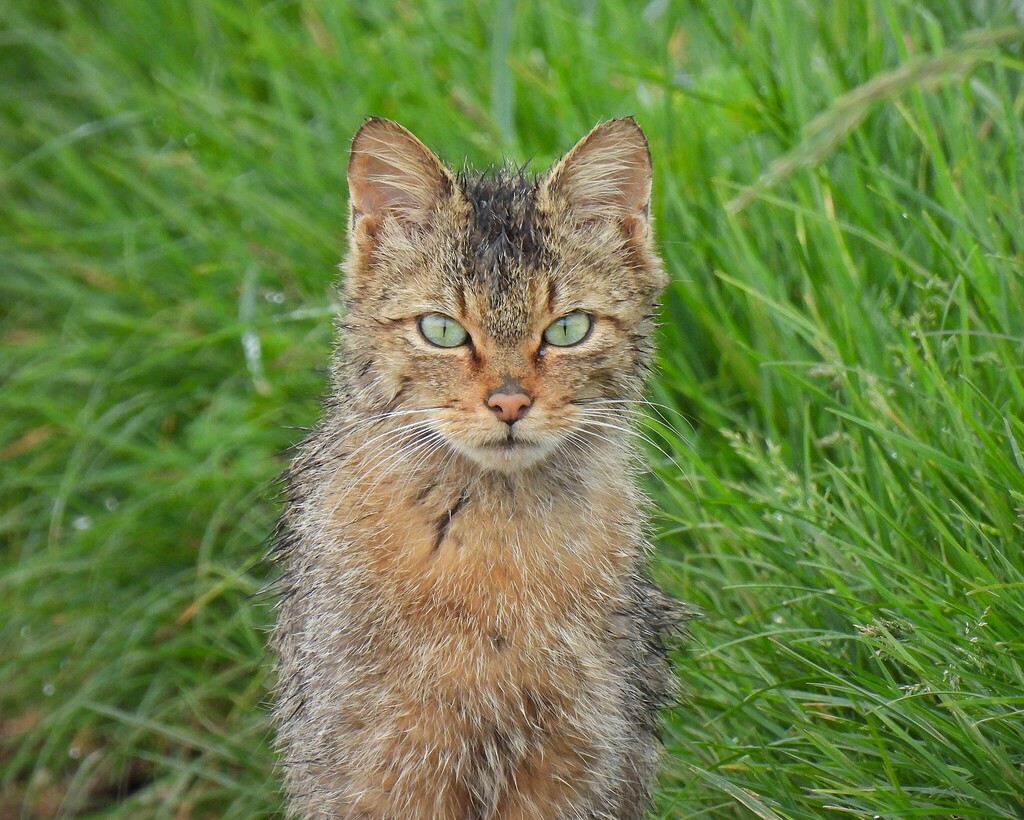
European Wildcat
Photo © Antoine Thivolle
Photo © Antoine Thivolle — CC BY 4.0 — Source: iNaturalist photo #607218309Identification
The European wildcat is a small wildcat species with distinctive markings that set it apart from domestic cats. Its fur ranges from brownish to grey, featuring five prominent stripes on the forehead that break into small spots, along with irregular dark stripes on the sides. A characteristic dark stripe runs along the spine from the shoulders to the base of the tail. The bushy tail, a key identifying feature, displays two to three black transverse rings and terminates in a distinctive black tip.
European wildcats are noticeably larger and stockier than domestic cats, with longer fur and a shorter, non-tapering bushy tail. Males typically weigh between 5–8 kg (11–18 lb) with a head-to-body length of up to 65 cm (26 in) and a tail measuring around 34.5 cm (13.6 in). Females are smaller, averaging 3.5 kg (8 lb). Their weight fluctuates seasonally by up to 2.5 kg (6 lb).
Range & Habitat
The European wildcat is native to continental Europe, Scotland, Turkey, and the Caucasus region. Two subspecies are currently recognized: F. s. silvestris, found across continental Europe, Scotland, and Sicily, and F. s. caucasica, inhabiting Turkey and the Caucasus. The species primarily occupies broad-leaved and mixed forests, where it finds shelter and hunting grounds.
Behaviour & Diet
European wildcats are predominantly nocturnal in France and Italy, though they may be active during daylight hours when undisturbed by human activity. Their diet consists primarily of small mammals, particularly lagomorphs and rodents, supplemented with ground-dwelling birds. In southern Spain, larger males feed more frequently on rabbits, while populations north of the Douro-Ebro Rivers depend more heavily on small rodents.
Best Time & Places to See It
Given the species' nocturnal habits in much of its range, observing European wildcats presents a significant challenge for wildlife enthusiasts. Your best opportunities lie in forested regions of continental Europe, Scotland, Turkey, and the Caucasus. Early morning or dusk visits to broad-leaved and mixed forests may increase sighting chances, particularly in areas where human disturbance is minimal. Local knowledge of forest habitats and wildlife corridors will greatly improve your odds.
Photography Tips
Photographing European wildcats requires patience and preparation due to their elusive, primarily nocturnal nature. If attempting daytime photography in undisturbed areas, use longer focal lengths to maintain distance and avoid alarming the animal. Given their preference for forest habitats, expect challenging lighting conditions and dappled shade. Night photography using camera traps or infrared equipment may prove more successful than traditional daytime techniques. Always prioritize the animal's well-being and maintain a respectful distance to avoid disrupting natural behavior.
Aberdare National Park
Augrabies Falls National Park
Avesnois Regional Nature Park
Bardenas Reales
Bavarian Forest National Park
Bieszczady National Park
Cairngorms National Park
Chartreuse Regional Nature Park
Danube Delta Biosphere Reserve
Nothing matches these filters.
No community photos yet. Log in to add the first one.
No community observations of this species yet.