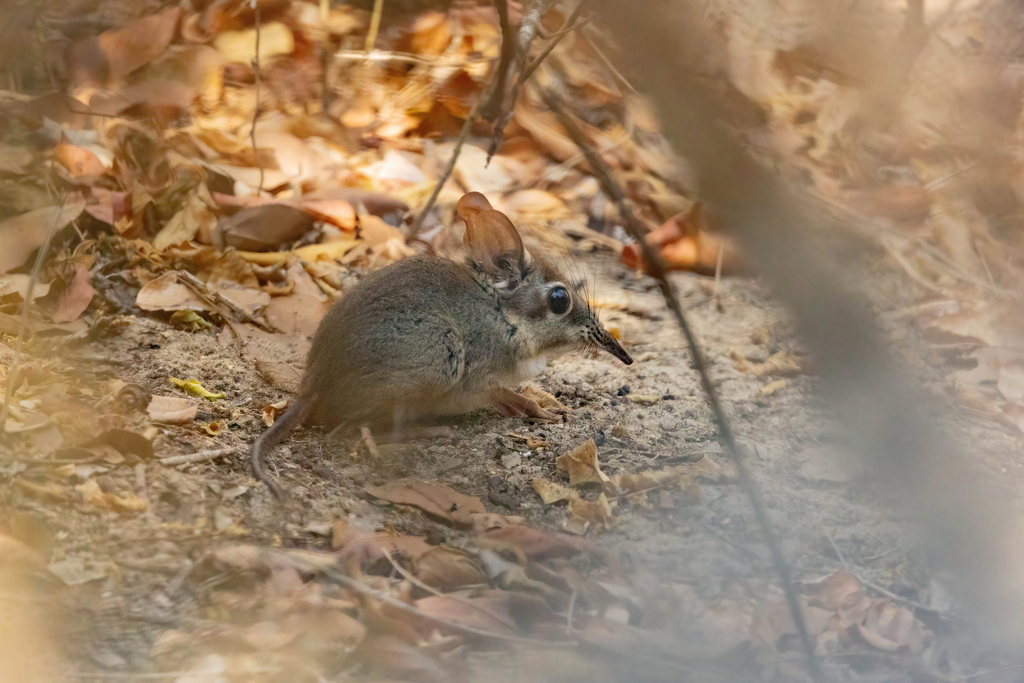
Four-toed Sengi
Photo © Thibaud Aronson
Photo © Thibaud Aronson — CC BY-SA 4.0 — Source: iNaturalist #160841346The four-toed sengi or four-toed elephant shrew (Petrodromus tetradactylus) is the only living species in the genus Petrodromus, which together with five other extant genera Rhynchocyon, Macroscelides, Petrosaltator, Galegeeska and Elephantulus constitutes the order Macroscelidea. This species of sengi is only found in particular regions in Africa and is smaller than its relatives. A comprehensive record of this species is lacking. As its name suggests, the species has four toes on its hind feet, and like other sengis, it has been named for its elephant-like, mobile proboscis. == Geographic location and habitat == The four-toed sengi is found in Central and Southern East Africa, notably in Angola, Democratic Republic of the Congo, Kenya, Malawi, Mozambique, South Africa, Tanzania, Zambia, Zimbabwe, and possibly Namibia. Its natural habitats are subtropical or tropical dry forests, montane forests, and moist savannas. Throughout these countries, they are the second most widespread species, following the short-snouted sengi. Specifically, they thrive in dense forests (notably in dense evergreen growths), woodlands and thickets, with suitable cover and protection, as well as invertebrates for food. During the night, they prefer to sleep under dense brush (as opposed to a nest). In some areas, their habitats are being destroyed and…
Kruger National Park
Ba-Phalaborwa Local Municipality, South Africa
+540 birds+91 mammals
Across the low-lying savanna of northeastern South Africa unfolds one of Africa's largest and most ecologically intact protected areas, where acacia woodlands merge into mopane scrub…
VIEW NATIONAL PARKArabuko Sokoke Forest Reserve
Kilifi, Kenya
+383 birds+29 mammals
Coastal forest rises from the Indian Ocean plains of Kilifi County, where sandy soils and seasonal rainfall have sculpted a woodland ecosystem unlike anywhere else on…
VIEW NATURE RESERVENo community photos yet. Log in to add the first one.
No community observations of this species yet.