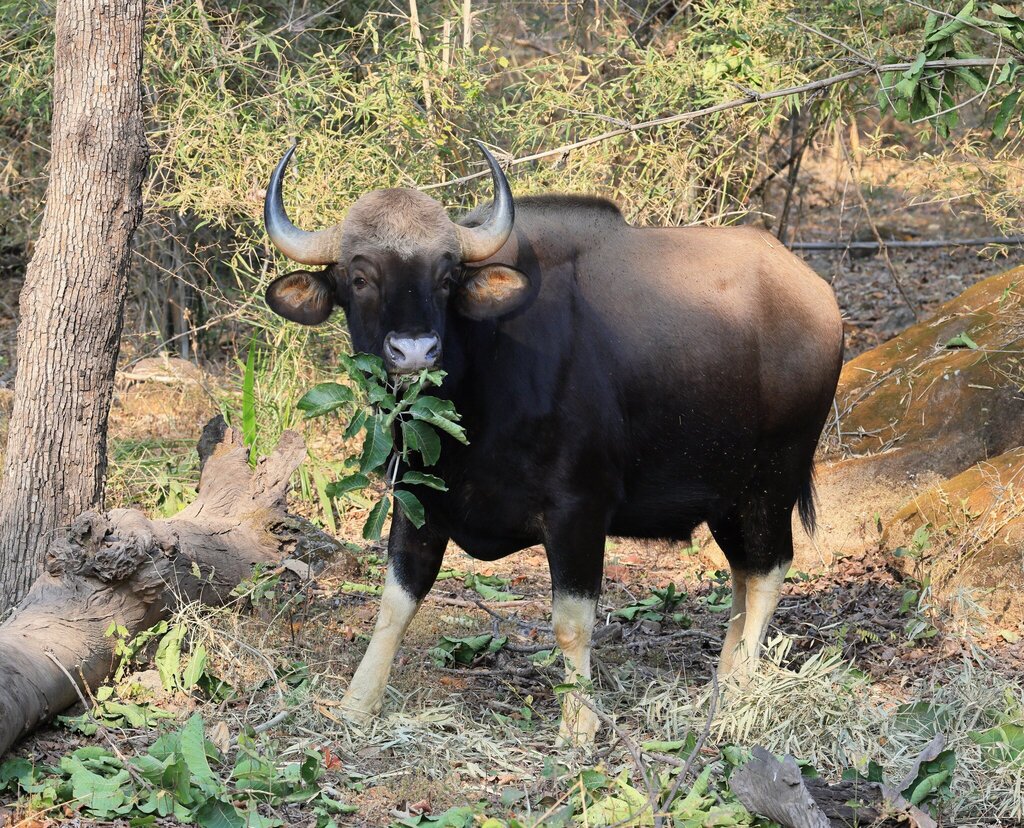
Gaur
Photo © Darren Obbard
Photo © Darren Obbard — CC BY 4.0 — Source: iNaturalist #342976811Identification
The gaur is the largest living wild bovine species, an imposing animal that demands attention in any landscape. Adult males are dark brown, approaching black in older individuals, with distinctive pale colouring on the upper head from above the eyes to the nape of the neck—ashy grey or occasionally dirty white. The muzzle is pale, and the lower legs are pure white or tan. Females and young bulls are considerably paler, sometimes with a rufous tinge. Both sexes possess pale green or yellow horns with black tips, growing to 60–115 cm in length and curving upward from the sides of the head.
The gaur's most striking features are its massive, muscular build and prominent anatomical details. A high, convex ridge runs across the forehead between the horns, and another ridge extends from the shoulders to the middle of the back—the shoulders can be up to 12 cm higher than the rump. There is a distinct dewlap on the throat and chest, very large ears, and a shorter tail than typical oxen. The hooves are narrow and pointed. Males average around 188 cm at the shoulder and weigh up to 1,500 kg, making them roughly one-fourth larger and heavier than females.
Range & Habitat
The gaur's range historically extended throughout mainland South and Southeast Asia, including Nepal, India, Bhutan, Bangladesh, Myanmar, Thailand, Laos, Cambodia, Vietnam, and China. Today, however, its distribution is seriously fragmented and regionally extinct in Peninsular Malaysia and Sri Lanka. The global population was estimated at a maximum of 21,000 mature individuals in 2016, with the majority existing in India. The species is listed as Vulnerable on the IUCN Red List since 1986.
Gaurs are largely confined to evergreen forests, semi-evergreen forests, and moist deciduous forests. Three subspecies are provisionally recognized: the nominate subspecies ranges across India, Nepal, and Bhutan; another inhabits regions from Upper Myanmar to the Tanintharyi Region; and a third is associated with areas from Peninsular Malaysia northward through Tenasserim, though this classification is no longer widely recognized among researchers.
Behaviour & Diet
While detailed behavioural and dietary information is limited in the source material, gaurs are forest-dwelling bovines adapted to the dense woodland habitats of tropical Asia. Their preference for evergreen and moist deciduous forests suggests they are specialized inhabitants of humid, forested environments rather than open grasslands. The sexually dimorphic characteristics—males being substantially larger and darker than females, with more robust horn bases—indicate typical bovine social structure with dominance hierarchies.
The gaur's wild ancestry is noteworthy: the domesticated gayal or mithun originated partly from the wild gaur and remains most common in the border regions of Northeast India (Assam, Manipur, Nagaland) and Bangladesh, as well as in Myanmar and Yunnan, China. This demonstrates the species' historical significance to human communities across its range and its adaptability to semi-domestication.
Best Time & Places to See It
India remains the best location for encountering gaurs, as the majority of the global population occurs there. The species' serious range fragmentation means that sightings depend on visiting protected forest reserves and national parks within its surviving strongholds, particularly in India, and potentially in remaining populations in Myanmar, Thailand, and other Southeast Asian nations where suitable evergreen or moist deciduous forest habitat persists.
Given their preference for dense forest cover and the vulnerable status of most populations, viewing gaurs requires patience and timing. Consulting with local wildlife authorities and experienced guides familiar with specific protected areas where gaur populations are known to occur will maximize your chances of observation. Early morning or late afternoon forays into appropriate forest habitat offer the best opportunities.
Photography Tips
The gaur's massive size and striking coloration—particularly the contrast between the dark body and pale head and legs—make it a rewarding photographic subject when visibility permits. The prominent ridge along the back and shoulders, combined with the muscular build and large ears, provides distinctive silhouettes recognizable even in partial forest light. Focus on capturing the animal's impressive stature and the characteristic pale upper head against its darker body.
The pale horns with black tips and the deep convex ridge between them are diagnostic features worth isolating in close-up shots. Given that gaurs inhabit dense forests, you may encounter challenging lighting conditions; be prepared for low-light photography and use appropriate camera settings for forest environments. Wide-angle shots that convey the animal's size relative to its surroundings will impress viewers with the true scale of the world's largest wild bovine.
Valmiki National Park
Ramnagar, India
+66 birds+6 mammals
Along Bihar's western frontier, where the Gandak River winds through subtropical forest and grassland, Valmiki National Park sprawls across terrain shaped by monsoon rains and seasonal…
VIEW NATIONAL PARKEravikulam National Park
Devikulam, India
+192 birds+7 mammals
High in the Western Ghats of Kerala, where monsoon mists cling to slopes that rise above 2,000 metres, Eravikulam National Park preserves one of South India's…
VIEW NATIONAL PARKKhao Yai National Park
Prachantakham District, Thailand
+377 birds+46 mammals
Evergreen dipterocarp forest blankets the rolling terrain of this national park in eastern Thailand, where limestone hills rise abruptly from the forest floor and seasonal streams…
VIEW NATIONAL PARKKanha Tiger Reserve
Kanha Kisli F.V., India
+321 birds+23 mammals
Where sal forests give way to emerald meadows and crystalline streams carve through ancient valleys, one of India's finest wilderness reserves unfolds across the Maikal Range.…
VIEW NATIONAL PARKTadoba National Park
Palasgaon Singru, India
+270 birds+20 mammals
Where sal forests meet open grasslands and rocky outcrops rise from red laterite soil, central India's landscape unfolds in raw, untamed beauty. Ancient teak woodlands and…
VIEW NATIONAL PARKBandhavgarh National Park
Garhpuri, India
+285 birds+17 mammals
Where granite ridges rise dramatically above sal and bamboo forests, one of India's most pristine tiger reserves unfolds across the Vindhyan plateau. Ancient rock formations tower…
VIEW NATIONAL PARKPeriyar National Park
Mlappara, India
+232 birds+4 mammals
Dawn breaks over mist-shrouded ridges where the Western Ghats tumble toward Kerala's spice-scented lowlands. Here, ancient tropical forests envelope a glittering artificial lake, creating a mosaic…
VIEW NATIONAL PARKPampadum Shola National Park
Vattavada, India
+258 birds+14 mammals
Where misty shola forests cling to the high plateaus of the Nilgiri Mountains, ancient evergreen remnants create a world apart. This 2,316-hectare reserve protects one of…
VIEW NATIONAL PARKBandipur National Park
Hirehalli, India
+302 birds+19 mammals
Where the Western Ghats descend into the Deccan plateau, ancient deciduous forests blanket a landscape carved by the Nugu River. Bandipur unfolds across 880 square kilometres…
VIEW NATIONAL PARKNagarahole Tiger Reserve
Nalkeri Forest, India
+323 birds+23 mammals
Where granite escarpments rise above dense deciduous forests and the Kabini River carves through pristine wilderness, one of India's most biodiverse landscapes unfolds across the Western…
VIEW NATIONAL PARKTaman Negara National Park
Kampong Samas, Malaysia
+393 birds+48 mammals
Where ancient rainforest meets limestone peaks, one of Southeast Asia's oldest protected wilderness preserves sprawls across 4,343 square kilometers of primordial landscape. Dipterocarp giants tower overhead,…
VIEW NATIONAL PARKNo community photos yet. Log in to add the first one.
No community observations of this species yet.