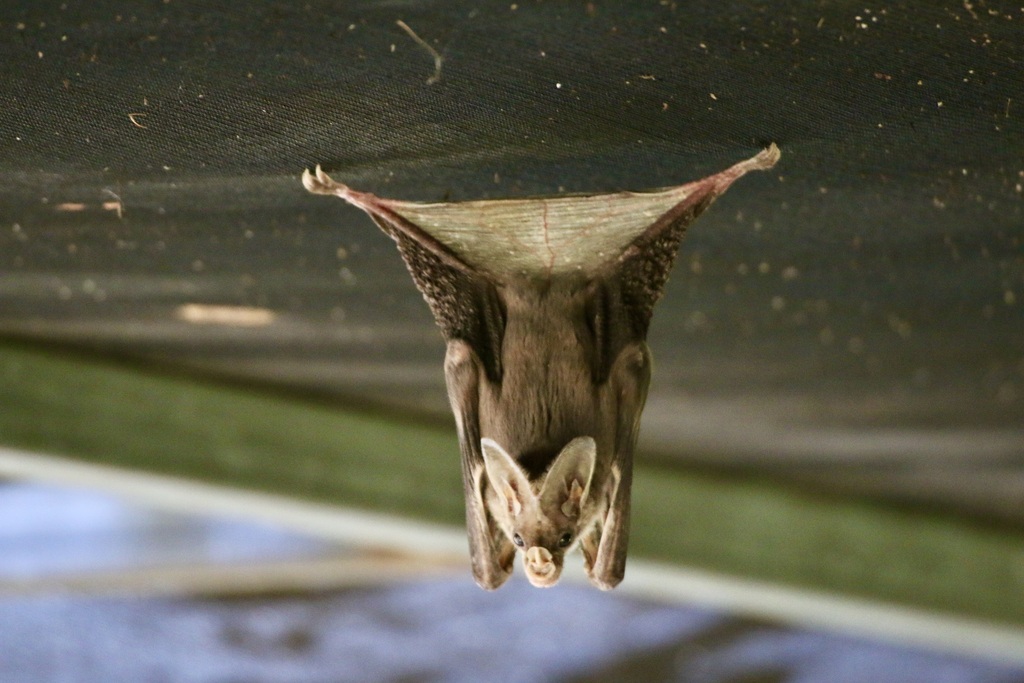
Ghost False-vampire
Photo © Kevin Brix
Photo © Kevin Brix — CC BY-SA 4.0 — Source: iNaturalist #191673406The ghost bat (Macroderma gigas) is a species of bat found in northern Australia. It is the only Australian bat that preys on large vertebrates – birds, reptiles and other mammals – which they detect using acute sight and hearing, combined with echolocation, while waiting in ambush at a perch. The wing membrane and bare skin is pale in colour, their fur is light or dark grey over the back and paler at the front. The species has a prominent and simple nose-leaf, with large elongated ears that are joined at the lower half, sharp teeth for attacking prey and large dark eyes. The first description of the species was published in 1880, since when its recorded range has significantly contracted. == Taxonomy == A species of Macroderma, one of several genera in the family Megadermatidae (false vampires). The family all have large eyes, a nose-leaf and tragus, long ears joined at the base, and are also found in southern Asia and central Africa. The description was published in 1880 by George Dobson, emerging from an examination of specimens held by the Göttingen Museum. The author compared his specimen to taxa named as species of Megaderma, identifying species Megaderma spasma…
Kakadu National Park
Kakadu, Australia
+273 birds+46 mammals
Kakadu National Park is Australia’s largest national park and one of the world’s most remarkable protected areas, covering nearly 20,000 square kilometres in the tropical north…
VIEW NATIONAL PARKLitchfield National Park
Australia
+175 birds+15 mammals
Where weathered sandstone plateaus rise above the savanna woodlands of Australia's Top End, Litchfield National Park unfolds as a landscape of dramatic contrasts shaped by a…
VIEW NATIONAL PARKNitmiluk National Park
Australia
+186 birds+27 mammals
Dramatic sandstone gorges carved by the Katherine River slice through the tropical savanna of Australia's Top End, creating a landscape where escarpments tower above crystalline pools…
VIEW NATIONAL PARKNo community photos yet. Log in to add the first one.
No community observations of this species yet.