Giant Anteater
Photo © Paulo Mascaretti
Photo © Paulo Mascaretti — CC0 1.0 — Source: iNaturalist #194927871Identification
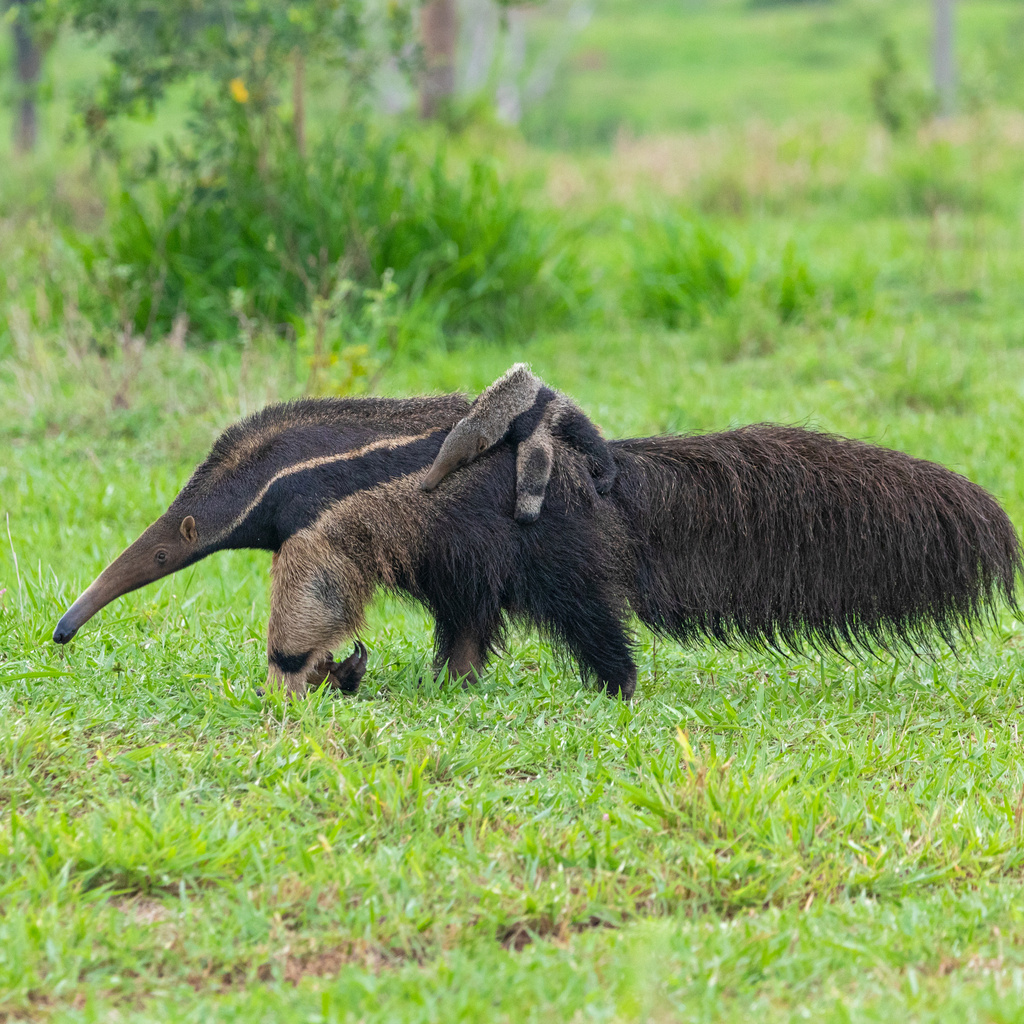
The giant anteater is unmistakable in the field, being the largest living anteater species. Look for its most distinctive features: an exceptionally long, narrow, cylindrical snout that dominates its elongated head, combined with a notably bushy tail. The animal's thick neck and small hump behind it are also characteristic. Body length ranges from 182 to 217 cm (72 to 85 inches), with males weighing 33 to 50 kg and females 27 to 47 kg, making them considerably larger than other anteater species. The coat is mostly grayish brown or black with mottled white markings, including white front legs with distinctive black-ringed wrists and hands. Despite their size, giant anteaters have relatively small eyes, ears, and mouths—their poor eyesight is more than compensated by an extraordinarily powerful sense of smell, 40 times more acute than a human's.
Range & Habitat
Giant anteaters are native to Central and South America, with three subspecies occupying different regions: one ranging from Venezuela and the Guianas south to northern Argentina, another from Central America to northwestern Colombia and northern Ecuador, and a third in northeastern Colombia and northwestern Venezuela. They are notably the most terrestrial of living anteater species, unlike their more tree-dwelling relatives. These adaptable animals occupy multiple habitat types, including grasslands and rainforests, typically foraging in open areas while seeking rest and shelter in more densely forested zones.
Behaviour & Diet
Giant anteaters are specialized insectivores, feeding primarily on ants and termites. They employ a remarkable feeding strategy: their powerful foreclaws excavate insect nests, while an extraordinarily long, sticky tongue collects the insects. Despite living in overlapping home ranges, these animals are predominantly solitary creatures. Social contact occurs mainly during mother-offspring relationships, when mothers carry their young on their backs until weaning, during aggressive male-to-male interactions, and during mating periods.
Best Time & Places to See It
Giant anteaters inhabit protected areas throughout their range in Central and South America, offering opportunities for wildlife enthusiasts to encounter them in their natural habitat. Their terrestrial lifestyle and preference for open foraging areas make them potentially visible during daytime searches, though specific seasonal patterns for observation are not well documented. Visiting protected reserves within the species' range—from Central America through the Amazon basin to northern Argentina—provides the best chance of sighting these remarkable animals.
Photography Tips
The giant anteater's distinctive silhouette—dominated by its elongated snout and bushy tail—offers striking photographic opportunities. The striking coat pattern of white and dark markings, particularly the black-ringed forearms, provides excellent contrast for photography. Since these animals forage in open grasslands and savanna, photographers may have relatively unobstructed views. Their deliberate, ground-focused feeding behavior provides extended opportunities to capture images of them at work, using their powerful claws and extended tongue to extract food from termite and ant nests.
Emas National Park
Brazil
+333 birds+23 mammals
Across the high plateaux of central Brazil, where the cerrado grasslands roll toward distant horizons under an immense sky, Emas National Park anchors one of South…
VIEW NATIONAL PARKYasuní National Park
Aguarico, Ecuador
+601 birds+43 mammals
Where the western Amazon basin converges with Ecuador's Orellana Province, lowland rainforest reaches toward the horizon in an unbroken canopy of staggering botanical density. Yasuní National…
VIEW NATIONAL PARKPantanal Matogrossense National Park
Brazil
+322 birds+17 mammals
Where the flooded forests of central Brazil meet vast seasonally inundated grasslands, Pantanal Matogrossense National Park sprawls across nearly 2,900 square kilometers of one of the…
VIEW NATIONAL PARKBrasília National Park
Plano Piloto, Brazil
+338 birds+15 mammals
Cerrado grassland and scattered woodland sweep across the central Brazilian plateau where this national park sprawls across more than a thousand square kilometres of the Federal…
VIEW NATIONAL PARKCampos Amazónicos National Park
Amazonas, Brazil
+434 birds+7 mammals
Sprawling across the southwestern Amazon basin in Amazonas state, this 27,263-square-kilometre national park encompasses some of the region's most pristine lowland rainforest, where terra firme forest…
VIEW NATIONAL PARKManu National Park
Manu, Peru
+892 birds+26 mammals
Across the eastern slopes of the Peruvian Andes, tropical rainforest descends into the Amazon basin with a complexity that few terrestrial ecosystems match. Manu National Park…
VIEW NATIONAL PARKNo community photos yet. Log in to add the first one.
No community observations of this species yet.