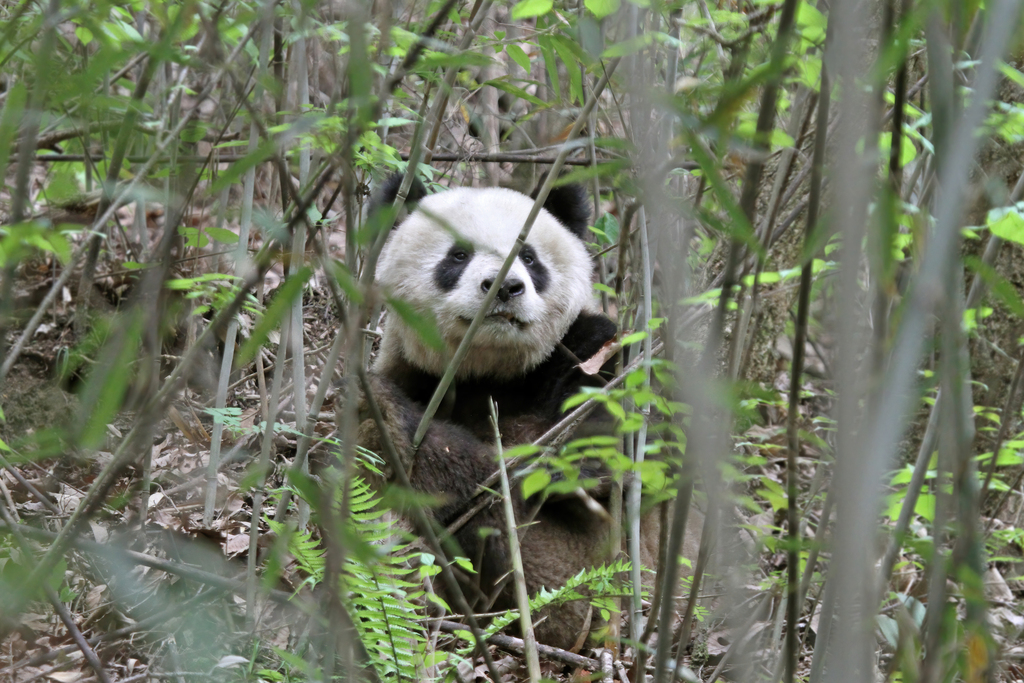
Giant Panda
Photo © James Eaton
Photo © James Eaton — CC0 1.0 — Source: iNaturalist photo #351209016Identification
The giant panda is instantly recognisable by its distinctive white coat with striking black patches around the eyes, ears, legs and shoulders. This bear species is characterised by a rotund body, with adults typically weighing between 100 and 115 kg and measuring 1.2 to 1.9 metres in length. Males are noticeably larger than females, typically 10–20% heavier, making sexual dimorphism apparent in the field.
A unique feature visible on the giant panda's forepaw is an adapted thumb-like structure that serves a crucial feeding function, helping the animal grip bamboo while eating. The panda's skull displays enlarged molar teeth and expanded temporal fossae—adaptations that reflect its specialised herbivorous diet and ability to digest starch efficiently.
Range & Habitat
The giant panda is endemic to China, found exclusively in six fragmented montane regions across a few Chinese provinces, primarily in Sichuan and also in neighbouring Shaanxi and Gansu. These populations inhabit mountainous terrain at elevations up to 3,000 metres. Habitat loss due to farming, deforestation and infrastructural development has confined pandas to these high-altitude refuges, having driven them from the lowland areas where they once lived.
As of the Fourth National Survey (2011–2014), the wild giant panda population aged over 1.5 years was estimated at 1,864 individuals, with approximately 2,060 total adults as of 2018. Conservation efforts have successfully halted population decline, and the species is now classified as Vulnerable rather than Endangered, though it remains conservation-reliant.
Behaviour & Diet
Giant pandas are solitary animals that gather only during mating seasons. They rely heavily on olfactory communication, using scent marks as chemical signals on landmarks such as rocks and trees to interact with other pandas across their range. This communication system is essential for their largely solitary existence.
True to their Chinese name "bamboo bear," giant pandas have a diet consisting almost entirely of bamboo and bamboo shoots. Females rear their cubs for an average of 18 to 24 months, investing considerable time in offspring development. The oldest known giant panda on record lived to 38 years old.
Best Time & Places to See It
The giant panda's restricted range in six Chinese montane regions—particularly in Sichuan, Shaanxi and Gansu provinces—limits viewing opportunities to these specific areas. The fragmented nature of panda populations means that sightings in the wild remain challenging. Most wildlife travellers encounter pandas in captive settings, where over 239 individuals are housed in Chinese facilities and another 27 outside the country.
For the best chance of observing giant pandas in their natural habitat, visitors should plan trips to the montane regions where populations persist, particularly in areas with successful habitat preservation initiatives.
Photography Tips
The giant panda's striking black and white coloration provides excellent contrast for photography, making distinctive images relatively straightforward in good light. The animal's round body shape and characteristic patches around the eyes and ears are key identifying features to capture. Note that the Qinling subspecies displays a light brown and white pattern rather than stark black and white, offering different photographic opportunities.
Photographers should be aware that wild pandas are solitary and elusive, making patience and early morning or late afternoon sessions advisable for maximising encounter chances. The montane habitat often features steep terrain and variable lighting conditions, so flexibility in composition and exposure settings will yield better results.
Giant Panda National Park
Mianyang, China
+447 birds+47 mammals
Where the eastern slopes of China's Sichuan plateau descend into cloud-wrapped valleys, one of Asia's most biodiverse landscapes unfolds across more than 350,000 square kilometres. This…
VIEW NATIONAL PARKWolong National Nature Reserve
Wenchuan County, China
+333 birds+17 mammals
Where the Qingyi River cuts through the eastern flanks of the Minshan Range, a temperate montane forest cloaks steep valleys in dense canopy that thins dramatically…
VIEW NATURE RESERVENo community photos yet. Log in to add the first one.
No community observations of this species yet.