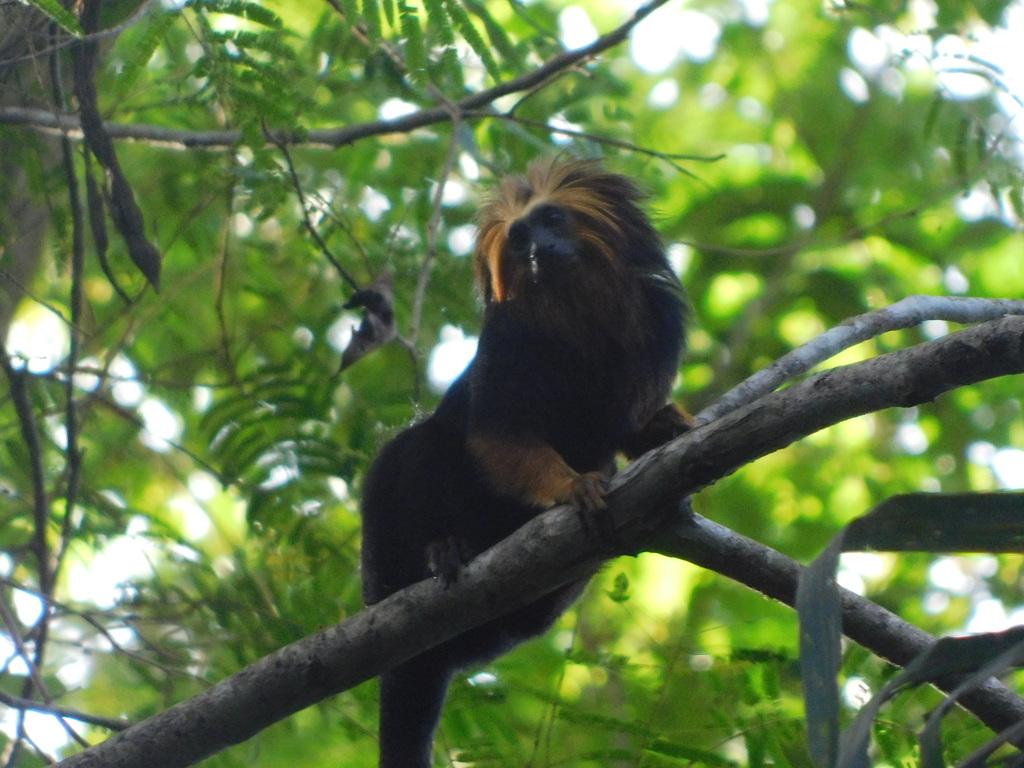
Golden-headed Lion Tamarin
Photo © Francisco Liguori
Photo © Francisco Liguori — CC0 1.0 — Source: iNaturalist #235210810Identification
The golden-headed lion tamarin is a small primate endemic to Brazil, distinguished by the golden coloration on its head that gives the species its name. It is one of four species of lion tamarin and inhabits the lowland and premontane tropical forests of Bahia. These diminutive primates typically live at heights of 3–10 metres in the forest canopy, making them challenging subjects for observation despite their striking appearance.
Range & Habitat
Found exclusively in the state of Bahia, Brazil, the golden-headed lion tamarin is restricted to fragmented tropical forest remnants in one of the world's most threatened ecosystems. The Atlantic Forest of Bahia has been reduced to just 2% of its original extent due to agricultural development, mining, and urbanization. The species prefers mature forest environments, though habitat loss has forced populations to adapt to secondary forests and agricultural mosaics. Historically, cocoa plantations using traditional shade-cropping methods (cabruca) provided some habitat value, but the abandonment of these farms following fungal disease in 1989 led to further forest clearance for timber, cattle ranching, and crop cultivation.
Behaviour & Diet
Golden-headed lion tamarins live in groups ranging from 2 to 11 individuals, typically averaging 4 to 7 members. Group composition varies, with some evidence suggesting monogamous or polyandrous mating systems, though much remains unknown. All group members participate in caring for juveniles. These primates defend large home ranges—averaging 123 hectares—relative to their small body size, spending about 50% of their time in just 11% of their range. Their ranging patterns are driven primarily by resource acquisition rather than territorial defense. Encounters with neighboring groups, though infrequent, are invariably aggressive and involve long-calling, chases, and physical fights.
The species maintains an exceptionally varied diet of fruits, flowers, nectar, plants, and small invertebrates including insects, larvae, spiders, snails, frogs, lizards, bird eggs, and small snakes. They typically consume fruits immediately after waking to obtain quick energy for foraging. Animal prey is hunted within epiphytic bromeliads and in tree crevices, holes, palm fronds, and leaf litter. Because their rainforest habitat provides consistent food availability throughout the year, they rarely resort to eating gum or tree exudates.
Best Time & Places to See It
The Una Biological Reserve, established in 1980 by the Brazilian government specifically to protect the golden-headed lion tamarin, harbors the largest population within the most intact forest remaining. This reserve offers the best opportunity to encounter the species in its preferred mature forest habitat. Early morning is optimal, as tamarins begin their day by foraging for fruits in the canopy. Patience and a skilled local guide are essential, given the species' small size and arboreal habits at heights of 3–10 metres.
Photography Tips
Photographing golden-headed lion tamarins requires patience, a telephoto lens, and early morning light. Position yourself beneath fruiting trees at dawn when tamarins are most active and foraging. The species' golden head provides striking contrast against the forest canopy, but the dappled light of the understory demands fast film speeds or high ISO settings. Wide-angle shots capturing groups moving through the canopy can convey their arboreal lifestyle, while close-ups reveal the distinctive golden coloration that defines this endangered primate.
No community photos yet. Log in to add the first one.
No community observations of this species yet.