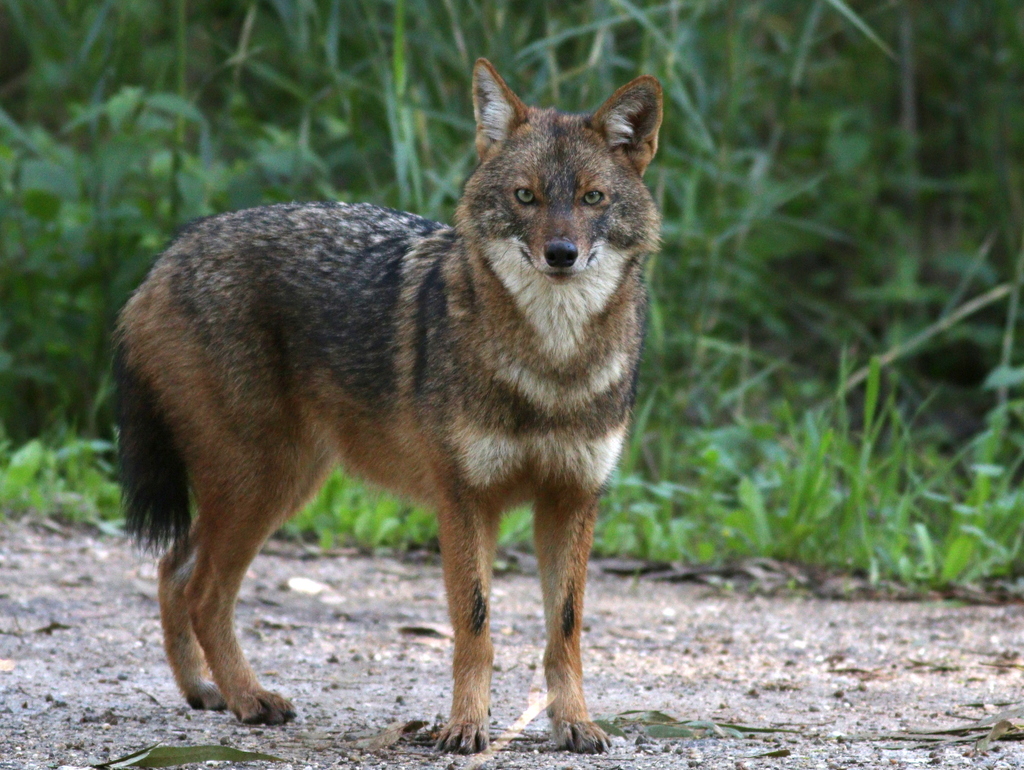
Golden Jackal
Photo © Jan Ebr & Ivana Ebrová
Photo © Jan Ebr & Ivana Ebrová — CC BY 4.0 — Source: iNaturalist photo #114837596Identification
The golden jackal is a wolf-like canid with a distinctly slender build that sets it apart from its larger relatives. Its coat colour varies seasonally, ranging from pale creamy yellow in summer to dark tawny beige in winter. Compared to the Arabian wolf, the golden jackal is noticeably smaller with shorter legs, a shorter tail, a more elongated torso, a less-prominent forehead, and a narrower, more pointed muzzle. Despite sharing the name "jackal" with African species, genetic studies reveal that the golden jackal is actually closer to wolves and coyotes than to the black-backed or side-striped jackals of Africa.
Range & Habitat
The golden jackal is native to Eurasia and is listed as Least Concern on the IUCN Red List due to its widespread distribution and high density in suitable areas. The species is abundant in valleys and beside rivers and their tributaries, canals, lakes, and seashores, but remains rare in foothills and low mountains. In recent decades, the golden jackal has expanded beyond its traditional native range, spreading from Southeast Europe into Central Europe as far as France, and from Northeast Europe into areas where few or no wolves remain.
Behaviour & Diet
The golden jackal is a highly adaptable and social species, with the basic social unit consisting of a breeding pair and their offspring. Its diet reflects its opportunistic nature, ranging from fruit and insects to small ungulates. The species also preys on domestic fowl and domestic mammals, including calves of domestic water buffalo. Its natural competitors include the red fox, steppe wolf, jungle cat, Caucasian wildcat, the Asiatic wildcat, and in the Caucasus and Central Asia, the raccoon.
Best Time & Places to See It
To encounter golden jackals, focus your efforts on valleys and riparian habitats—areas bordering rivers, tributaries, canals, lakes, and seashores. These are the landscapes where the species is most abundant. While the source material does not specify seasonal variation in sightability, the species' preference for lowland water-associated environments should guide your search strategy. Given the jackal's recent range expansion into Central and Northeast Europe, observing populations in these newly colonised areas may offer particular interest to travelling naturalists.
Photography Tips
The golden jackal's seasonal coat colour variation offers photographic opportunities across different times of year: capture the pale creamy yellows of summer or the richer tawny beiges of winter for striking colour contrast. The species' slender build, elongated torso, and pointed muzzle are distinctive features worth emphasizing in your compositions. Early morning and dusk visits to river valleys and lakeside habitats will maximise your chances of encountering these social canids in their preferred lowland environments, when light is also most favourable for wildlife photography.
Kanha Tiger Reserve
Minneriya National Park
Bandhavgarh National Park
Bardiya National Park
Chitwan National Park
Danube Delta Biosphere Reserve
Gir National Park
Kaeng Krachan National Park
Keoladeo National Park
Nothing matches these filters.
No community photos yet. Log in to add the first one.
No community observations of this species yet.