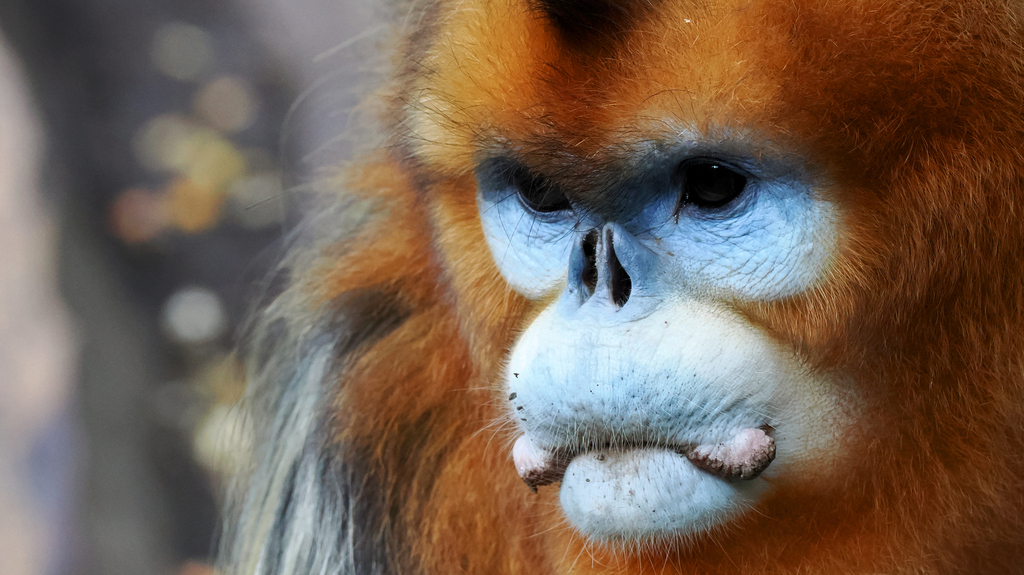
Golden Snub-nosed Monkey
Photo © steve b
Photo © steve b — CC0 1.0 — Source: iNaturalist photo #519130809Identification
The golden snub-nosed monkey is a striking primate with distinctive golden guard hairs on the back and cape area. Adult males are substantially larger than females, weighing around 16.4 kg and measuring 58–68 cm in length, with deep brown coloring on the back, crown, and outer thighs contrasted by their luminous golden plumage. Females are approximately half the size of males at 9.4 kg, with shorter golden guard hairs and prominently visible breasts and nipples. Both sexes display a distinctive upright-haired crest useful for individual identification. The species' common name derives from its unusual flattened nose, a characteristic feature of the snub-nosed monkey group. Younger animals transition through color phases—infants appear light brownish-gray or nearly white in sunlight, while juveniles display reddish-gold tones that gradually develop into the deeper brown and gold coloration of adults.
Range & Habitat
Endemic to central and southwestern China, the golden snub-nosed monkey inhabits temperate, mountainous forests at elevations between 1,500 and 3,400 meters. The species is divided into three geographically separated subspecies: the Moupin subspecies inhabits the mountains flanking the Sichuan Basin; the Qinling subspecies occupies the Qinling Mountains of southern Shaanxi; and the Hubei subspecies resides in the Daba Mountains of Hubei and northeastern Chongqing. Snow falls frequently throughout its range, and this remarkable primate can tolerate colder temperatures than any other non-human primate, making it uniquely adapted to harsh alpine conditions.
Behaviour & Diet
Golden snub-nosed monkeys are diurnal and highly arboreal, spending approximately 97% of their time in the forest canopy. They are primarily herbivorous, with lichens forming their main food source, though their diet varies considerably with the seasons. These monkeys are social animals that live in multi-individual groups, and their behavior is adapted to their specialized ecological niche in high-altitude forests.
Best Time & Places to See It
The three subspecies occupy distinct regions: seek the Moupin subspecies in the Min Mountains and Qionglai Mountains of Sichuan, or in the border regions of Gansu and Shaanxi provinces. The Qinling subspecies is found in the Qinling Mountains of southern Shaanxi, while the Hubei subspecies can be found in the Shennongjia Forest District and nearby mountains of Hubei and Chongqing. Population estimates range from 8,000 to 15,000 individuals across all subspecies. Snow and cold weather are frequent in these montane habitats, making proper preparation essential for any field visit.
Photography Tips
The upright crest hairs and the contrast between deep brown and golden plumage provide excellent photographic subjects, particularly when backlit to highlight the luminous guard hairs. The large canines visible when the mouth is open offer distinctive portrait opportunities. Since these monkeys spend most of their time high in the canopy, a telephoto lens and patience are essential. Female specimens with clinging infants provide compelling family group compositions, while the marked size dimorphism between males and females allows for dynamic social documentation. Early morning light in these high-altitude forests enhances the golden coloration of the primates' fur.
No community photos yet. Log in to add the first one.
No community observations of this species yet.