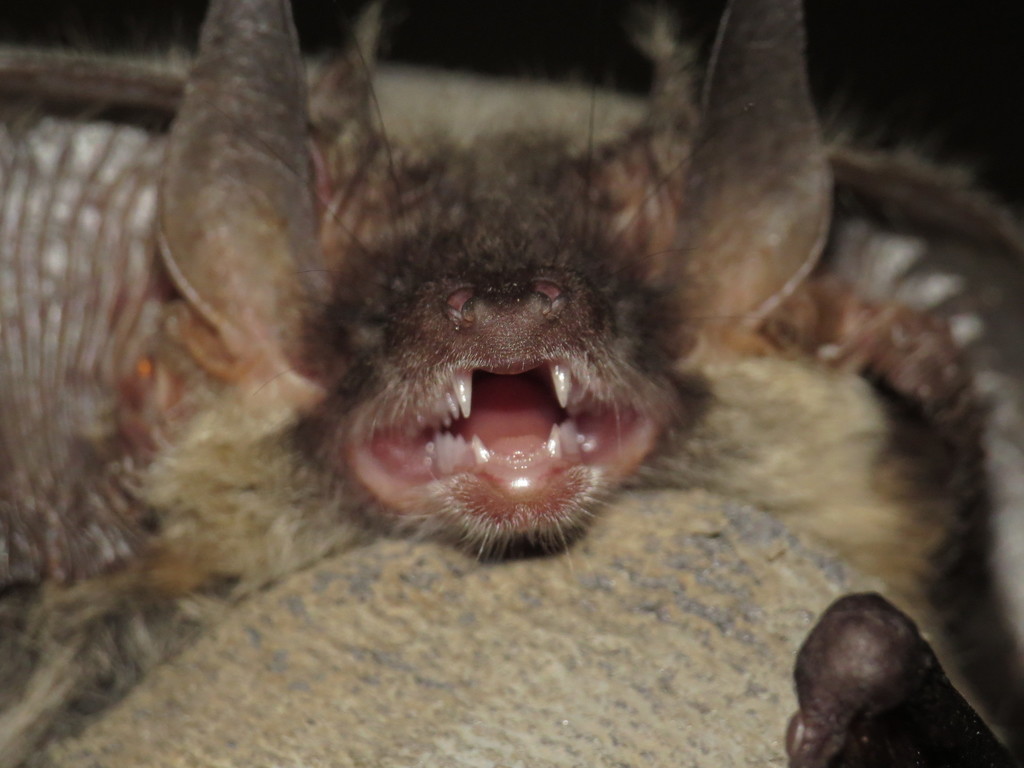
Gray Long-eared Bat
Photo © Yves Bas
Photo © Yves Bas — CC BY 4.0 — Source: iNaturalist photo #170559394The grey long-eared bat (Plecotus austriacus) is a fairly large European bat. It has distinctive ears, long and with a distinctive fold. It hunts above woodland, often by day, and mostly for moths. In captivity, it has also been recorded to eat small lizards. It is extremely similar to the more common brown long-eared bat, and was only distinguished in the 1960s, but has a paler belly. == Biology and ecology == Its main foraging habitats are lowland meadows and marshes. It locates its insect prey via echolocation. The frequencies used by this bat species for echolocation lie between 18 and 45 kHz, have most energy at 28 kHz and have an average duration of 5.8 ms. == Distribution == Distributed throughout all of Europe, except for the Scandinavian Peninsula. Although they are a near threatened species, they are more commonly found in Southern Europe. (To be more specific, woodlands and grasslands, as well as a few urban areas.) == Conservation == It is currently listed as near-threatened by the IUCN. It has a large geographic range and it is considered relatively common. In most of the countries where it is found, it is protected from intentional harm by legislation.…
Calanques National Park
Camargue Regional Nature Park
Cap de Creus Natural Park
Caps et Marais d’Opale Regional Nature Park
Causses du Quercy Regional Nature Park
Cévennes National Park
Chartreuse Regional Nature Park
Corse Regional Nature Park
De Meinweg National Park
Nothing matches these filters.
No community photos yet. Log in to add the first one.
No community observations of this species yet.