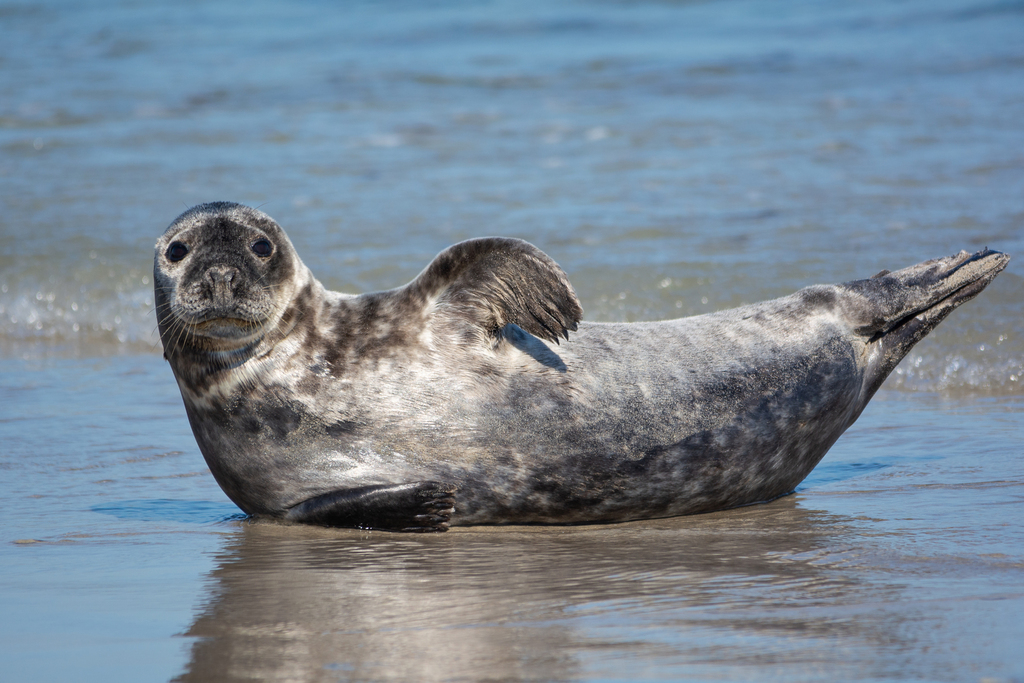
Gray Seal
Photo © Johannes S.
Photo © Johannes S. — CC BY 4.0 — Source: iNaturalist photo #606850922Identification
The gray seal is a large, robust member of the "true seal" family, instantly recognizable by its distinctive long, sloped snout often likened to a Roman nose. Males are noticeably larger and heavier than females, with particularly wide muzzles and characteristically wrinkled, scarred necks and chests. In the eastern Atlantic, males typically measure 1.95–2.3 m in length and weigh 170–310 kg, while females are considerably smaller at 1.6–1.95 m and 100–190 kg. Western Atlantic populations are even more impressive, with males reaching up to 2.7 m and weighing as much as 400 kg. Like all earless seals, gray seals lack external ear flaps.
Coloration is highly variable and often sexually dimorphic. Males typically display a light pattern on a dark background, whereas females more commonly show a dark pattern on a light background with a noticeably light belly. Juveniles are often solid-colored and can be difficult to sex. Gray seals are easily confused with harbor seals across their range, but can be distinguished by their longer, more sloped snout, flatter head, more widely-spaced eyes, and parallel (rather than V-shaped) nostrils. They possess fewer but larger spots than harbor seals and are substantially heavier—about three times the weight of a typical harbor seal.
Range & Habitat
Gray seals are found on both shores of the North Atlantic Ocean, distributed across 18 countries from the United States to Russia, with occasional vagrants recorded as far south as Portugal and Greenland. The species is divided into two subspecies: the Baltic gray seal, confined to the Baltic Sea, and the Atlantic gray seal, found throughout the rest of the range. Canada and the United Kingdom support the largest populations. The global population was estimated at approximately 632,000 individuals in 2016.
In the UK, the most significant breeding grounds include the Monach Islands in the Outer Hebrides, Faray and Holm of Faray in Orkney, North Rona, the Isle of May, the Treshnish Isles, and Berwickshire and North Northumberland Coast. More accessible sites for visitors include Blakeney Point and Horsey Beach in Norfolk, various Cornish locations, and Donna Nook in Lincolnshire. Gray seals have recently begun recolonizing parts of the tidal River Thames.
Behaviour & Diet
Gray seals are primarily piscivorous, feeding mostly on fish species across their range. Their diet occasionally includes invertebrates such as octopuses and lobsters. In the wild, their main predator is the orca, while they are also hunted by sharks. Young pups face predation from eagles and gulls, making their early months particularly vulnerable.
Best Time & Places to See It
The UK offers excellent opportunities for observing gray seals, particularly at established breeding and haul-out sites. Blakeney Point in Norfolk and Horsey Beach provide reliable viewing, as do various locations along the Cornish coast and Donna Nook in Lincolnshire. The Hebridean islands—including the Outer Hebrides and Orkney—host significant populations, though these require more planning to access. The Thames in London now offers an unexpected urban viewing opportunity.
Photography Tips
Gray seals' variable coloration and distinctive facial features make them rewarding photographic subjects. The sexual dimorphism in appearance—particularly the wrinkled, scarred necks of males versus the smoother appearance of females—offers compositional variety. Capture the characteristic "Roman nose" profile and the wide-set eyes that distinguish them from harbor seals. Breeding and haul-out sites provide predictable locations for photography, though approach distances should respect wildlife regulations. The variable light patterns across their bodies create interesting opportunities for both close-up portraiture and environmental context shots showing them at rest on rocks or beaches.
Cape Breton Highlands National Park
Cape Breton Highlands National Park, Canada
+215 birds+18 mammals
Where the Atlantic coast of Nova Scotia rises in weathered cliffs and glacially carved valleys, Cape Breton Highlands National Park spans a landscape where boreal and…
VIEW NATIONAL PARKKosterhavets National Park
Västra Götalands län, Sweden
+211 birds+9 mammals
Where the west coast of Sweden dissolves into an archipelago of granite skerries and pine-clad islands, Kosterhavets National Park emerges as one of northern Europe's most…
VIEW NATIONAL PARKJasmund National Park
Sassnitz, Germany
+136 birds+7 mammals
Towering chalk cliffs rise abruptly from the Baltic shoreline, their luminous white faces sculpted by millennia of wind, frost, and wave action into one of northern…
VIEW NATIONAL PARKVorpommersche Boddenlandschaft National Park
Küstengewässer einschließlich Anteil am Festlandso, Germany
+230 birds+19 mammals
Where the Baltic coast dissolves into a labyrinth of shallow lagoons and coastal wetlands, Vorpommersche Boddenlandschaft National Park protects one of northern Europe's most dynamic and…
VIEW NATIONAL PARKSchleswig-Holsteinisches Wattenmeer National Park
Germany
+378 birds+49 mammals
Where the North Sea ebbs and flows across a vast expanse of exposed mud and sand, the Schleswig-Holsteinisches Wattenmeer National Park reveals one of Europe's most…
VIEW NATIONAL PARKPembrokeshire Coast National Park
Pembrokeshire, United Kingdom
+250 birds+41 mammals
Where the Cambrian coastline meets the Celtic Sea, cliff-top moorland and hidden coves define a landscape carved by 300 million years of geological drama. Pembrokeshire Coast…
VIEW NATIONAL PARKEryri National Park
Gwynedd, United Kingdom
+199 birds+36 mammals
Where granite peaks rise abruptly from the Snowdonia landscape, Eryri National Park encompasses one of Britain's most dramatic mountain terrain. The park's rugged plateaus, deep glacial…
VIEW NATIONAL PARKNorth York Moors National Park
North Yorkshire, United Kingdom
+234 birds+32 mammals
Across the high moorlands of North Yorkshire, where heather and bilberry sprawl beneath vast skies, the landscape rises and falls in gentle undulation—a patchwork of open…
VIEW NATIONAL PARKSouth Downs National Park
Chichester, United Kingdom
+298 birds+45 mammals
Chalk downland ridges rise and fall across the South Downs, their open grasslands and beech hangers creating a mosaic of habitats that has shaped human settlement…
VIEW NATIONAL PARKL’Île-Bonaventure-Et-Du-Rocher-Percé National Park
Le Rocher-Percé, Canada
+214 birds+3 mammals
A dramatic thrust of russet sandstone pierces the Gulf of Saint Lawrence, its weathered arch framing a seascape where cool Atlantic currents sweep past cliffs alive…
VIEW NATIONAL PARKSkuleskogen
Nätra District, Sweden
+158 birds+11 mammals
Where boreal forest meets the raw Höga Kusten coastline, Skuleskogen National Park unfolds across nearly 47 square kilometers of one of northern Sweden's most dramatic landscapes.…
VIEW NATIONAL PARKD’Anticosti National Park
Anticosti Island, Canada
+115 birds+3 mammals
Where boreal forest meets the Gulf of Saint Lawrence, Anticosti Island rises as one of North America's largest and most pristine wilderness preserves. Spanning roughly 2,266…
VIEW NATIONAL PARKGros Morne National Park
Canada
+180 birds+19 mammals
Where glacier-carved fjords pierce the interior of Newfoundland, Gros Morne National Park unfolds across nearly four thousand square kilometres of some of Canada's most dramatic coastal…
VIEW NATIONAL PARKBic National Park
Rimouski, Canada
+250 birds+9 mammals
Where the St. Lawrence River meets the Gaspé Peninsula, a rugged coastline of forests, wetlands, and rocky shores unfolds across nearly 95 square kilometres of protected…
VIEW NATIONAL PARKKouchibouguac National Park of Canada
Carleton Parish, Canada
+207 birds+14 mammals
Where the Maritime provinces meet the Atlantic, 591 square kilometres of coastal forest and wetland unfold across New Brunswick's eastern shoulder, a mosaic of boreal woodland,…
VIEW NATIONAL PARKForillon National Park
Gaspé, Canada
+258 birds+16 mammals
Where the Gaspésie Peninsula juts into the Gulf of Saint Lawrence, granite cliffs and coastal headlands frame one of eastern Canada's most dramatic marine-terrestrial boundaries. Forillon…
VIEW NATIONAL PARKD’Armorique Regional Nature Park
Le Faou, France
+103 birds+23 mammals
Where granite ridges meet Atlantic moorland, one of Brittany's wildest regions reveals itself in layers of ecological richness. The landscape shifts dramatically from heather-clad uplands to…
VIEW NATURAL PARKLoch Lomond & the Trossachs National Park
Duchray, United Kingdom
+188 birds+40 mammals
Where ancient woodlands rise from glassy lochs and rugged Highland peaks pierce the lowland horizon, Scotland's most biodiverse landscape unfolds across 720 square kilometres of wild…
VIEW NATIONAL PARKLahemaa National Park
Lääne-Viru County, Estonia
+237 birds+25 mammals
Where the Baltic coast meets temperate forest in northwestern Estonia, Lahemaa National Park sprawls across more than 1,300 square kilometers of deeply character-filled terrain. Coastal wetlands…
VIEW NATIONAL PARKWolin National Park
Kamień County, Poland
+232 birds+21 mammals
Where the Baltic shoreline meets vast wetland complexes and Pleistocene woodlands, Wolin National Park unfolds across nearly 440 square kilometres of northwestern Poland's most biodiverse terrain.…
VIEW NATIONAL PARKSłowiński National Park
Smołdzino, Poland
+217 birds+16 mammals
Where the Baltic shoreline surrenders to vast inland dunes and freshwater lagoons, Słowiński National Park spans nearly 610 square kilometres of one of Europe's most dynamic…
VIEW NATIONAL PARKSkomer Island
Haverfordwest, United Kingdom
+177 birds+5 mammals
Where the Irish Sea crashes against the Welsh coast, wind-scoured cliffs rise dramatically from churning waters, creating one of Britain's most pristine island sanctuaries. Skomer Island's…
VIEW ISLAND & ARCHIPELAGOCabo Peñas
Susacasa, Spain
+303 birds+21 mammals
Where sea cliffs rise sheer from the Bay of Biscay, Susacasa's observation point commands one of Asturias's most dramatic coastal vistas. The landscape here is defined…
VIEW OBSERVATION POINTAcadia National Park
Bar Harbor, United States
+291 birds+27 mammals
Where the Maine coast rises in granite cliffs and spruce-clad headlands, Acadia National Park unfolds across Mount Desert Island and its surrounding waters, a landscape carved…
VIEW NATIONAL PARKChincoteague National Wildlife Refuge
Chincoteague, United States
+362 birds+16 mammals
Across the barrier islands and salt marshes of Virginia's Eastern Shore, where Atlantic tides sculpt an intricate mosaic of sandy spits and tidal flats, lies one…
VIEW WILDLIFE SANCTUARYLindisfarne National Nature Reserve
Holy Island, United Kingdom
+240 birds+13 mammals
Windswept tidal flats and rocky outcrops define this reserve on Holy Island, where the North Sea's relentless rhythm shapes both landscape and wildlife. The terrain shifts…
VIEW NATURE RESERVEHolkham National Nature Reserve
North Norfolk, United Kingdom
+235 birds+11 mammals
Where Norfolk's coastal flatlands meet the North Sea, Holkham National Nature Reserve unfolds across nearly 4,000 hectares of some of England's most dynamic and least predictable…
VIEW NATURE RESERVEThe Lizard National Nature Reserve
Garras, United Kingdom
+120 birds+2 mammals
Where windswept moorlands meet rocky outcrops along Cornwall's dramatic southern coast, the Lizard National Nature Reserve unfolds as one of southwest England's most ecologically distinctive landscapes.…
VIEW NATURE RESERVECaerlaverock National Nature Reserve
Carsethorn, United Kingdom
+109 birds+16 mammals
Where the Solway Firth meets the Scottish coast, saltmarsh and mudflat create a landscape shaped by tidal rhythms and temperate maritime climate. Caerlaverock's mosaic of habitats—brackish…
VIEW NATURE RESERVERum National Nature Reserve
Isle Of Rum, United Kingdom
+112 birds+8 mammals
Where the Inner Hebrides rise from the Atlantic, Rum's landscape embodies the raw drama of Scotland's northwest. Steep ridges and volcanic plateaus dominate this island nature…
VIEW NATURE RESERVEDyfi National Nature Reserve
Aberdyfi, United Kingdom
+148 birds+25 mammals
Where the River Dyfi widens into a broad coastal basin, a 2,400-hectare mosaic of saltmarsh, reedbed, mudflat and freshwater wetland spreads across the Cardigan Bay estuary…
VIEW NATURE RESERVEGreat Orme National Nature Reserve
Llandudno, United Kingdom
+113 birds+7 mammals
Limestone cliffs rise dramatically from the Irish Sea along the Conwy coast, their windswept summits offering sanctuary to a mosaic of heathland, grassland and rocky outcrops…
VIEW NATURE RESERVESeven Sisters National Nature Reserve
Eastbourne, United Kingdom
+190 birds+15 mammals
Where the South Downs meet the English Channel, the chalk cliffs of Seven Sisters rise in a dramatic sequence of white promontories that have shaped both…
VIEW NATURE RESERVEThe Wash National Nature Reserve
King's Lynn and West Norfolk, United Kingdom
+141 birds+3 mammals
Where the North Sea meets the Norfolk coast, The Wash sprawls as one of Britain's most extensive estuarine systems—a vast, restless realm of mudflats, saltmarsh, and…
VIEW NATURE RESERVECors Fochno National Nature Reserve
Borth, United Kingdom
+179 birds+27 mammals
Where the Dovey Estuary opens to the Irish Sea, a sprawling wetland mosaic of reedbed, fen and mire transforms the coastal flats of mid-Wales into one…
VIEW NATURE RESERVENo community photos yet. Log in to add the first one.
No community observations of this species yet.