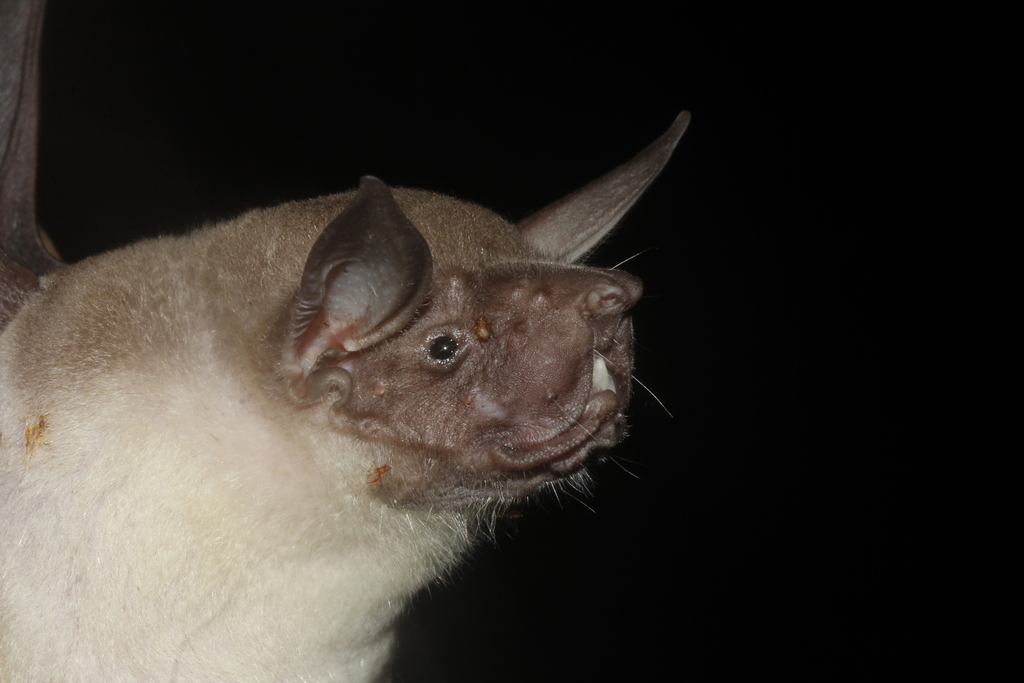
Greater Bulldog Bat
Photo © Juan Cruzado Cortés
Photo © Juan Cruzado Cortés — CC BY-SA 4.0 — Source: iNaturalist photo #82949387The greater bulldog bat or fisherman bat (Noctilio leporinus) is a species of fishing bat native to Latin America (Spanish: murciélago pescador; Portuguese: morcego-pescador). The bat uses echolocation to detect water ripples made by the fish upon which it preys, then uses the pouch between its legs to scoop the fish up and its sharp claws to catch and cling to it. It is not to be confused with the lesser bulldog bat, which, though belonging to the same genus, merely catches water insects, such as water striders and water beetles. It emits echolocation sounds through the mouth like Myotis daubentoni, but the sounds are quite different, containing a long constant frequency part around 55 kHz, which is an unusually high frequency for a bat this large. == General description == The greater bulldog bat is a large bat, often with a combined body and head length of 10.9 to 12.7 cm (4.3 to 5.0 in). It generally weighs from 50–90 grams (1.8–3.2 oz). Males tend to be larger than females, with the former averaging 67 grams (2.4 oz) and the latter averaging 56 grams (2.0 oz). They also differ in fur color. Males have bright orange fur on the…
Corcovado National Park
Puerto Jiménez, Costa Rica
+444 birds+48 mammals
Where the Osa Peninsula juts into the Pacific, rainforest descends almost to the tide line, and Corcovado National Park protects one of Central America's most intact…
VIEW NATIONAL PARKSoberanía National Park
Cristóbal, Panama
+495 birds+34 mammals
Rainforest and riverine woodland blanket the rolling terrain of this 714-square-kilometre national park in Colón Province, where the Caribbean watershed feeds a maze of streams and…
VIEW NATIONAL PARKPalo Verde National Park
Bagaces, Costa Rica
+318 birds+24 mammals
Dry forest spreads across Palo Verde's low-lying terrain in northwestern Guanacaste, where seasonal rivers and lagoons etch through deciduous woodland that sheds its canopy each winter.…
VIEW NATIONAL PARKNo community photos yet. Log in to add the first one.
No community observations of this species yet.