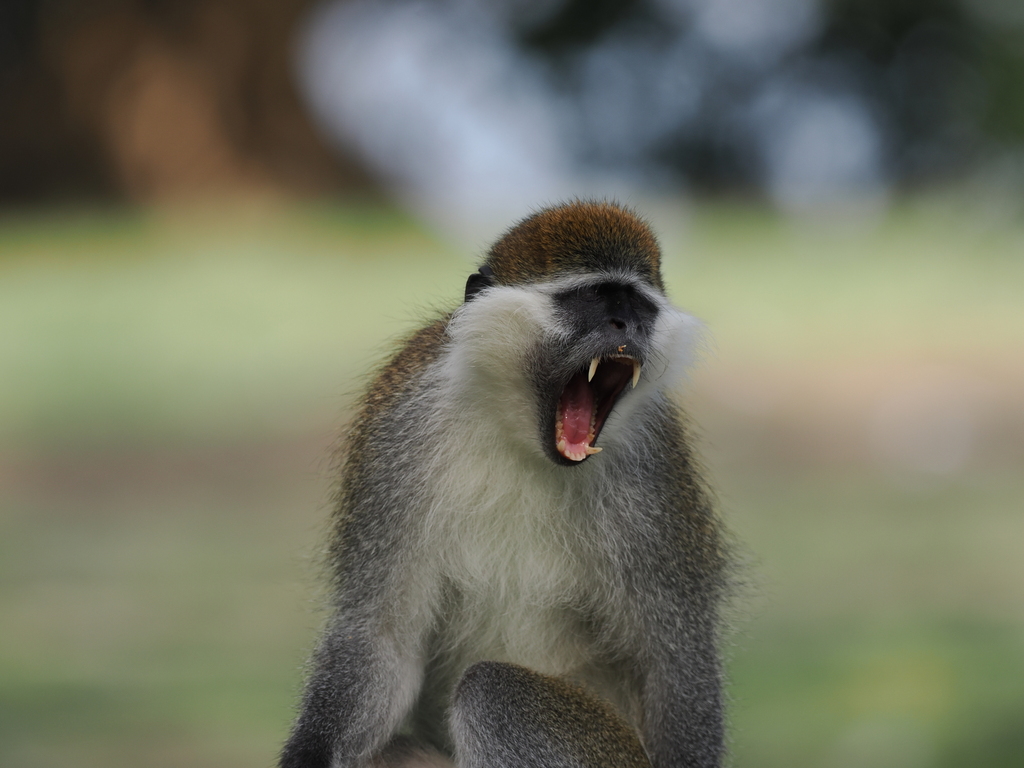
Grivet Monkey
Photo © Lin Scott
Photo © Lin Scott — CC BY 4.0 — Source: iNaturalist photo #513919190Identification
The grivet is a distinctive Old World monkey easily recognized by its striking facial markings: a white line above the eyes, long white whiskers on the cheeks, and black facial skin, hands, and feet. The body fur is olive-colored on the back with white underparts, and the stomach skin has a blue tint. The fur itself has a bristly texture. Males are noticeably larger than females, measuring approximately 49 cm in head and body length compared to 42.6 cm for females, with tails ranging from 30–50 cm. Body mass varies from 3.4 to 8.0 kg, with females at the smaller end of the scale.
Range & Habitat
The grivet is endemic to the Horn of Africa, with its range restricted to Ethiopia, Sudan (east of the White Nile), Eritrea, and Djibouti. The species inhabits savanna woodlands and shows remarkable adaptability to various environments, though it requires proximity to reliable water sources, particularly during the dry season. In the southern portions of its range, the grivet's distribution overlaps with the closely related vervet monkey and Bale Mountains vervet, creating potential for hybridization.
Behaviour & Diet
Grivets are most active during morning and early evening hours, spending much of the day foraging on the ground before retreating to trees at night. These highly social primates live in multi-male groups ranging from five to over 70 individuals, organized by a male dominance hierarchy displayed through characteristic stiff-tailed posturing. They are primarily omnivorous, feeding on fruits, vegetables, insects, small mammals, and birds, while also scavenging human food. Daily water consumption is essential. Grivets spend considerable time grooming, playing, and climbing—behaviors vital for group cohesion and survival. Females produce single infants after a 2–3 month gestation; young grivets are born with pink faces and black hair, acquiring their adult coloration within two months and becoming independent after approximately six months.
Best Time & Places to See It
The grivet's morning and evening activity peaks make these the optimal times for observation. Visitors to Ethiopia, Sudan, Eritrea, and Djibouti exploring savanna woodland habitats near permanent water sources offer the best opportunities for encounters. The species' common status and least concern conservation rating mean sightings are relatively reliable throughout its range, particularly in protected woodland areas.
Photography Tips
The grivet's striking facial markings—white eyebrows, black face, and prominent white whiskers—are best captured with medium telephoto lenses (200–400mm) in soft morning or evening light. Position yourself near water sources during dry seasons when groups congregate. The contrast between the white underparts and olive back is dramatic in side-profile shots. The animals' frequent grooming and social interactions provide excellent behavioral photography opportunities. Patience and positioning yourself downwind will allow closer approaches as grivets forage on the ground.
Tsavo West National Park
Mwatate, Kenya
+513 birds+49 mammals
Where volcanic ridges and weathered lava flows meet the semi-arid lowlands of south-central Kenya, Tsavo West National Park unfolds across a landscape sculpted by fire and…
VIEW NATIONAL PARKAbijata-Shalla Lakes National Park
Ethiopia
+438 birds+7 mammals
Two crater lakes of contrasting chemistry define this remote corner of Ethiopia's Rift Valley, where soda lakes and freshwater basins create a mosaic of distinct aquatic…
VIEW NATIONAL PARKBale Mountains National Park
Ethiopia
+397 birds+20 mammals
Where the Ethiopian highlands rise above 4,000 metres, the Bale Mountains create a landscape of stunning ecological extremes—from afroalpine grasslands swept by wind and mist to…
VIEW NATIONAL PARKAwash National Park
Didiga, Ethiopia
+473 birds+23 mammals
Where the Ethiopian Rift Valley carves through volcanic plateaus, a ribbon of riverine forest winds through acacia scrubland and grassland, creating a mosaic of habitats that…
VIEW NATURAL PARKNech Sar National Park
Arba Minch, Ethiopia
+191 birds+10 mammals
Where the East African Rift Valley plateaus drop dramatically toward the shore of Lake Abaya, a mosaic of habitats unfolds across sun-scorched savanna and acacia woodland.…
VIEW NATIONAL PARKNo community photos yet. Log in to add the first one.
No community observations of this species yet.