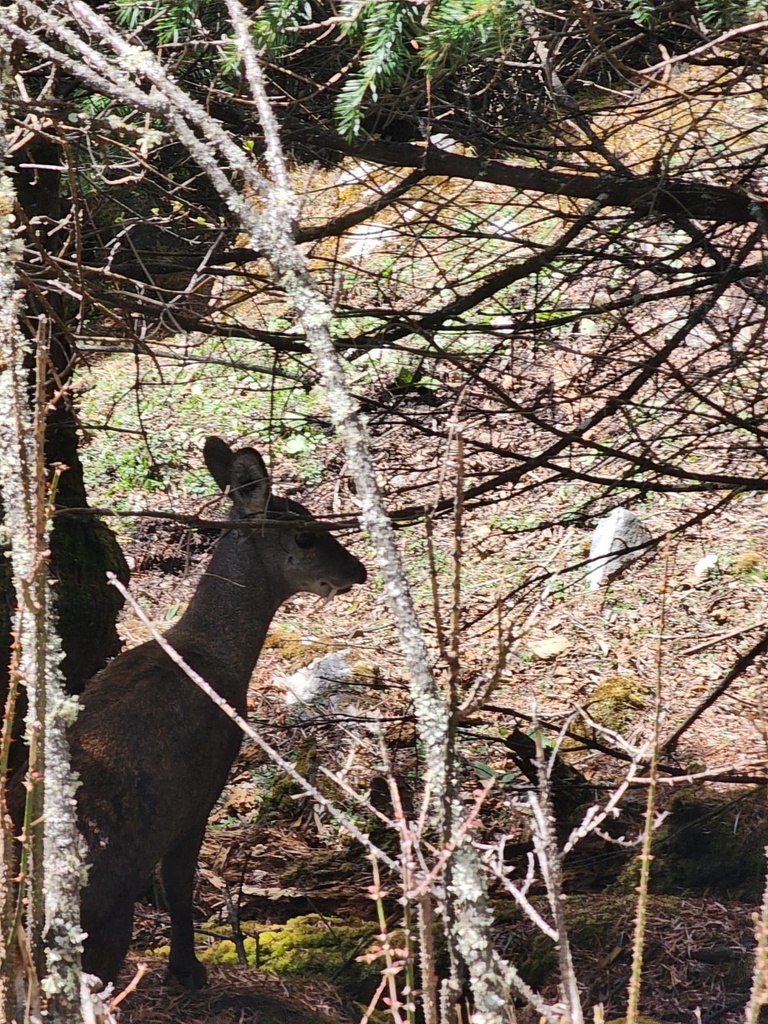
Himalayan Musk-deer
Photo © Steve Llewellyn
Photo © Steve Llewellyn — CC BY 4.0 — Source: iNaturalist #162326545Identification
The Himalayan musk deer is a stocky, small ungulate with distinctive physical adaptations for high-altitude living. Males are easily recognized by their pair of enlarged canine teeth that grow continuously, reaching a maximum length of about 10 cm (3.9 in)—these tusks are fragile and break easily. The species has a dense coat of coarse hairs with air-filled cells that provide insulation against extreme temperatures. Their hind legs are significantly longer and more muscular than their shorter, thinner forelimbs, giving them a characteristically hunched appearance. Rather than running or leaping, these deer move by bounding. Young fawns display white spots for camouflage, but these markings disappear as they mature. Males possess a specialized abdominal gland that secretes a waxy substance called musk, which is used for territory marking and mate attraction.
Range & Habitat
The Himalayan musk deer is endemic to the eastern Himalayas, with confirmed records in Nepal and likely populations in Sikkim, Bhutan, and parts of China's southwestern Tibet Autonomous Region. The species is distributed eastwards from the Annapurna Himalayas and Kali Gandaki Gorge. These deer inhabit exclusively high alpine environments at elevations above 2,500 m (8,200 ft), where they have evolved remarkable physiological adaptations. Well-developed dew claws and broad toes provide increased stability on the steep, rocky slopes characteristic of their mountainous range.
Behaviour & Diet
Himalayan musk deer are remarkably shy and secretive, remaining hidden in dense cover throughout the day and only emerging at night to feed in more open habitats. They are fairly sedentary, occupying small home ranges of up to 22 hectares. These herbivores preferentially select leaves from trees and shrubs that offer high protein and low fibre content. During winter months, they subsist on lower-quality lichens and will climb small trees to access otherwise unreachable foliage. Males are fiercely territorial, permitting only females to enter their range, which they mark with defecation sites and strong-smelling musk secretions. During mating season, males engage in fierce combat using their long canines to compete for females, who remain hidden during the territorial displays. Females typically give birth to one or two young, which nurse for approximately six months before becoming independent. Young deer reach sexual maturity between 16 and 24 months of age. The species can live 10 to 14 years in the wild.
Best Time & Places to See It
Observing Himalayan musk deer presents a significant challenge due to their shy, nocturnal nature and remote high-altitude habitat. Nepal offers the most reliable opportunities, particularly in protected areas, though sightings remain uncommon. The eastern Himalayan regions of India, including areas around Sikkim, may also provide opportunities for dedicated wildlife watchers. Night observation in alpine zones above 2,500 m elevation offers the best chance of encounters. However, travelers should be prepared for difficult mountain terrain and expect that sightings are far from guaranteed. Spring and summer months, when weather permits access to higher elevations, offer the most practical window for attempts to observe this elusive species.
Photography Tips
Photographing Himalayan musk deer requires patience, specialized equipment, and realistic expectations. A telephoto lens (at least 300–500 mm) is essential given the animal's shy nature and the distances at which observations occur. Since these deer are primarily nocturnal and crepuscular, fast film or high ISO settings become necessary, along with careful exposure compensation for the bright alpine environment and snow reflection. Tripods and stabilizing gear are valuable for managing the challenging mountain terrain. Approach should be extraordinarily slow and cautious, as these animals are extremely wary and will retreat into dense cover at the slightest disturbance. Early morning or late evening light provides optimal conditions for both viewing and photography, though sightings remain rare and unpredictable even under ideal circumstances.
Langtang National Park
Helambu, Nepal
+364 birds+14 mammals
Where the southern slopes of the Himalayan highlands descend toward the subtropical valleys of central Nepal, Langtang National Park sprawls across one of the subcontinent's most…
VIEW NATIONAL PARKSagarmatha National Park
Khumjung, Nepal
+219 birds+7 mammals
Soaring peaks and deep glacial valleys define this alpine wilderness in northeastern Nepal, where the terrain rises from forested foothills into a realm of high-altitude tundra…
VIEW NATIONAL PARKNo community photos yet. Log in to add the first one.
No community observations of this species yet.