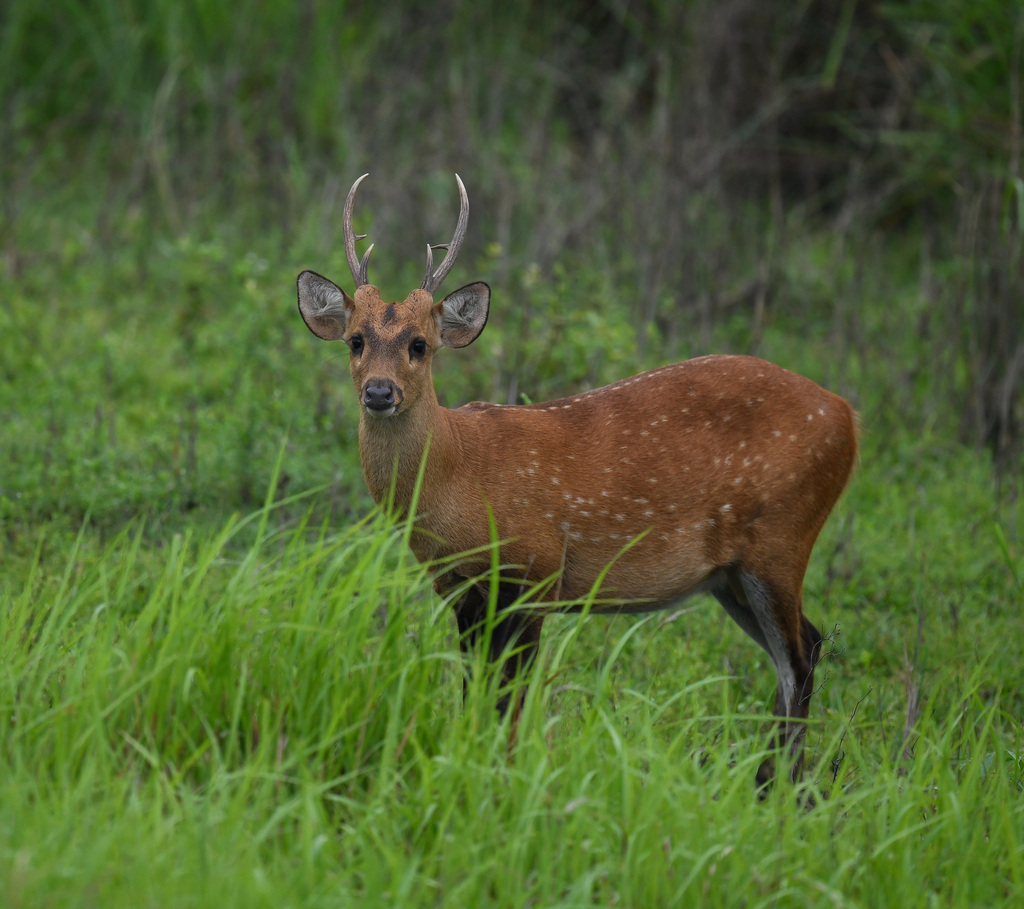
Hog Deer
Photo © Rejoice Gassah
Photo © Rejoice Gassah — CC BY 4.0 — Source: iNaturalist #304895191The Indian hog deer (Axis porcinus), or Indochinese hog deer, is a small cervid native to the region of the Indian subcontinent and Indo-Gangetic Plain. Introduced populations are established in Australia, as well as the United States and Sri Lanka. Its name derives from the hog-like manner in which it runs through forests (with its head hung low), to ease ducking under obstacles instead of leaping over them, like most other deer. == Taxonomy == Cervus porcinus was the scientific name used by Eberhard August Wilhelm von Zimmermann in 1777 and 1780, based on an earlier description of Indian hog deer brought to England from India. It was placed in the genus Axis by William Jardine in 1835 and by Brian Houghton Hodgson in 1847. In 2004, it was proposed to be placed in the genus Hyelaphus. The proposal has not been accepted, with most authors keeping it under Axis. A subspecies, A. p. annamiticus, was once considered its own species, but is now generally considered the same species as A. porcinus. == Description == A mature hog deer stag stands about 70 centimetres (28 in) at the shoulder, and weighs approximately 50 kilograms (110 lb); hinds are much smaller…
Valmiki National Park
Ramnagar, India
+66 birds+6 mammals
Along Bihar's western frontier, where the Gandak River winds through subtropical forest and grassland, Valmiki National Park sprawls across terrain shaped by monsoon rains and seasonal…
VIEW NATIONAL PARKWilsons Promontory National Park
Australia
+210 birds+21 mammals
Where granite headlands plunge toward Bass Strait, Wilson's Promontory National Park sprawls across nearly 1,300 square kilometers of southeastern Victoria's most rugged coastal wilderness. The park's…
VIEW NATIONAL PARKKaziranga National Park
Kohora, India
+422 birds+26 mammals
Dawn breaks over the floodplains of the Brahmaputra, where tall grasslands stretch endlessly beneath monsoon-heavy skies. This sprawling wilderness of northeastern Assam is a mosaic of…
VIEW NATIONAL PARKNo community photos yet. Log in to add the first one.
No community observations of this species yet.