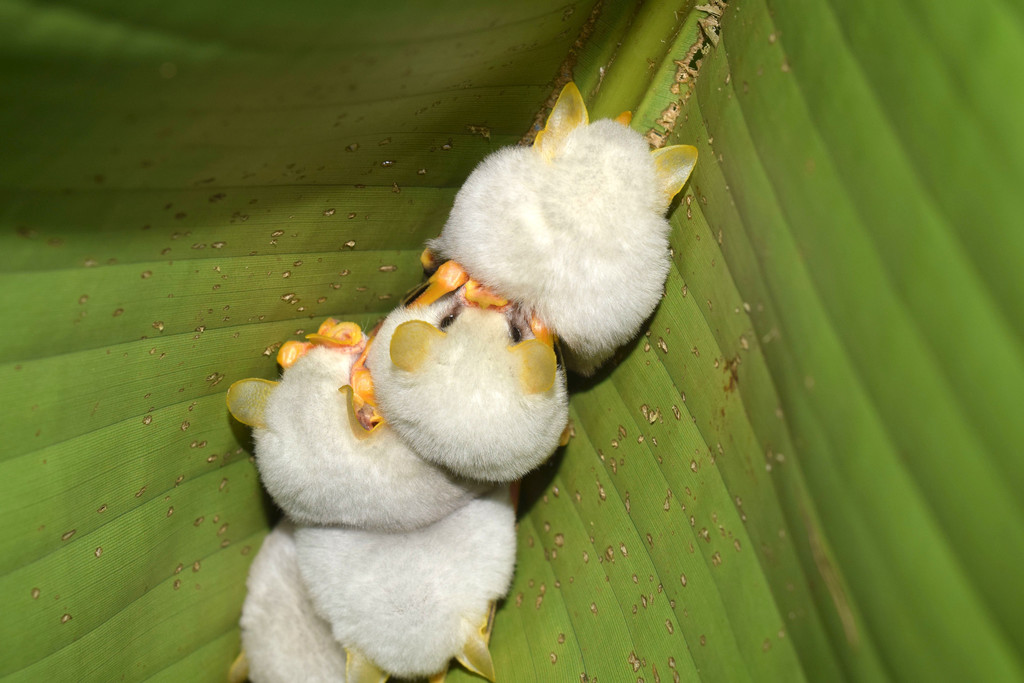
Honduran White Bat
Photo © Philipp Hoenle
Photo © Philipp Hoenle — CC0 1.0 — Source: iNaturalist photo #124498597Identification
The Honduran white bat is unmistakable among Central American bats: it is one of only six bat species worldwide known to have entirely white fur. Its most striking feature is the bright yellow-orange coloration of its ears, nose-leaf, and lips—a distinctive pigmentation caused by high concentrations of carotenoids. The bat is tiny, weighing just 5–6 grams, with a head and body length of 37–47 mm. Its wings are black, contrasting sharply with its white body, and its ears are large and rounded. The erect nose-leaf easily distinguishes it from the only other sympatric white bat, the northern ghost bat, which lacks this feature.
Range & Habitat
This species is found in Honduras, Nicaragua, Costa Rica, and western Panama, occupying lowland forests from sea level to 700 meters elevation. It is a forest specialist, dependent on the understory vegetation where it constructs its characteristic leaf tents. Habitat loss across its range has led to its classification as near-threatened by the IUCN, making it increasingly important to protect remaining suitable forest areas.
Behaviour & Diet
The Honduran white bat is famous for its remarkable tent-making behavior. Using its teeth, it strategically cuts the side veins of large Heliconia leaves, causing them to fold down into tent-like shelters where the bat roosts during daylight hours. Multiple individuals, including females, construct and maintain these tents, which must be renewed throughout the year as the modified leaves die. The bat is an extreme dietary specialist, feeding almost exclusively on the fruit of a single fig species, making it highly dependent on the availability of this food source. Females can breed twice per year, typically giving birth to one offspring at a time.
Best Time & Places to See It
Look for this bat in lowland primary and secondary forests within its Central American range, particularly in areas where suitable Heliconia plants grow in the understory. The bat is most active during dawn and dusk, though it remains within its tents during daylight hours. Visiting protected forest reserves in Costa Rica, Panama, Nicaragua, and Honduras offers the best chances of encountering this species. Early morning or late afternoon observations near fruiting fig trees may yield sightings of foraging individuals.
Photography Tips
The bright white fur and vivid yellow facial features of this bat create striking photographic subjects, particularly when backlit by dappled forest light filtering through the canopy. The yellow coloration is thought to provide camouflage within the greenish light of the leaf tents, so positioning yourself to capture this interplay of color and shadow will enhance your images. Photographing roosting bats within their tents requires patience and respect for the animals—avoid disturbing the tents themselves. Use a fast shutter speed to capture the bat's small, active form, and consider macro techniques to highlight the distinctive facial markings and pigmentation that make this species so visually distinctive.
Barra del Colorado National Wildlife Refuge
Braulio Carrillo National Park
La Amistad International Park
Tapantí Macizo de la Muerte National Park
Tortuguero National Park
Nothing matches these filters.
No community photos yet. Log in to add the first one.
No community observations of this species yet.