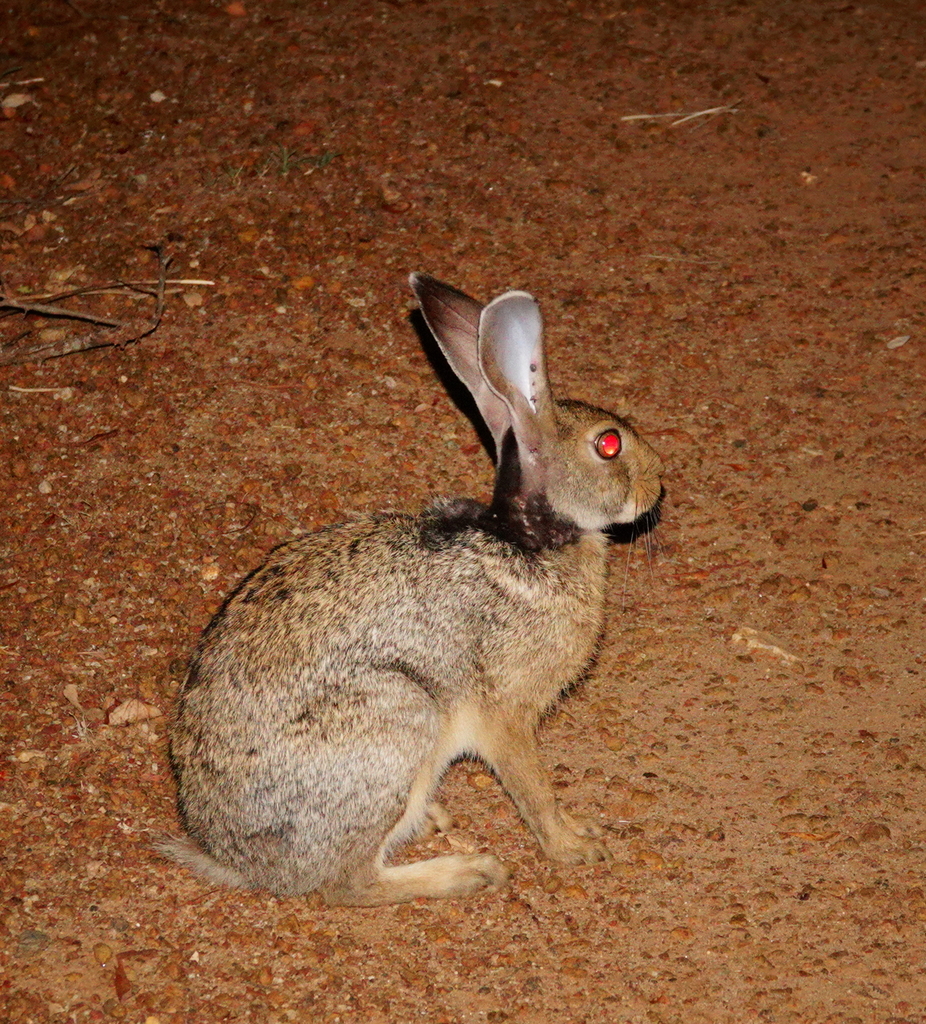
Indian Hare
Photo © desertnaturalist
Photo © desertnaturalist — CC BY 4.0 — Source: iNaturalist #116687336Identification
The Indian hare is a medium-sized hare with a distinctive patchwork coat of black and rufous fur, particularly vivid on the legs and breast. Its underside and the underside of its tail are white, while the upper tail is brown or black depending on subspecies. Adults measure 33 to 53 centimetres in head and body length, with notably larger individuals found in the southern parts of its range. The hare has characteristically large, well-furred hind feet and relatively long ears measuring 8 to 12 centimetres, with adults typically weighing 1.8 to 3.6 kilograms.
Three subspecies display subtle but recognizable differences. The nominate subspecies, L. n. nigricollis, is marked by a black tail and a distinctive black patch of fur on the back of the neck—a feature that gives it an alternative common name, the black-naped hare. L. n. dayanus has paler fur tending towards yellow, while L. n. ruficaudatus resembles the nominate subspecies but features a rufous rather than black tail and neck patch.
Range & Habitat
The Indian hare is native to the Indian subcontinent, Sri Lanka, and Java, where it inhabits rocky highlands. Across its primary range, it favours open grassy areas, cultivated plains, semi-arid and arid plains, and hills. The species has proven adaptable and has been introduced to numerous islands across the Indian Ocean and Western Pacific, including Madagascar, the Comoro Islands, the Andaman Islands, the Seychelles, Mauritius, Réunion, and Mayotte, as well as to Western New Guinea and Papua New Guinea.
Behaviour & Diet
The Indian hare is primarily crepuscular and nocturnal, meaning it is most active during dawn and dusk hours and throughout the night. This activity pattern helps it avoid daytime heat in the open grasslands and cultivated areas it inhabits, and also provides some protection from predators and human disturbance.
Best Time & Places to See It
To encounter Indian hares, plan your wildlife viewing for early morning or evening hours, when their crepuscular activity peaks, or undertake a night excursion if local conditions and guides permit. Within the Indian subcontinent, open grassy plains and cultivated agricultural areas offer the best opportunities for sightings. Rocky highland habitats in Java may also reward patient observers during active periods.
Photography Tips
The Indian hare's crepuscular and nocturnal habits present both challenges and opportunities for photographers. Early morning and late evening light will illuminate the contrasting rufous and black patches of its coat most beautifully. A telephoto lens is essential, as these alert creatures are easily disturbed. Consider using a camera trap or night vision equipment if photographing during nocturnal hours. The hare's large ears and white underside offer striking compositional elements—position yourself to capture the contrast between its upper coat and pale belly or underside of the tail.
Lunugamvehera National Park
Sri Lanka
+204 birds+14 mammals
Dry scrubland and shallow wetlands converge in Sri Lanka's southeastern lowlands, where Lunugamvehera National Park anchors one of the island's most ecologically vital landscapes. The park's…
VIEW NATIONAL PARKRanthambhore National Park
Sawai Madhopur, India
+294 birds+20 mammals
Granite ridges and ravines carved through the Aravalli Range frame this protected landscape in eastern Rajasthan, where deciduous forest mingles with open scrubland and seasonal water…
VIEW NATIONAL PARKTadoba National Park
Palasgaon Singru, India
+270 birds+20 mammals
Where sal forests meet open grasslands and rocky outcrops rise from red laterite soil, central India's landscape unfolds in raw, untamed beauty. Ancient teak woodlands and…
VIEW NATIONAL PARKKeoladeo National Park
Shreenagar Rural, India
+326 birds+14 mammals
Where shallow wetlands shimmer beneath vast Rajasthani skies, one of Asia's finest bird sanctuaries pulses with extraordinary life. This former maharaja's hunting reserve, now spanning 29…
VIEW NATIONAL PARKBandipur National Park
Hirehalli, India
+302 birds+19 mammals
Where the Western Ghats descend into the Deccan plateau, ancient deciduous forests blanket a landscape carved by the Nugu River. Bandipur unfolds across 880 square kilometres…
VIEW NATIONAL PARKNagarahole Tiger Reserve
Nalkeri Forest, India
+323 birds+23 mammals
Where granite escarpments rise above dense deciduous forests and the Kabini River carves through pristine wilderness, one of India's most biodiverse landscapes unfolds across the Western…
VIEW NATIONAL PARKNo community photos yet. Log in to add the first one.
No community observations of this species yet.