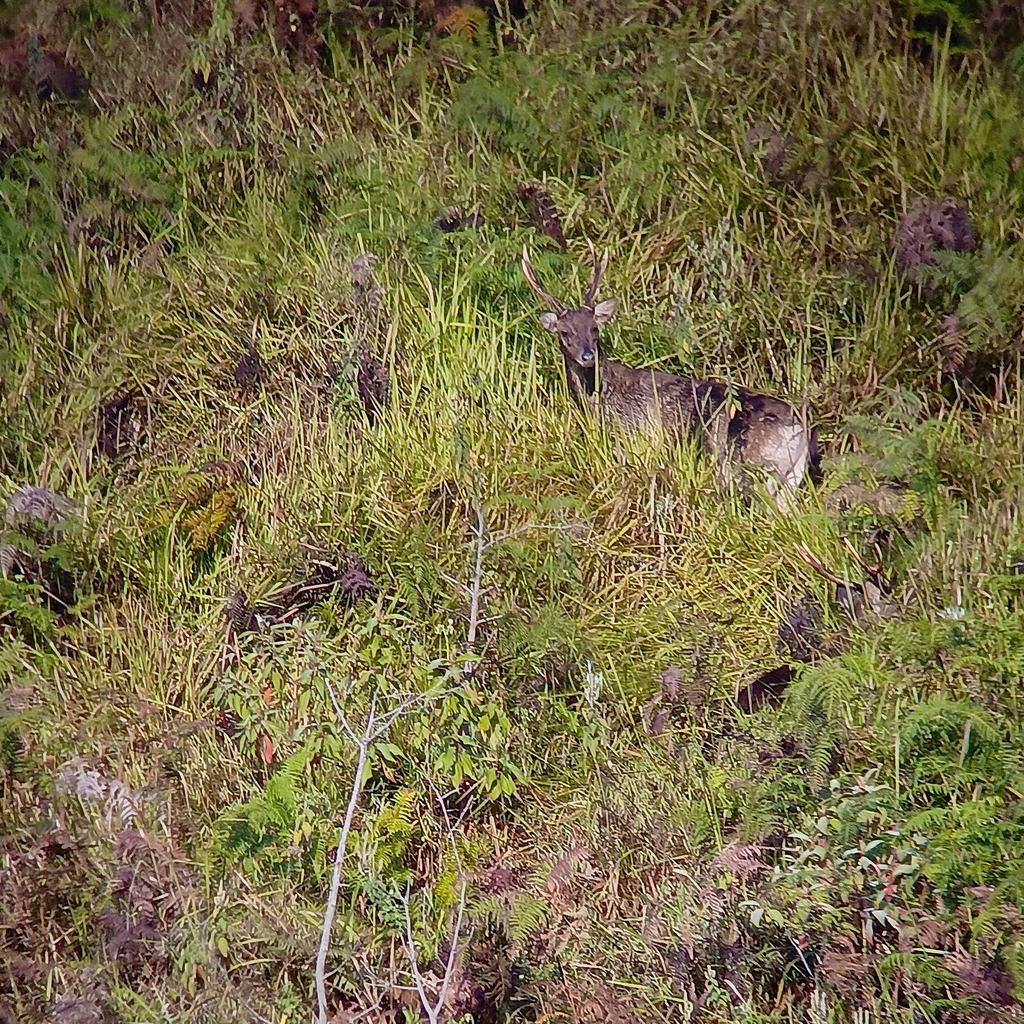
Javan Deer
Photo © Legawa, Everest C.
Photo © Legawa, Everest C. — CC BY 4.0 — Source: iNaturalist #248410900Identification
The Javan rusa is a large deer with distinctive dark colouring. Its back is almost black, while the underparts and inner thighs are yellowish-brown, with a lighter brown abdomen. A grey forehead contrasts with the overall dark blackish-brown coat, and the tail tuft is dark blackish-brown. The coarse hair is notably longer on the chest than elsewhere on the body, and the ears are wide and slightly shorter than the head. Males are considerably larger than females, measuring 142 to 185 centimetres in head-to-body length and weighing 152–160 kilograms, whereas females weigh only about 74 kilograms. The antlers are medium-length and relatively wide, with the upper branch pointing forward. Fawns are born without spots, making young animals distinguishable from spotted deer species in overlapping ranges.
Range & Habitat
The Javan rusa is native to the Indonesian islands of Java, Bali, and Timor, as well as Timor-Leste. Seven subspecies are recognised across different Indonesian islands, including populations on Sulawesi, the Moluccan Islands, Flores, and Muna. However, the species has been widely introduced across the Southern Hemisphere, with established populations now found in Australia, New Zealand, various Pacific islands including Fiji, Samoa, and Vanuatu, as well as on Indian Ocean islands such as Mauritius and Réunion.
Sadly, populations in the native range have declined markedly by approximately 10,000 individuals over the past two decades due to habitat loss and poaching. The species was declared protected under Indonesian law in 2018 and listed as vulnerable in its native range. In some introduced areas, such as the West Papuan lowlands, the species has become widespread and common, though in others, such as Baluran National Park in Indonesia, invasive vegetation has destroyed critical grazing areas.
Behaviour & Diet
Javan rusa are primarily nocturnal animals, though they do graze during daylight hours. They are notoriously difficult to observe in the wild, as they are rarely seen in open areas and possess keen senses and cautious instincts that allow them to avoid detection. They typically occur in small groups or pairs, with adult males often solitary. When alarmed, a stag produces an extremely loud honk—an alarm call that alerts nearby deer to danger.
The diet consists mainly of grass, leaves, and fallen fruit. Interestingly, Javan rusa obtain most of their water requirements from their food and drink very little water. During the breeding season in July and August, stags engage in dramatic contests, calling with loud, shrill barks and duelling with their antlers. Does give birth to one or two calves after an eight-month gestation period, typically at the start of spring. Calves are weaned at 6–8 months and reach sexual maturity between 3–5 years depending on habitat conditions. Lifespans typically range from 15–20 years in both wild and captive settings.
Best Time & Places to See It
Observing wild Javan rusa in their native Indonesian range is challenging due to their nocturnal habits and wariness. Early morning or dusk visits to protected areas offer the best chances, particularly during the breeding season in July and August when stags are more vocal and active. National parks and protected areas across Java, Bali, and the Lesser Sunda Islands provide designated viewing opportunities, though sightings remain unpredictable.
Visitors to islands with introduced populations, particularly in Australia and New Zealand, may have somewhat better success, as populations there are often more established and less pressured. Always consult local guides familiar with recent sightings and movement patterns, as knowledge of specific locations and seasonal behaviour significantly improves encounter prospects.
Photography Tips
Photographing Javan rusa demands patience and stealth. Visit during dawn or dusk when they are most active, move slowly and quietly, and use natural cover to approach. The species' dark colouring requires attention to exposure—metering carefully to preserve detail in the blackish-brown coat without losing highlights on the lighter underparts. Their keen hearing means minimizing noise from camera equipment is essential.
The grey forehead and contrasting body colours offer good compositional opportunities, while the dramatic antlers—particularly during the July-August breeding season—make compelling subjects. Wide-angle lenses can capture them in their habitat context, but a longer focal length allows safer observation from distance. The loud alarm call is an audio bonus for wildlife recordists, though photographically it signals the moment to remain motionless if you hope for continued viewing.
Nerang National Park
Gold Coast, Australia
+126 birds+13 mammals
Steep subtropical rainforest clads the hinterland ridges of southeast Queensland's Gold Coast, where Nerang National Park sprawls across 34 square kilometres of protected bushland between the…
VIEW NATIONAL PARKRoyal National Park
Sydney, Australia
+296 birds+46 mammals
Where sandstone ridges plunge toward the Tasman Sea, Royal National Park unfolds across 343 square kilometres of southeastern Australian coastal wilderness. The park's defining character emerges…
VIEW NATIONAL PARKHeathcote National Park
Sydney, Australia
+119 birds+16 mammals
Sandstone ridges and eucalypt woodlands rise from the Cumberland Plain southwest of Sydney, where Heathcote National Park unfolds across 82 square kilometres of bushland shaped by…
VIEW NATIONAL PARKTaman Nasional Baluran
Situbondo, Indonesia
+189 birds+9 mammals
Across the northeastern tip of East Java, where monsoon winds sweep down from the Bali Strait, a landscape of contrasts unfolds within 374 square kilometres of…
VIEW NATIONAL PARKWest Bali National Park
Gerokgak, Indonesia
+240 birds+8 mammals
Across West Bali's northwestern reaches, where the Indian Ocean meets volcanic slopes and limestone cliffs plunge toward turquoise shallows, sprawls a protected realm of roughly 325…
VIEW NATIONAL PARKKomodo National Park
Komodo, Indonesia
+155 birds+14 mammals
Where volcanic peaks rise dramatically from turquoise waters, a primordial landscape unfolds across three main islands and countless smaller ones scattered throughout the Lesser Sunda archipelago.…
VIEW NATIONAL PARKNo community photos yet. Log in to add the first one.
No community observations of this species yet.