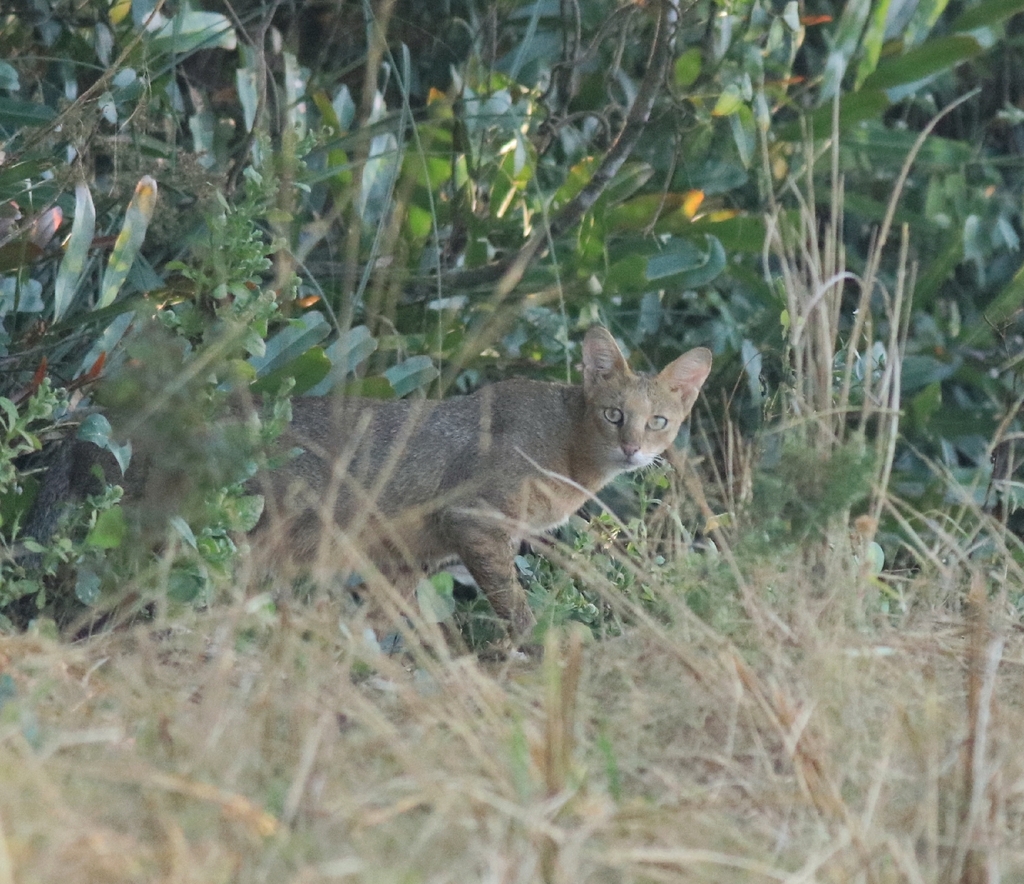
Jungle Cat
Photo © Afsar Nayakkan
Photo © Afsar Nayakkan — CC BY 4.0 — Source: iNaturalist #369662633Identification
The jungle cat is a medium-sized felid with uniformly coloured fur ranging from sandy and reddish-brown to grey, and notably lacking spots or markings. Melanistic and albino individuals are also known to occur. The species has prominent ears that aid in locating prey, and an overall build adapted to wetland habitats.
Range & Habitat
Native to the Eastern Mediterranean region and the Caucasus, the jungle cat's range extends through Central, South and Southeast Asia. It is primarily a wetland specialist, inhabiting swamps, littoral zones, and riparian areas characterised by dense vegetation. This preference for water-associated habitats has earned it the alternative names of reed cat and swamp cat.
Behaviour & Diet
Jungle cats are solitary animals except during the breeding season and while mothers care for kittens. Adults maintain territories through urine spraying and scent marking. They hunt small mammals and birds using a stalk-and-pounce strategy, with their sensitive ears helping to pinpoint prey location. Both sexes reach sexual maturity at around one year of age. Females enter oestrus between January and March, and after a gestation of nearly two months, kittens are born between December and June (timing varies geographically). Young cats begin hunting at approximately six months and become independent after eight to nine months.
Best Time & Places to See It
Jungle cats are most active in wetland areas with dense vegetation cover. Their preference for reed beds, swamps and riparian corridors makes them secretive and challenging to observe. Patience and familiarity with local wetland habitats offer the best chances of encounters. Dawn and dusk periods may increase sighting possibilities.
Photography Tips
Photographing jungle cats requires a cautious approach given their solitary and elusive nature. Use telephoto lenses to maintain distance from these wary animals. Their uniform colouration can make them blend into reed beds and marshy vegetation, so look for movement rather than distinctive markings. Overcast light is often preferable to harsh sunlight in wetland environments, helping to reduce harsh shadows while capturing the subtle tones of their fur.
Nothing matches these filters.
Kanha Tiger Reserve
Bandhavgarh National Park
Banke National Park
Bardiya National Park
Chitwan National Park
Keoladeo National Park
National Chambal Sanctuary
Panna National Park
Ranthambhore National Park
Nothing matches these filters.
No community photos yet. Log in to add the first one.
No community observations of this species yet.