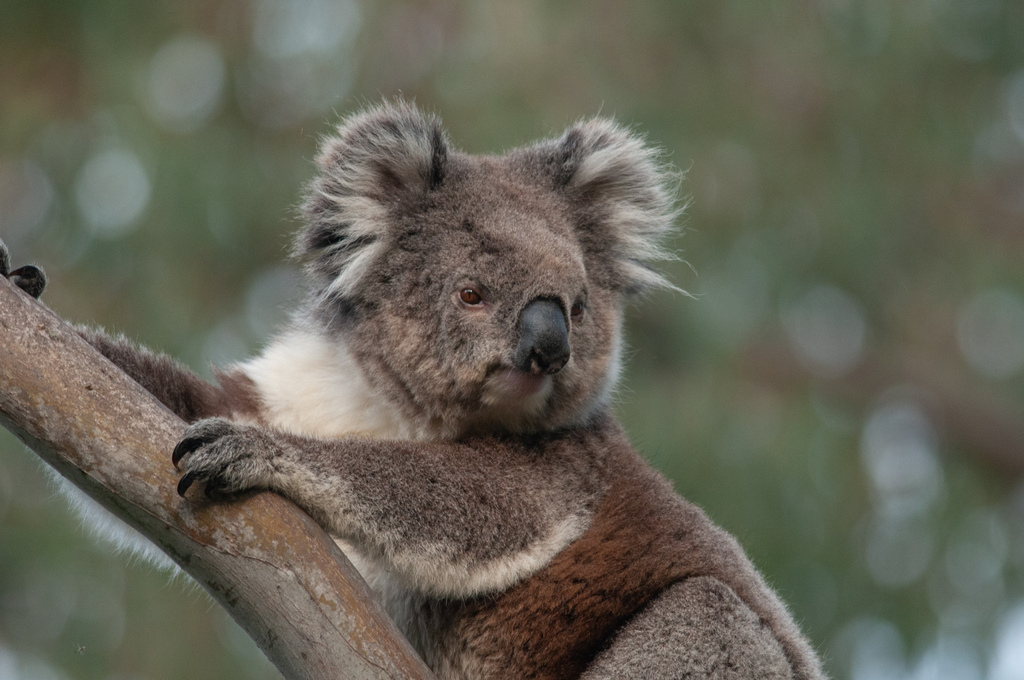
Koala
Photo © Rolf Lawrenz
Photo © Rolf Lawrenz — CC BY 4.0 — Source: iNaturalist photo #336287871Identification
The koala is instantly recognisable by its distinctive stout, tailless body and large head featuring round, fluffy ears and a prominent dark nose. Despite the common misnomer "koala bear," this arboreal marsupial is not a bear at all, but the sole living member of the family Phascolarctidae—its closest living relatives are actually wombats. Adults measure 60–85 cm in body length and weigh between 4–15 kg, making them relatively compact creatures perfectly adapted to tree life. Their thick fur ranges from silver grey to chocolate brown, with northern populations typically displaying smaller stature and lighter colouration than their southern counterparts.
Range & Habitat
Koalas are found exclusively along the eastern and southern coastal regions of Australia, inhabiting Queensland, New South Wales, Victoria, and South Australia. They favour open Eucalyptus woodlands, where they spend virtually their entire lives among the branches. This specialised habitat preference reflects their highly specialised diet: eucalypt leaves form the bulk of their food, despite being notoriously low in nutrition and calories, and containing toxic compounds that deter most other mammals from eating them.
Behaviour & Diet
Koalas are remarkably sedentary creatures, sleeping up to twenty hours daily as an adaptation to their low-energy diet. They are asocial animals with minimal social bonds; mothers care for their dependent young, but adults otherwise avoid contact. Male koalas communicate through distinctive bellows that serve to intimidate rivals and attract mates, while also marking their presence with secretions from scent glands on their chests. Like all marsupials, koalas give birth to highly underdeveloped young called joeys, which spend their first six to seven months in their mother's pouch before being fully weaned around one year of age.
Best Time & Places to See It
Koalas inhabit Queensland, New South Wales, Victoria, and South Australia, with varying population densities across these regions. While they have few natural predators, koala populations face significant conservation challenges and are listed as vulnerable by international standards. In 2022, the species was officially classified as endangered in Queensland, New South Wales, and the Australian Capital Territory, though populations remain over-abundant in parts of South Australia and Victoria. Travellers should research current population status and protected areas in their chosen region before planning visits.
Photography Tips
The koala's distinctive appearance—those characteristic round ears, dark nose, and compact body—makes it a photogenic subject. Their largely stationary nature and preference for perching in trees mean patient photographers can position themselves to capture compelling portraits with good natural light. Early morning or late afternoon light works well for highlighting their thick fur texture. Since koalas are most active during cooler parts of the day and spend the majority of their time resting, timing your photography to periods of movement or alertness will increase chances of capturing engaging behaviour rather than sleeping poses.
Eastern Australia
Nothing matches these filters.
Bald Rock National Park
Barrington Tops National Park
Belair National Park
Blue Mountains National Park
Bribie Island National Park
Budj Bim National Park
Carnarvon National Park
Chiltern-Mt Pilot National Park
Cleland National Park
Nothing matches these filters.
No community photos yet. Log in to add the first one.
No community observations of this species yet.