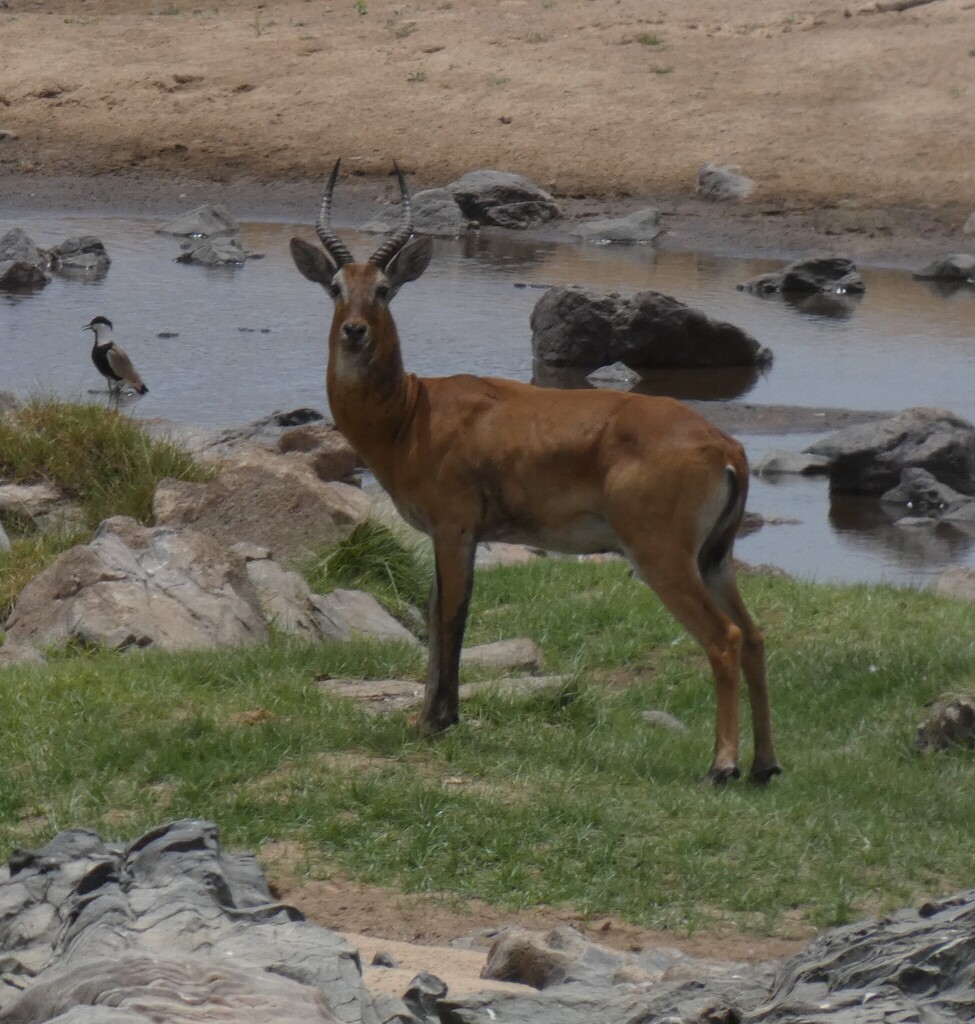
Kob
Photo © agujaceratops
Photo © agujaceratops — CC BY 4.0 — Source: iNaturalist #267474584Identification
The kob is a sturdy antelope more heavily built than the similar impala, with distinctive coloring and sexual dimorphism. Males stand 90–100 cm at the shoulder and weigh around 94 kg, while females are noticeably smaller at 82–92 cm and 63 kg. Both sexes display golden to reddish-brown pelage with white throat patches, eye rings, and inner ears, while the front of the forelegs are black. Males darken with age and carry prominent horns; females lack horns. The white-eared kob subspecies of South Sudan is strikingly different, with overall dark coloring similar to male Nile lechwe but retaining a white throat. All kob possess well-developed inguinal and preorbital glands that secrete yellow, waxy secretions.
Range & Habitat
Kob are found across Central Africa and parts of West and East Africa, with populations in Uganda, South Sudan, Democratic Republic of the Congo, and numerous West African countries including Senegal, Mali, and Nigeria. They inhabit flat, open country close to permanent water sources, favoring wet areas such as floodplains and grassy marshes. Daily water consumption is essential, and they require fresh grazing; consequently, they do not venture far into arid regions. During seasonal changes, kob move between pastures, sometimes traveling hundreds of kilometers across flooded areas or walking 10+ km during dry seasons to reach water.
Behaviour & Diet
Kob are diurnal but become inactive during the hottest hours of the day. They are highly social grazers feeding on specific grass species including Hyparrhenia, Brachiaria brizantha, and Setaria gayanus. Social organization is flexible and remarkably complex: females live in herds that can number in the thousands and are highly mobile, learning migration routes from their mothers. Males exhibit two distinct strategies—some establish conventional territories in suitable habitat, while others in high-density floodplain areas form leks, clustered territories on short grass patches with little inherent value. Lek-holding males compete intensely for brief tenure in central positions, with dominant males monopolizing mating. Territorial disputes are usually settled through ritualized displays rather than fighting, though serious injuries can occur when territory control is contested.
Best Time & Places to See It
Kob are readily observed in Uganda's Murchison Falls and Queen Elizabeth National Parks, as well as in Garamba and Virunga National Parks in the Democratic Republic of the Congo. The grassy floodplains of South Sudan also support significant populations. The Ugandan kob subspecies is so culturally significant it appears on Uganda's coat of arms. White-eared kob undertake large-scale migrations in South Sudan, southwest Ethiopia, and extreme northeast Uganda, offering spectacular viewing opportunities during seasonal movements.
Photography Tips
The kob's striking contrast of golden-brown body, white throat patches, and black forelegs provides excellent photographic subjects, particularly when males are captured in their characteristic erect posture used in territorial displays. The lek formations create unique opportunities to photograph multiple individuals interacting on open grassland. Early morning and late afternoon sessions will avoid the midday heat when kob are inactive. Capturing females leading herds toward water, or documenting the ritualized horn clashes between males, offers compelling behavioral imagery. The white-eared kob's darker coloration requires different exposure settings than the typical golden kob.
Murchison Falls National Park
Queen Elizabeth National Park
Kidepo Valley National Park
Niokolo-Koba National Park
Toro-Semliki Proposed National Park
Virunga National Park
Ziwa Rhino and Wildlife Ranch
Nothing matches these filters.
No community photos yet. Log in to add the first one.