Kuban Tur
Photo © Марат Адиев
Photo © Марат Адиев — CC BY 4.0 — Source: iNaturalist #314957949Identification
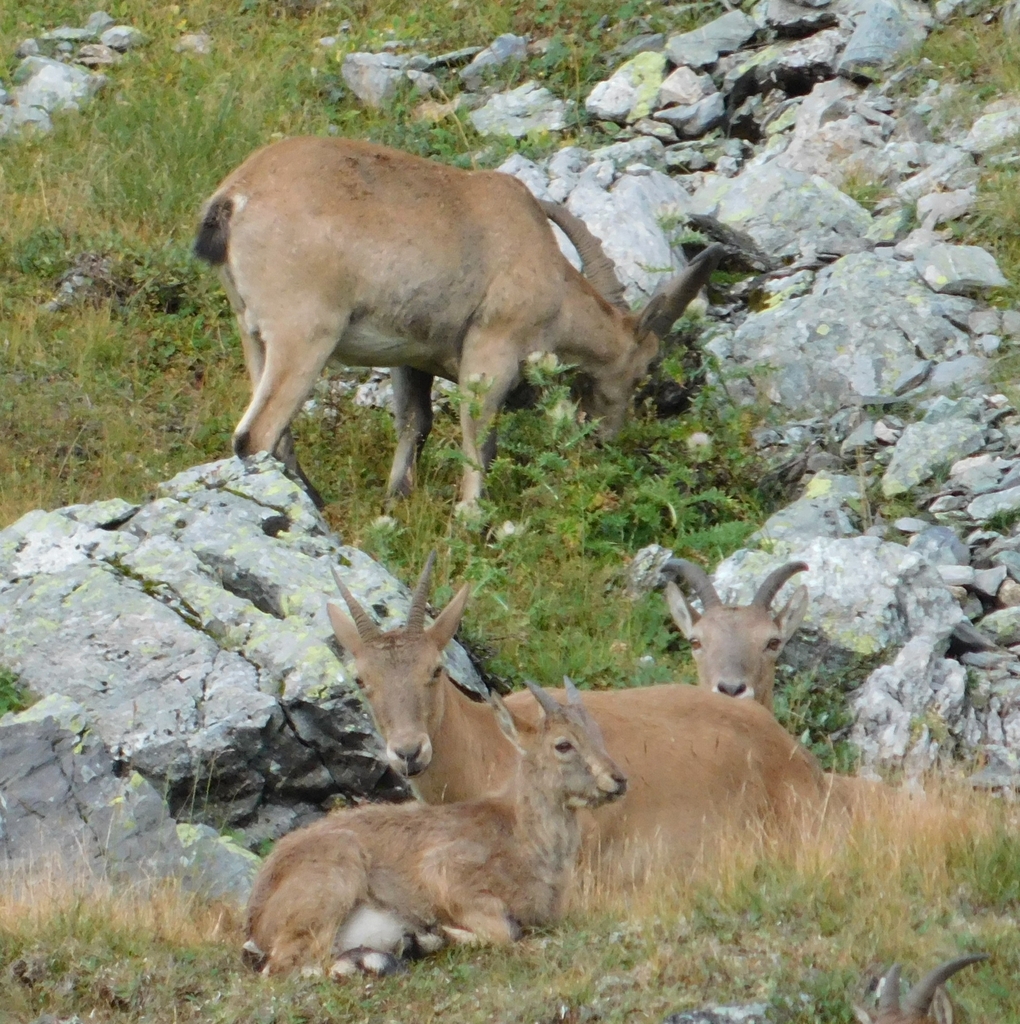
The Kuban Tur, also known as the West Caucasian tur, zebuder, zac, or Caucasian ibex, is a distinctive mountain goat-antelope built for life on steep terrain. These animals stand up to 1 metre tall at the shoulder and weigh around 65 kg, with characteristically large but narrow bodies and short, sturdy legs. Their coat is chestnut with a contrasting yellow underbelly and darker legs, providing excellent camouflage in rocky alpine terrain.
The most striking feature is their scimitar-shaped horns, which are heavily ridged and distinctive in profile. Sexual dimorphism is pronounced: males carry horns around 70 cm long that curve dramatically backward, while females have much smaller horns. Males are also noticeably larger overall than females, making sex identification straightforward in the field.
Range & Habitat
The Kuban Tur is endemic to the western half of the Caucasus Mountains, with populations found in Georgia and European Russia. Their current range covers approximately 4,500 square kilometres, though this represents a dramatic contraction from historical times—they once ranged as far as southern France during the Pleistocene. These animals now occupy the high alpine zone, living in rough mountainous terrain between 800 and 4,000 metres above sea level.
Their upward retreat to these high altitudes is a relatively recent phenomenon, forced by human activity and climate change over the past century. In their mountain strongholds, they inhabit rocky terrain where they feed mainly on grasses and leaves, exploiting the sparse vegetation of the alpine environment.
Behaviour & Diet
The Kuban Tur is strictly nocturnal, grazing openly during the night hours and retreating to shelter during daylight—an adaptation that helps them avoid both predators and the heat of exposed alpine terrain. They are highly social, living in herds that vary seasonally: groups of around ten individuals gather in summer, but these expand to approximately twenty animals during the harsh winter months, likely for improved vigilance and thermal efficiency.
The mating season runs from November to January, with kids born from May through July. These turs face predation from steppe wolves and lynxes, with Persian leopards and Syrian brown bears representing potential additional threats. Humans pose significant challenges: hunting is legal in Russia from August to November, though they are fully protected in Georgia. Poaching for meat, skin, and horns—which are crafted into traditional drinking vessels called Kantsi—remains a problem, and many individuals perish in avalanches each year.
Best Time & Places to See It
The Kuban Tur is listed as Endangered on the IUCN Red List, with the wild population estimated at only 3,000 to 4,000 individuals. This precarious status and their nocturnal habits make them challenging to observe. The mating season from November to January may offer increased daytime activity and visibility. Their preference for Georgia and the Russian Caucasus high mountains means that access and sightings depend heavily on local conditions and protected area regulations.
Viewing opportunities are limited by their remote alpine habitat, nocturnal behaviour, and protective legislation in some regions. Serious wildlife enthusiasts should seek guidance from local conservation authorities or specialist mountain guides familiar with current populations and seasonal movement patterns.
Photography Tips
Photographing the Kuban Tur demands patience, early morning preparation, and high-altitude fitness. Since these animals are nocturnal and shelter during daylight, positioning yourself on steep terrain at dawn with a clear view of rocky outcrops and alpine meadows offers the best chance of locating them. Their dark chestnut coat blends remarkably well with shadowed rock and scrub, so scan carefully across cliff faces and scree slopes.
A telephoto lens (at least 200–400 mm) is essential, as these wary animals will not tolerate close approach in their exposed habitat. The dramatic landscape of the Caucasus high peaks provides stunning compositional opportunities: position turs against distant mountains or dramatic morning light to emphasize their silhouette and impressive horns. Overcast conditions often suit mountain wildlife photography, softening harsh alpine light and revealing more detail in their chestnut coat.
No community photos yet. Log in to add the first one.
No community observations of this species yet.