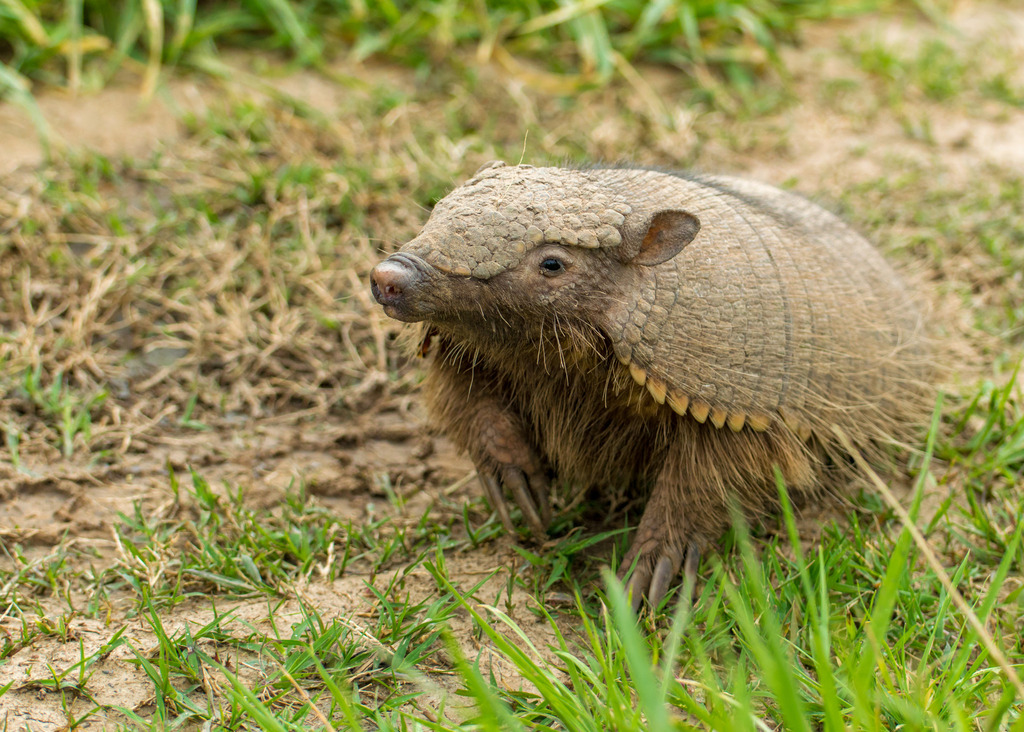
Large Hairy Armadillo
Photo © Facundo Chieffo
Photo © Facundo Chieffo — CC BY 4.0 — Source: iNaturalist photo #288913767Identification
The large hairy armadillo is one of South America's largest and most abundant armadillos. Adults typically measure 26–34 cm in body length and weigh around 2 kg at maturity, though individuals can range up to 40 cm and 3 kg. Its most distinctive feature is the dense covering of long, coarse hair projecting from its bony plates—far hairier than any related species—particularly on its underside. The head and back are protected by thin, bony plates, with flexible bands along the torso providing mobility. Powerful front claws are prominently visible. The tail measures 9–17 cm long.
Range & Habitat
This species inhabits the southern portion of South America, with a continuous range spanning Argentina, Bolivia, and Paraguay. In Argentina, it extends from the Pampas south to Santa Cruz Province in Patagonia, and has been introduced to Tierra del Fuego Island. It thrives from sea level to altitudes of 1,300 metres, occupying grasslands, forests, savannahs, and increasingly agricultural areas. The large hairy armadillo is an accomplished digger that spends most of its time underground, constructing both temporary and long-term burrows depending on food availability.
Behaviour & Diet
This armadillo reaches sexual maturity at around 9 months and can live over 30 years in captivity. Its powerful front claws serve dual purposes: foraging and predator defence. A specialised adaptation in the nose allows it to extract oxygen from soil particles without inhaling soil itself. Though routinely harvested for meat and shell, and sometimes killed by farmers, the species has demonstrated remarkable resilience and populations appear stable. It is frequently used in laboratory research due to its adaptability and hardiness under stress.
Best Time & Places to See It
The large hairy armadillo is found across much of southern South America and inhabits numerous protected areas, though no specific protective practices currently target this species. Its fossils originate from the Pampean region, suggesting this as its evolutionary homeland. Look for this species in suitable habitat across Argentina, Bolivia, and Paraguay, where it can be encountered in grasslands, forests, and savannahs.
Photography Tips
Photographing this species presents challenges due to its largely subterranean lifestyle and nocturnal or crepuscular habits. Focus on capturing the distinctive hirsute appearance—the long, coarse guard hairs projecting from the bony carapace are a key identifying feature. Close-up shots of the head plate and flexible bands reveal the species' remarkable armour. Early morning or late afternoon sessions in suitable grassland or savannah habitat offer the best opportunities. Patience is essential, as this accomplished digger spends most of its time below ground.
Campos del Tuyú National Park
Cerro Castillo National Park
Parque Provincial Península de Magallanes
Patagonia National Park
Torres del Paine National Park
Nothing matches these filters.
No community photos yet. Log in to add the first one.
No community observations of this species yet.