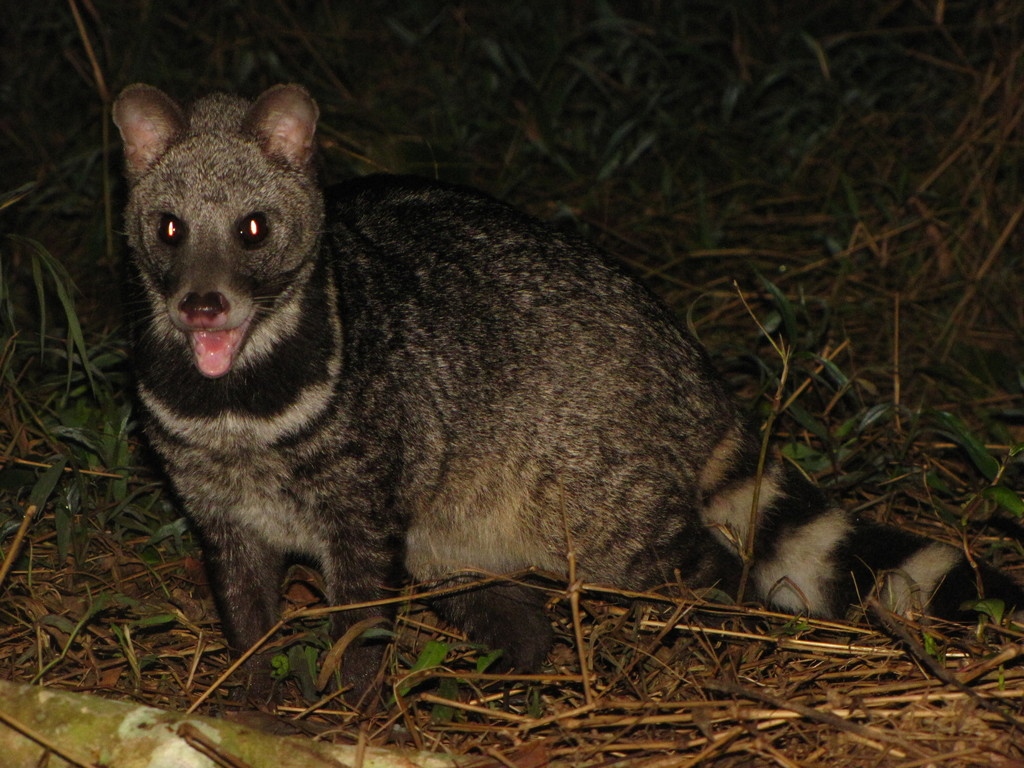
Large Indian Civet
Photo © Rohit Naniwadekar
Photo © Rohit Naniwadekar — CC BY 4.0 — Source: iNaturalist #29769067Identification
The large Indian civet is a stocky, cat-like carnivore with distinctive grey or tawny fur marked by a bold black spinal stripe running from behind the shoulders to the tail's base. The face features a whitish patch on the muzzle front, contrasted by blackish patches on either side, while the chin and fore throat are dark. The neck displays striking black and white banding on its sides and lower surface. The tail is ringed with variable numbers of black and white bands, and the animal possesses retractable claws and characteristically hairy foot soles.
As its name suggests, this is the largest of the Viverra genus civets, exceeded in size among the entire Viverridae family only by African civets and binturongs. Head-and-body length ranges from 50–95 cm with a 38–59 cm tail, and weight typically ranges from 3.4–9.2 kg, though some sources report weights up to 11 kg.
Range & Habitat
The large Indian civet is native to South and Southeast Asia, with a range extending from Nepal, northeast India, Bhutan, and Bangladesh eastward through Myanmar, Thailand, the Malay Peninsula, and Singapore to Cambodia, Laos, Vietnam, and China. In Nepal, it has been recorded at elevations up to 2,250 metres in the Himalayas, demonstrating considerable altitude tolerance.
The species has experienced dramatic population declines in parts of its range. In China particularly, wild populations fell by 94–99% since the 1950s due to deforestation, hunting for the fur trade, and exploitation of its musk glands for traditional medicine and the perfume industry. By the 1990s, it was largely confined to northern Guangdong Province in southern China.
Behaviour & Diet
The large Indian civet is solitary and strictly nocturnal, spending most of its time on the ground. Radio-tracked individuals in Thailand displayed home ranges of 2.7 to 8.8 square kilometres, indicating a moderately mobile lifestyle within defined territories.
As an opportunistic hunter, it preys on a wide variety of small animals, making it an adaptable predator capable of exploiting whatever prey is available within its habitat. This dietary flexibility has likely aided its survival across diverse environments throughout its range.
Best Time & Places to See It
Given the large Indian civet's nocturnal habits and declining populations across much of its range, encounters are challenging but possible in well-preserved forest habitats throughout Southeast Asia, particularly in Myanmar, Thailand, Laos, and Cambodia. Night surveys in suitable lowland and hill forest areas offer the best opportunities, though sightings remain uncommon.
The species is now largely or entirely extirpated from Hong Kong and has not been recorded in Hainan Island during recent surveys, making these former strongholds no longer viable destinations for viewing. Conservation status varies across its range, with populations healthier in less disturbed Southeast Asian regions than in China and parts of South Asia.
Photography Tips
Photographing large Indian civets presents considerable challenges owing to their nocturnal, solitary nature and ground-dwelling habits. Night photography equipment, including infrared camera traps or headlamps with red-light filters, is essential for capturing images without disturbing the animal. Patient, long-term field presence in appropriate habitat offers the best chance of successful documentation.
Focus on capturing the animal's distinctive markings: the black spinal stripe, facial patches, and neck banding are key identification features that make compelling subjects. The animal's ringed tail and low-slung posture as it moves across the forest floor offer additional compositional opportunities for wildlife photographers willing to invest time in nocturnal fieldwork.
Khao Yai National Park
Prachantakham District, Thailand
+377 birds+46 mammals
Evergreen dipterocarp forest blankets the rolling terrain of this national park in eastern Thailand, where limestone hills rise abruptly from the forest floor and seasonal streams…
VIEW NATIONAL PARKKaziranga National Park
Kohora, India
+422 birds+26 mammals
Dawn breaks over the floodplains of the Brahmaputra, where tall grasslands stretch endlessly beneath monsoon-heavy skies. This sprawling wilderness of northeastern Assam is a mosaic of…
VIEW NATIONAL PARKTaman Negara National Park
Kampong Samas, Malaysia
+393 birds+48 mammals
Where ancient rainforest meets limestone peaks, one of Southeast Asia's oldest protected wilderness preserves sprawls across 4,343 square kilometers of primordial landscape. Dipterocarp giants tower overhead,…
VIEW NATIONAL PARKNo community photos yet. Log in to add the first one.
No community observations of this species yet.