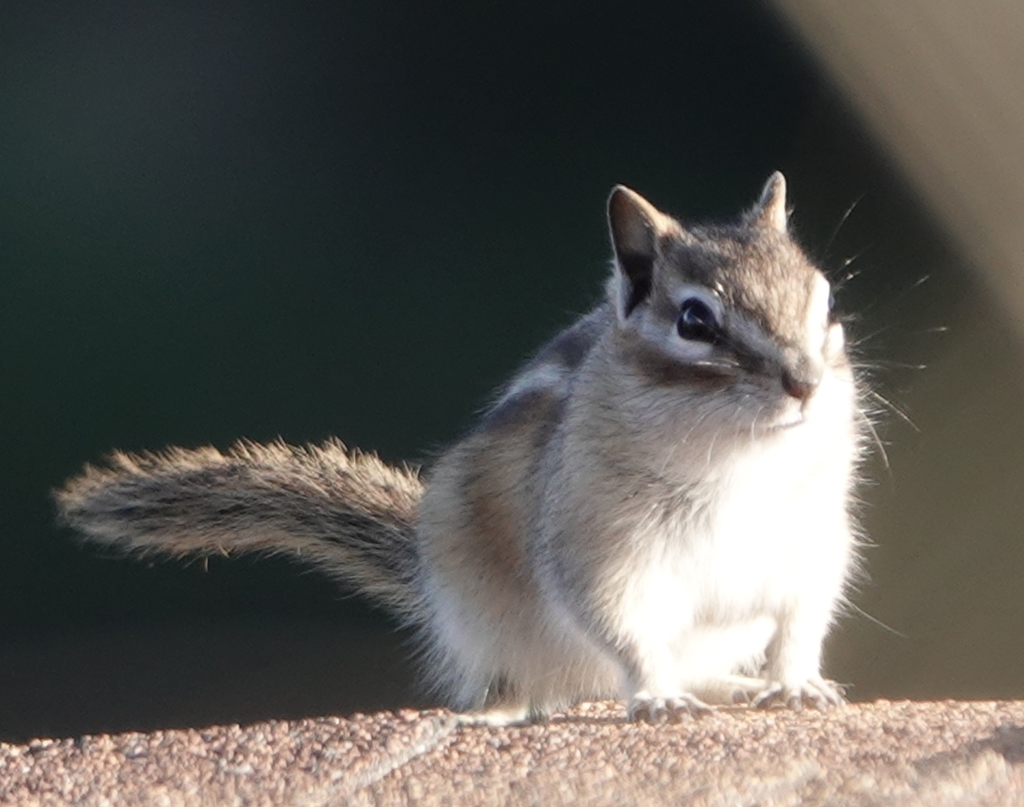
Least Chipmunk
Photo © Colin Croft
Photo © Colin Croft — CC BY 4.0 — Source: iNaturalist #34947233Identification
The least chipmunk is North America's smallest chipmunk species, measuring just 15.7–25 cm in total length and weighing a mere 25–66 grams. Its compact body is gray to reddish-brown on the sides with grayish-white underparts. The most distinctive feature is the striking striped pattern: five dark brown to black stripes separated by four white or cream-colored stripes run the length of the back from neck to tail base. The face is similarly marked with two light and two dark stripes running from the nose tip to the ears. The bushy, orange-brown tail is proportionally short at 10–11 cm long. Like all chipmunks, it has four toes on the forefeet and five on the hindfeet.
In regions where the least chipmunk's range overlaps with the yellow-pine chipmunk, field identification can be challenging or impossible, sometimes requiring laboratory examination of skeletal structures to distinguish between the two species with certainty.
Range & Habitat
The least chipmunk is the most widespread chipmunk across North America, ranging through most of the western United States from northern New Mexico and western North and South Dakota to eastern California, Oregon, and Washington. Its distribution extends throughout much of southern and western Canada from Yukon and southeastern British Columbia to central Ontario, and into the Upper Peninsula of Michigan and neighboring parts of Wisconsin and Minnesota.
Less arboreal than other chipmunk species, the least chipmunk favors sagebrush habitats and coniferous woodlands, and is commonly found along rivers. It also inhabits alpine meadows and the edges of northern tundra, demonstrating remarkable adaptability across diverse environments.
Behaviour & Diet
Active during daylight hours, least chipmunks forage for seeds, berries, nuts, fruits, and insects. They are remarkably agile, capable of running up to 7.7 km/h in natural conditions. These animals exhibit a clever behavior: they mark food-depleted areas with urine and avoid returning to them. Home ranges vary substantially across their distribution, from as little as 0.1 hectares in northern Michigan to 5.5 hectares in Colorado. Despite their diminutive size making them subordinate to larger yellow-pine chipmunks when food is abundant, least chipmunks thrive in resource-scarce environments where their lower food requirements provide an advantage.
Rather than hibernating, least chipmunks survive winters by entering prolonged torpor in their burrows, periodically waking to consume cached food. Burrows are modest structures with a single chamber about 15 cm across, tunnels 7.5 cm in diameter, typically extending 1.7 meters in length with two to four entrances concealed near rocks and situated about 18 cm below the surface. They also construct temporary summer nests in trees or occupy woodpecker cavities. Hawks, owls, and mustelids are their primary predators.
Best Time & Places to See It
Least chipmunks are diurnal and most active during daylight hours, making them reliably observable when searching appropriate habitat. They emerge from burrows in spring when mating occurs between March and May, and are active through summer and fall before retreating into extended torpor. The timing of winter dormancy varies by latitude: in Michigan they withdraw from late November to mid-March, while in northern Manitoba this period extends from mid-October to late April.
Look for least chipmunks in sagebrush areas, coniferous woodlands, and along riverbanks throughout the western United States and Canada. Their presence in alpine meadows and tundra edges offers opportunities across varied landscapes and elevations.
Photography Tips
The least chipmunk's diminutive size and rapid movements present both challenges and opportunities for photographers. Their agility and speeds up to 7.7 km/h demand fast shutter speeds to freeze action. Their diurnal activity provides good natural lighting conditions, but photographing them in sagebrush or woodland habitats may require patience to capture clear shots with suitable backgrounds. Early morning and late afternoon light will enhance the contrast of their striking dorsal stripes and the orange-brown tones of their bushy tail.
When photographing in areas where least chipmunks and yellow-pine chipmunks coexist, document identifying features carefully—the small size and stripe pattern are your best clues. Their tendency to mark and avoid depleted food patches suggests setting up observations in well-vegetated areas where resources are adequate, increasing encounter likelihood.
Kootenay National Park
Area G (Forster Creek/Mount Assiniboine), Canada
+181 birds+23 mammals
Where the spine of the Canadian Rockies rises above 3,000 metres, the high alpine realm around Forster Creek and Mount Assiniboine reveals one of the continent's…
VIEW NATIONAL PARKBanff National Park
Improvement District No. 9, Canada
+264 birds+33 mammals
Where the Canadian Rockies thrust skyward in a cathedral of limestone and ice, Banff National Park preserves a wilderness of astounding vertical drama. Glacier-carved valleys cradle…
VIEW NATIONAL PARKJasper National Park
Improvement District No. 12, Canada
+235 birds+34 mammals
Where the Canadian Rockies rise in dramatic succession across western Alberta, Jasper National Park spans over 11,000 square kilometres of subalpine and alpine terrain, glaciated valleys,…
VIEW NATIONAL PARKVoyageurs National Park
Northwest Saint Louis, United States
+198 birds+13 mammals
Where the boreal forest meets the glacially sculpted lakes of northwestern Minnesota, Voyageurs National Park sprawls across nearly two thousand square kilometres of a landscape shaped…
VIEW NATIONAL PARKLassen Volcanic National Park
Shasta County, United States
+239 birds+18 mammals
Volcanic peaks and geothermal upheaval have sculpted 545 square kilometers of Northern California into a landscape where fire and water engage in perpetual dialogue. Lassen Peak…
VIEW NATIONAL PARKZion National Park
Washington County, United States
+244 birds+30 mammals
Towering sandstone cliffs in shades of crimson, rust, and cream rise abruptly from the Virgin River's winding canyon floor, their sculpted faces bearing witness to millions…
VIEW NATIONAL PARKGreat Sand Dunes National Park
Saguache County, United States
+193 birds+14 mammals
Where the Colorado high plains collide with one of North America's most extraordinary geological anomalies, nearly 600 square kilometres of windswept sand rise abruptly from the…
VIEW NATIONAL PARKYosemite National Park
Mariposa County, United States
+224 birds+28 mammals
Granite cliffs soar nearly a kilometer above the valley floor in this expanse of high Sierra wilderness, where glacial U-shaped valleys sculpt a landscape of dramatic…
VIEW NATIONAL PARKGrand Teton National Park
Teton County, United States
+247 birds+38 mammals
Where the Teton Range tears skyward in a dramatic escarpment above the Snake River valley, nearly 2,550 square kilometers of montane wilderness unfolds across Teton County,…
VIEW NATIONAL PARKYellowstone National Park
Park County, United States
+253 birds+43 mammals
Across nearly 11,400 square kilometres of the Rocky Mountain plateau, geothermal fury and pristine wilderness converge in one of Earth's most dynamic landscapes. Hot springs, geysers…
VIEW NATIONAL PARKCrater Lake National Park
Klamath County, United States
+174 birds+13 mammals
At 1,949 metres above sea level, a volcanic caldera of impossible clarity holds one of North America's deepest and most pristine alpine lakes, ringed by pumice-and-ash…
VIEW NATIONAL PARKBlack Canyon of the Gunnison National Park
Montrose County, United States
+169 birds+13 mammals
Where the Gunnison River has carved one of North America's steepest and most dramatic canyons, ancient metamorphic rock walls plunge nearly 2,000 feet in places, creating…
VIEW NATIONAL PARKRocky Mountain National Park
Larimer County, United States
+259 birds+33 mammals
Where granite peaks rise above 12,000 feet and alpine tundra gives way to subalpine forest, Rocky Mountain National Park spans the Continental Divide across nearly 1,600…
VIEW NATIONAL PARKWaterton Lakes National Park
Improvement District No. 04, Canada
+252 birds+31 mammals
Where the Continental Divide plunges toward the prairies of Alberta, glacier-carved valleys and emerald lakes pierce a landscape where montane forest meets alpine tundra. Waterton Lakes…
VIEW NATIONAL PARKYoho National Park
Area A (Kicking Horse/Kinbasket Lake), Canada
+207 birds+19 mammals
Where the Canadian Rockies meet the Columbia River watershed, a vast wilderness of 2,211 square kilometres unfolds across Yoho National Park in British Columbia. The landscape…
VIEW NATIONAL PARKKluane National Park and Reserve
Canada
+171 birds+17 mammals
Where granite peaks thrust through boreal forest to touch the sky, Kluane National Park and Reserve sprawls across southwestern Yukon as one of North America's most…
VIEW NATIONAL PARKBadlands National Park
Wall, United States
+200 birds+14 mammals
Eroded badlands rise in jagged formations across northwestern South Dakota, where the White River has carved deep canyons through layers of sedimentary rock spanning millions of…
VIEW NATIONAL PARKBryce Canyon National Park
Tropic, United States
+202 birds+20 mammals
Hoodoos rise like a forest of stone pillars from an amphitheater carved into Utah's high plateau, where the Paunsaugunt elevates the landscape to over 9,000 feet…
VIEW NATIONAL PARKGlacier National Park
United States
+246 birds+39 mammals
Where jagged peaks pierce a subarctic sky and glacial valleys carve through ancient rock, Glacier National Park spans the spine of the Northern Rockies along Montana's…
VIEW NATIONAL PARKGrand Canyon National Park
United States
+277 birds+35 mammals
A mile-deep chasm of rust-red rock and purple shadow cuts through the high desert plateau of northern Arizona, revealing nearly two billion years of geological history…
VIEW NATIONAL PARKWind Cave National Park
Custer County, United States
+175 birds+13 mammals
Beneath the rolling prairie of the Black Hills, a network of passages carved through limestone creates one of North America's most extensive cave systems. Wind Cave…
VIEW NATIONAL PARKMalheur National Wildlife Refuge
Harney County, United States
+309 birds+24 mammals
Across the high desert plateau of southeastern Oregon, where sagebrush scrubland stretches toward distant ridgelines under an enormous sky, lies a sanctuary shaped by water in…
VIEW WILDLIFE SANCTUARYSeedskadee National Wildlife Refuge
Sweetwater County, United States
+209 birds+8 mammals
Where the Green River carves through the high-desert basin of southwestern Wyoming, Seedskadee National Wildlife Sanctuary preserves one of the West's most vital riparian corridors. The…
VIEW WILDLIFE SANCTUARYNational Elk Refuge
Jackson, United States
+230 birds+27 mammals
Where the sagebrush flats of northwestern Wyoming rise toward the Gros Ventre Mountains, winter transforms the landscape into a realm of survival and spectacle. The National…
VIEW WILDLIFE SANCTUARYNo community photos yet. Log in to add the first one.
No community observations of this species yet.