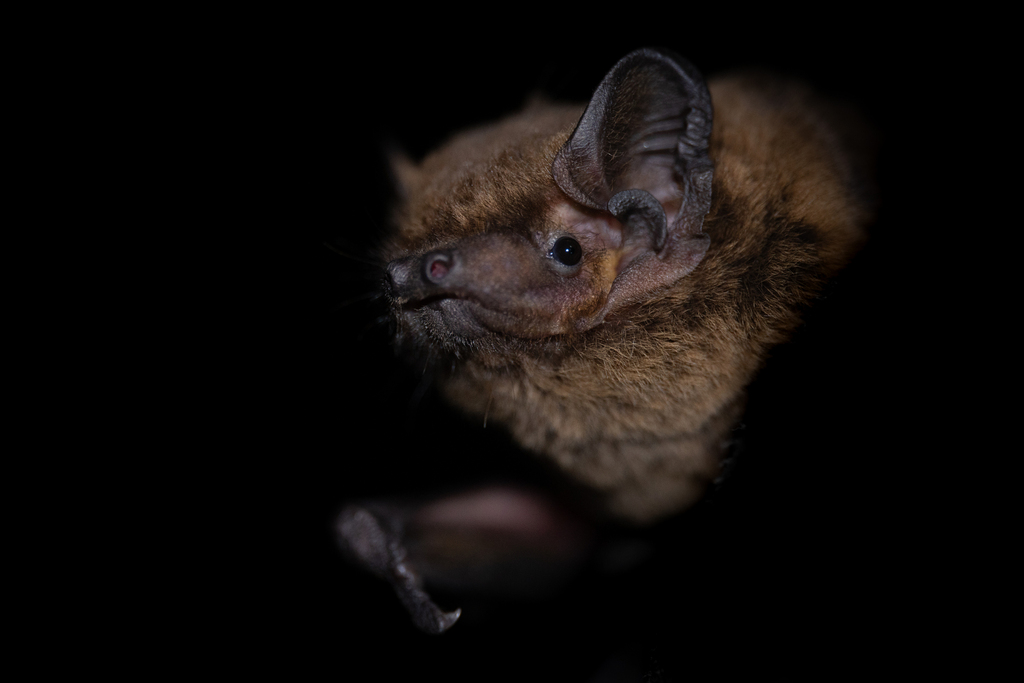
Leisler’s Noctule
Photo © Sylvain Eichhorn
Photo © Sylvain Eichhorn — CC BY 4.0 — Source: iNaturalist photo #536697905Identification
Leisler's noctule is a medium-sized insectivorous bat, slightly smaller than the common noctule, with a head and body length of 48 to 68 mm and a wingspan of 260 to 330 mm. It weighs between 11 and 20 grams. The species is characterized by its dark face, ears, and wings, combined with brown fur that is notably darker at the base than at the tip—a useful distinction from the common noctule, whose fur is uniform in colour throughout. The undersides of its arms are distinctively hairy, earning it the alternative name "hairy-armed bat." Look for short, rounded ears with a distinctive mushroom-shaped tragus, and notably long, narrow wings that give the bat its swift, agile flight profile.
Range & Habitat
This species is found locally across Europe and western Asia, ranging eastwards to the Urals and Himalayas, and also occurs in north-west Africa, the Canary Islands, and Madeira. The bat typically inhabits forests—both coniferous and deciduous—but has successfully adapted to parkland and urban areas, frequently roosting in buildings. Leisler's noctule is rare across most of its range, with one notable exception: Ireland, where it is much more common and represents the island's largest and third most abundant bat species. Ireland is considered the species' global stronghold.
Behaviour & Diet
Leisler's noctule emerges soon after sunset to hunt flying insects, particularly moths and beetles. It flies in a characteristically straight and fast manner with shallow dives, often at treetop level. The species is especially active around dusk and dawn and will travel up to 10 km while foraging. Interestingly, it sometimes feeds around streetlights, taking advantage of the insects attracted to artificial light sources. Breeding typically occurs in small colonies of around 20 to 50 individuals, though Irish colonies can be significantly larger, with some numbering as many as 1,000 bats. Females usually give birth to one or two young, with twins being more common in the eastern parts of its range.
Best Time & Places to See It
Ireland is your best destination for reliably encountering Leisler's noctule, where it is far more common than elsewhere in its range. The bat is most active around dusk and dawn, so plan your wildlife watching during these twilight hours. Look for it emerging from hollow trees or buildings where colonies roost. Observing the species around streetlights in woodland areas or parkland may also prove rewarding, as it actively hunts insects attracted to artificial light.
Photography Tips
Photographing Leisler's noctule presents the typical challenges of bat photography: rapid flight and low-light conditions. Focus on dusk and dawn when light levels are slightly better and the bat is most active. Fast shutter speeds are essential to freeze the swift, straight flight pattern. If the bat feeds around streetlights, position yourself nearby with high ISO settings and a fast lens. The distinctive hairy undersides of the arms and the mushroom-shaped tragus are useful field marks worth capturing if possible, though the bat's speed will demand patience and multiple shooting attempts.
Picos de Europa National Park
Posada de Valdeón, Spain
+166 birds+26 mammals
Where limestone massifs rise abruptly from the Castilian plateau, the Picos de Europa create one of Spain's most dramatic mountain wilderness areas. The park's jagged peaks,…
VIEW NATIONAL PARKSouth Downs National Park
Chichester, United Kingdom
+298 birds+45 mammals
Chalk downland ridges rise and fall across the South Downs, their open grasslands and beech hangers creating a mosaic of habitats that has shaped human settlement…
VIEW NATIONAL PARKCévennes National Park
Vebron, France
+187 birds+63 mammals
Where granite gorges slice through the limestone plateaux of southern France, the Cévennes Cœur National Park unfolds across nearly 3,500 square kilometres of one of Europe's…
VIEW NATIONAL PARKMercantour National Park
Isola, France
+146 birds+32 mammals
Where alpine meadows surrender to vertiginous limestone cliffs, the Mercantour's beating heart pulses with Mediterranean and Alpine rhythms. This 4,221-square-kilometre sanctuary straddles France's southeastern border, its…
VIEW NATIONAL PARKÉcrins National Park
La Chapelle-en-Valgaudémar, France
+143 birds+36 mammals
Where granite peaks and Alpine meadows converge across nearly 2,100 square kilometres, Écrins National Park forms one of the wildest mountainous strongholds of the French Alps.…
VIEW NATIONAL PARKVanoise National Park
Val-Cenis, France
+107 birds+29 mammals
Where the French Alps rise in serrated ranks above the Maurienne valley, Vanoise National Park sprawls across more than 1,700 square kilometres of high-altitude wilderness—a realm…
VIEW NATIONAL PARKForêts National Park
Lucey, France
+140 birds+50 mammals
Across the rolling plateaux of central Burgundy, where limestone uplands give way to deep valleys carved by time and water, lies a landscape of profound ecological…
VIEW NATIONAL PARKMontseny Natural Park
Viladrau, Spain
+156 birds+30 mammals
The Montseny Natural Park is one of Catalonia’s most remarkable protected areas, offering an extraordinary blend of biodiversity, scenic landscapes, and cultural heritage within easy reach…
VIEW NATURAL PARKCamargue Regional Nature Park
Saintes-Maries-de-la-Mer, France
+378 birds+48 mammals
Where the Rhône Delta sprawls into the Mediterranean, a landscape of stark and haunting beauty emerges—vast salt marshes punctuated by shallow lagoons, reed beds, and scrubland…
VIEW NATURAL PARKTusheti National Park
Shavtskala, Georgia
+97 birds+4 mammals
Where granite peaks pierce the Caucasian sky at over 4,600 meters, ancient river valleys carve their way through one of Europe's most untamed wilderness regions. Tusheti's…
VIEW NATIONAL PARKTuscan Archipelago National Park
Rio, Italy
+174 birds+8 mammals
Where the Tyrrhenian Sea fragments into granite and schist islands, the Arcipelago Toscano National Park protects one of the Mediterranean's most biodiverse maritime realms. Scattered across…
VIEW NATIONAL PARKKampinos National Park
Roztoka, Poland
+183 birds+18 mammals
Sandy pine forests and wetland mosaics spread across the glacial plains northwest of Warsaw, where Kampinos National Park protects one of central Europe's most distinctive lowland…
VIEW NATIONAL PARKPort-Cros National Park
Hyères, France
+271 birds+29 mammals
Where Mediterranean granite islands rise from crystalline waters off the Provençal coast, Port-Cros National Park protects one of Europe's most intact marine and terrestrial ecosystems. The…
VIEW NATIONAL PARKPyrénées National Park
Hautes Pyrenees, France
+150 birds+35 mammals
Where alpine meadows give way to limestone cliffs and rushing torrents carve through ancient stone, the Pyrénées National Park spans a landscape of austere beauty along…
VIEW NATIONAL PARKCalanques National Park
Bouches-du-Rhône, France
+233 birds+42 mammals
Where limestone cliffs plunge dramatically into crystalline Mediterranean waters, Calanques National Park preserves one of Europe's most striking coastal landscapes. These steep-sided inlets, carved by erosion…
VIEW NATIONAL PARKNo community photos yet. Log in to add the first one.
No community observations of this species yet.