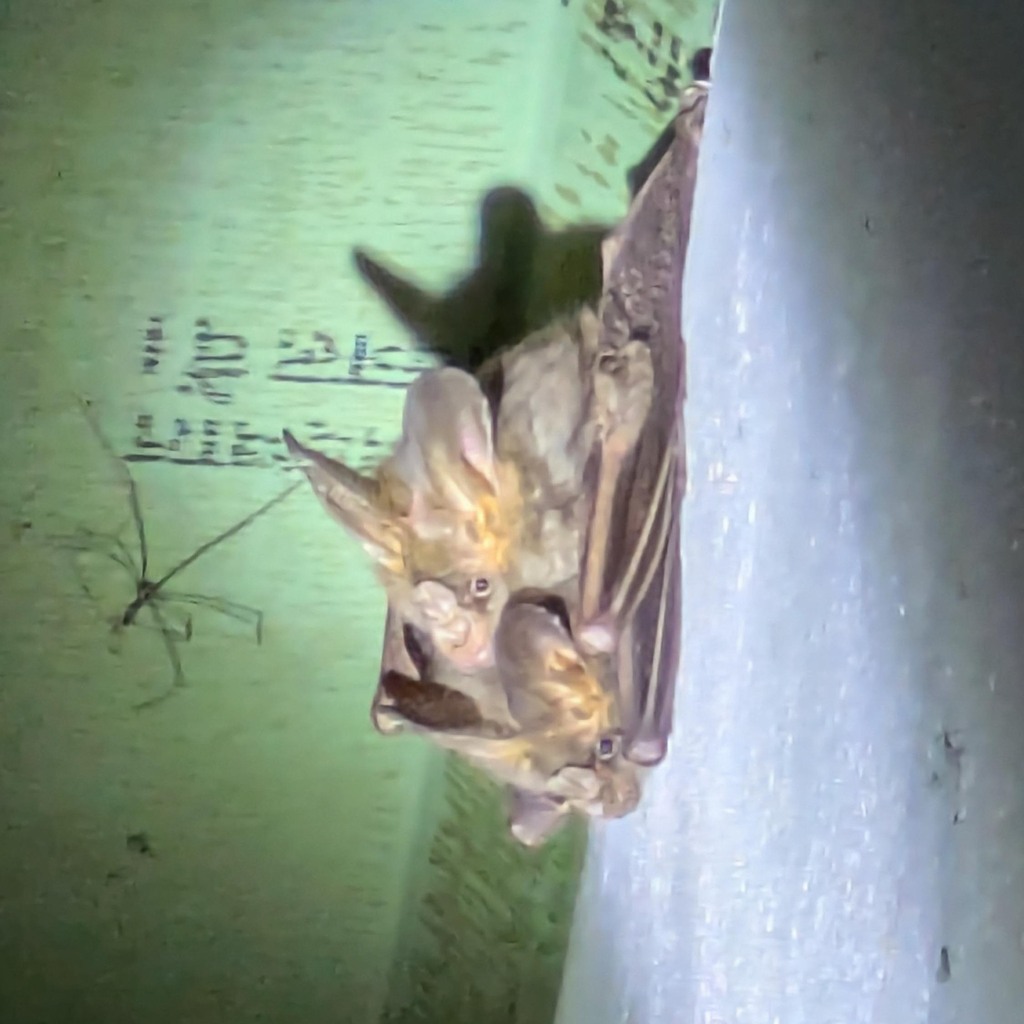
Lesser Asian False-vampire
Photo © Paulmathi Vinod
Photo © Paulmathi Vinod — CC BY 4.0 — Source: iNaturalist #254155226Identification
The lesser false vampire bat is a small bat with a wingspan of up to 30 centimetres and a head-and-body length of around 10 centimetres. Its most distinctive feature is the striking yellowish veins that run through its wings; when the wings are spread with light shining behind them, they display a prominent yellow or orange tinge. The body colour ranges from grey-brown to blue-brown, with fur that is typically pale grey to grey-brown overall.
This species has a complex facial structure adapted for its hunting style. Its noseleaf features a long dorsal lobe with a stiffened central ridge and broad convex flaps on the sides. The ears are very large and notably joined at the base, and the bat has no visible tail. Well-developed, forward-pointing eyes give it superior visual acuity compared to many bat species, enabling it to hunt using sight as well as sound.
Range & Habitat
The lesser false vampire bat is found across South Asia and Southeast Asia, from Sri Lanka and India in the west to Indonesia and the Philippines in the east. Its range extends throughout the southern and eastern Indian Subcontinent, including Bangladesh, Bhutan, and the Andaman and Nicobar Islands, as well as mainland Southeast Asia and the Malay Peninsula.
These bats are highly adaptable in their choice of roosts, living in rock crevices, caves, foliage, and hollow trees depending on local availability. They also roost in building structures and may be found hanging and sleeping on trees in general.
Behaviour & Diet
Lesser false vampire bats are social animals, usually roosting in groups of 3 to 30 individuals. They employ a sophisticated dual hunting strategy: their short, low-density, broadband echolocation pulses and large ears—which are particularly sensitive to returning echoes—work in tandem with their well-developed forward-pointing eyes to locate prey visually in their environment.
Insectivorous by nature, they show a preference for grasshoppers and moths, though they will opportunistically consume small vertebrates, including other bats. From a human perspective, their ecological role is mixed: they help control insects that damage crops, but they may also carry and transmit certain diseases.
Best Time & Places to See It
Travellers seeking this species should focus on cave systems and forested areas throughout the species' range in South and Southeast Asia. Caves, particularly those with suitable roosting crevices and nearby grasslands or forest edges, offer the best opportunities for observation. The bat's preference for roosting in groups means that suitable cave sites may harbour multiple individuals.
Local guides familiar with cave systems in Indonesia, the Philippines, Malaysia, India, or Sri Lanka will be invaluable for locating active roosts. Visiting sites at dusk, when the bats begin foraging activities, increases the likelihood of sightings.
Photography Tips
The lesser false vampire bat's striking wing pattern is its most photogenic feature. Backlighting is essential to capture the distinctive yellow and orange tinge of the translucent wing membranes—position your light source behind the bat to best showcase this characteristic. Roosting individuals in caves can be photographed during the day with careful use of flash and reflector fill-light to reveal details of facial structure and fur colouration.
Close-up photography of the face will highlight the complex noseleaf structure and the notably large, joined ears. The bat's forward-pointing eyes are another worthwhile detail to capture. Use a fast shutter speed if photographing in flight to freeze motion, and be respectful of roosting colonies—avoid disturbing animals unnecessarily.
Khao Yai National Park
Prachantakham District, Thailand
+377 birds+46 mammals
Evergreen dipterocarp forest blankets the rolling terrain of this national park in eastern Thailand, where limestone hills rise abruptly from the forest floor and seasonal streams…
VIEW NATIONAL PARKTaman Nasional Baluran
Situbondo, Indonesia
+189 birds+9 mammals
Across the northeastern tip of East Java, where monsoon winds sweep down from the Bali Strait, a landscape of contrasts unfolds within 374 square kilometres of…
VIEW NATIONAL PARKWay Kambas National Park
Lampung Timur, Indonesia
+237 birds+20 mammals
Across the low swamplands of eastern Lampung, where freshwater wetlands merge into tidal mangrove forests along the Sunda Strait, sprawls one of Sumatra's most vital sanctuaries.…
VIEW NATIONAL PARKNo community photos yet. Log in to add the first one.
No community observations of this species yet.