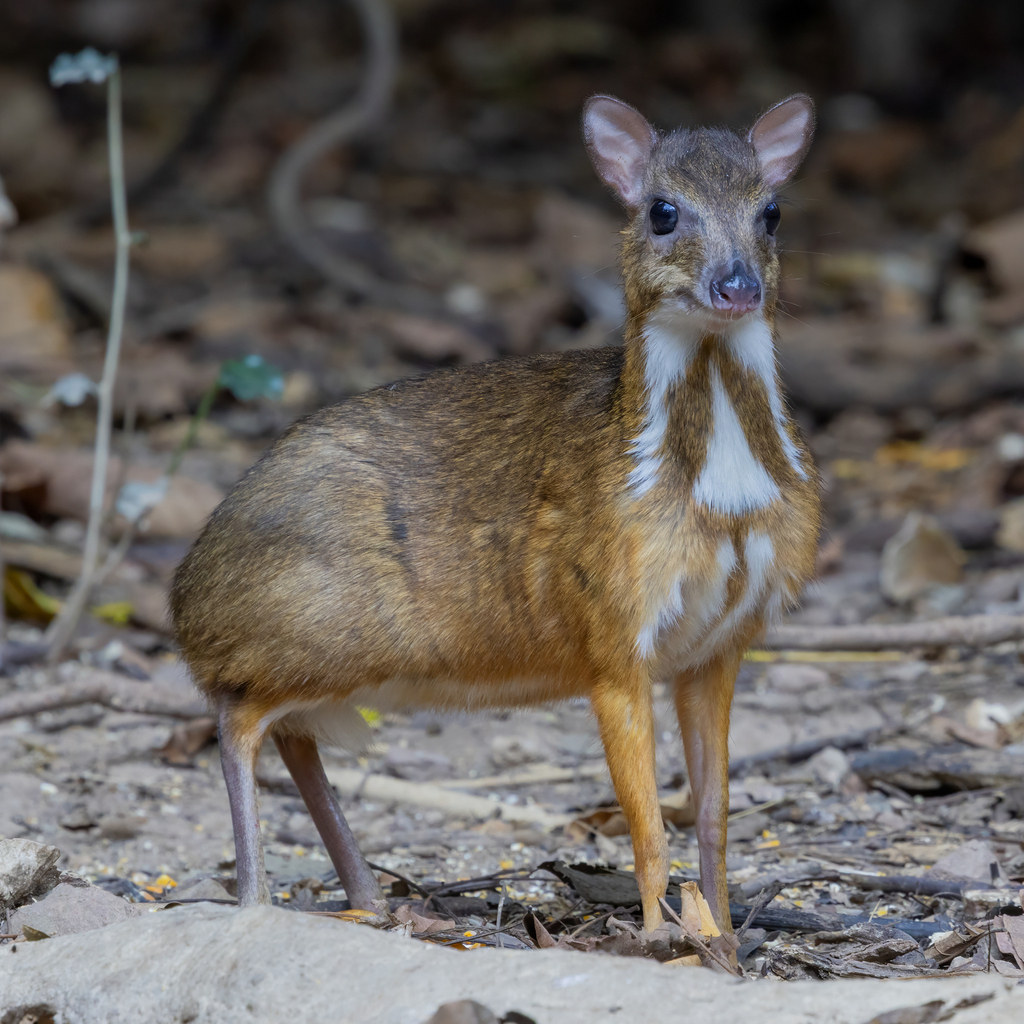
Lesser Indo-Malayan Chevrotain
Photo © Dan Vickers
Photo © Dan Vickers — CC BY 4.0 — Source: iNaturalist #344629079The lesser mouse-deer, lesser Malay chevrotain, or kanchil (Tragulus kanchil) is a species of even-toed ungulate in the family Tragulidae. == Distribution == The lesser mouse-deer is found widely across Southeast Asia in Indochina, Myanmar (Kra Isthmus), Brunei, Cambodia, China (Southern Yunnan), Indonesia (Kalimantan, Sumatra and many other small islands), Laos, Malaysia (Peninsular Malaysia, Sarawak and many other small islands), Singapore, Thailand, and Vietnam. == Description == It is one of the smallest known hoofed mammals, its mature size being as little as 45 cm (18 inches) and 2 kg (4.4 lb) and related to the even smaller Java mouse-deer. It is threatened by predation by feral dogs. Through further research it is also discovered that the creatures who were initially believed to be nocturnal actually conduct their activities during the day. Also, though many births occur in May, November or December, the females are able to reproduce throughout the year (Kusuda et al.). == Folklore and literature == In Indonesian and Malaysian folklore, the mouse-deer Sang Kancil is a cunning trickster similar to Br'er Rabbit from the Uncle Remus tales, even sharing some story plots. For instance, they both trick enemies pretending to be dead or inanimate, and both…
Khao Yai National Park
Prachantakham District, Thailand
+377 birds+46 mammals
Evergreen dipterocarp forest blankets the rolling terrain of this national park in eastern Thailand, where limestone hills rise abruptly from the forest floor and seasonal streams…
VIEW NATIONAL PARKBako National Park
Kuching, Malaysia
+210 birds+17 mammals
Weathered sandstone cliffs rise dramatically from the South China Sea, their ochre faces sculpted by millennia of wind and tide into a landscape of extraordinary geological…
VIEW NATIONAL PARKTaman Negara National Park
Kampong Samas, Malaysia
+393 birds+48 mammals
Where ancient rainforest meets limestone peaks, one of Southeast Asia's oldest protected wilderness preserves sprawls across 4,343 square kilometers of primordial landscape. Dipterocarp giants tower overhead,…
VIEW NATIONAL PARKNo community photos yet. Log in to add the first one.
No community observations of this species yet.