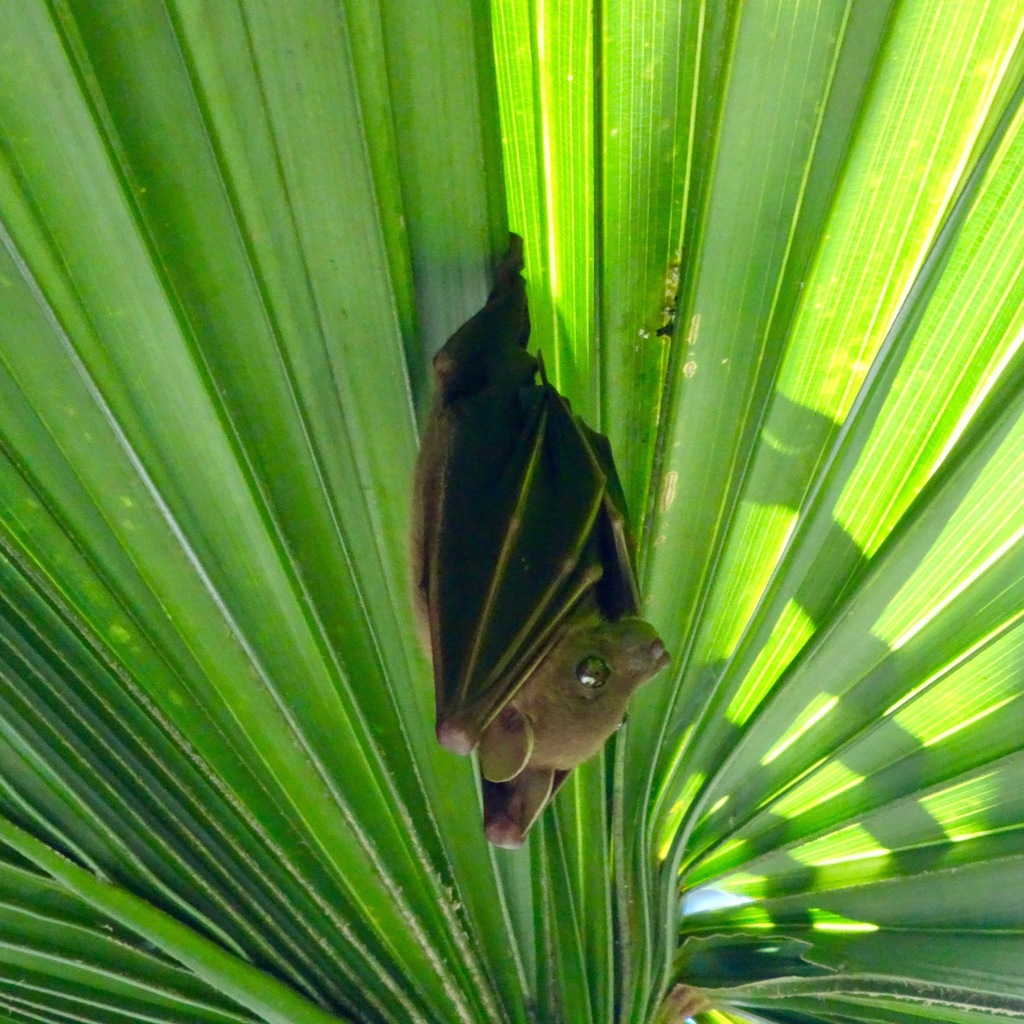
Lesser Short-nosed Fruit Bat
Photo © Jiro Iguchi
Photo © Jiro Iguchi — CC BY 4.0 — Source: iNaturalist #10081715Identification
The lesser short-nosed fruit bat is a small megabat, weighing between 21 and 32 grams with a head and body length of 7–8 centimetres. Its most distinctive feature is a bright collar: adult males display striking dark orange collars, while females wear yellowish ones. The bat's overall colouration ranges from brown to yellowish brown, with white edges to the ears and wing bones that stand out against darker fur. Its fox-like face, large dark eyes, and relatively short ears (1.4–1.6 centimetres) are characteristic of the species.
The forearm measures 6–7 centimetres and the tail is notably short at just 0.8–1.0 centimetres. Lesser short-nosed fruit bats possess two pairs of lower incisors, which distinguishes them from several similar species. Nine subspecies are recognised across their range, reflecting variation in distribution rather than dramatic visual differences.
Range & Habitat
This species is widely distributed across South Asia and Southeast Asia, with populations occurring in Sri Lanka, parts of India, Bangladesh, the Andaman and Nicobar Islands, southern China, Burma, Indochina, Thailand, the Malay Peninsula, Sumatra, Java, Bali, Sulawesi, the Philippines, and the Lesser Sunda Islands. They are found from sea level to 1,600 metres in altitude, with different subspecies occupying distinct geographic regions.
Lesser short-nosed fruit bats favour disturbed forest habitats, including lower montane forest and tropical lowland rainforest. They also thrive in gardens, mangroves, and coastal vegetation, demonstrating considerable adaptability to human-modified landscapes.
Behaviour & Diet
These bats are highly social, preferring to roost in small groups within trees, under leaves, or in caves. Typically, one male roosts alongside up to four females, while solitary young males may roost alone. Females sometimes gather in groups of up to 20. Remarkably, males construct shelters by spending more than two months chewing the veins of leaves and palm fronds until they fall, demonstrating complex shelter-building behaviour.
Lesser short-nosed fruit bats are frugivorous, preferring aromatic fruits—especially mangoes—which they feed on by sucking out juices and soft pulp. They also consume nectar and pollen. They navigate and forage using their keen vision and acute sense of smell, and communicate through tactile, visual, and acoustic stimuli. Both males and females participate in parental care, with males possessing mammary glands that exceed 8% of their body mass and actively contributing to offspring feeding.
Best Time & Places to See It
Timing your visit to coincide with fruiting seasons—particularly when mangoes and other preferred fruits are abundant—increases your chances of observing these bats. Breeding populations show regional variation: in the Philippines, most breed twice yearly with pregnant females present almost year-round, while in Thailand and Peninsular Malaysia, breeding is non-seasonal. However, lactation and breeding activity peaks correspond with the rainy season and fruiting season.
Look for lesser short-nosed fruit bats in gardens, mangroves, and disturbed forest areas throughout their extensive range. Fruiting trees attract them reliably, and they are particularly active during twilight hours when they depart to feed.
Photography Tips
Photograph these bats near fruiting trees, especially mangoes, where they gather to feed during dusk and dawn. Their distinctive orange or yellow collars—particularly striking on males—make excellent focal points. The contrast between their pale ear edges and darker fur, combined with their large, reflective dark eyes, photographs well even in low light conditions typical of twilight hours.
When photographing males with females, try to capture the social grouping behaviour that is characteristic of the species. Their small size and preference for hanging under leaves requires patience and careful positioning. A slow shutter speed or flash may be necessary given their activity levels and the dim lighting conditions of forests and mangroves where they roost.
Taman Negara National Park
Kampong Samas, Malaysia
+393 birds+48 mammals
Where ancient rainforest meets limestone peaks, one of Southeast Asia's oldest protected wilderness preserves sprawls across 4,343 square kilometers of primordial landscape. Dipterocarp giants tower overhead,…
VIEW NATIONAL PARKGunung Mulu National Park
Long Seridan, Malaysia
+280 birds+39 mammals
Where granite monoliths pierce the rainforest canopy of Sarawak, an ancient limestone karst landscape reveals one of Southeast Asia's most biodiverse strongholds. Soaring peaks cloaked in…
VIEW NATIONAL PARKWay Kambas National Park
Lampung Timur, Indonesia
+237 birds+20 mammals
Across the low swamplands of eastern Lampung, where freshwater wetlands merge into tidal mangrove forests along the Sunda Strait, sprawls one of Sumatra's most vital sanctuaries.…
VIEW NATIONAL PARKNo community photos yet. Log in to add the first one.
No community observations of this species yet.