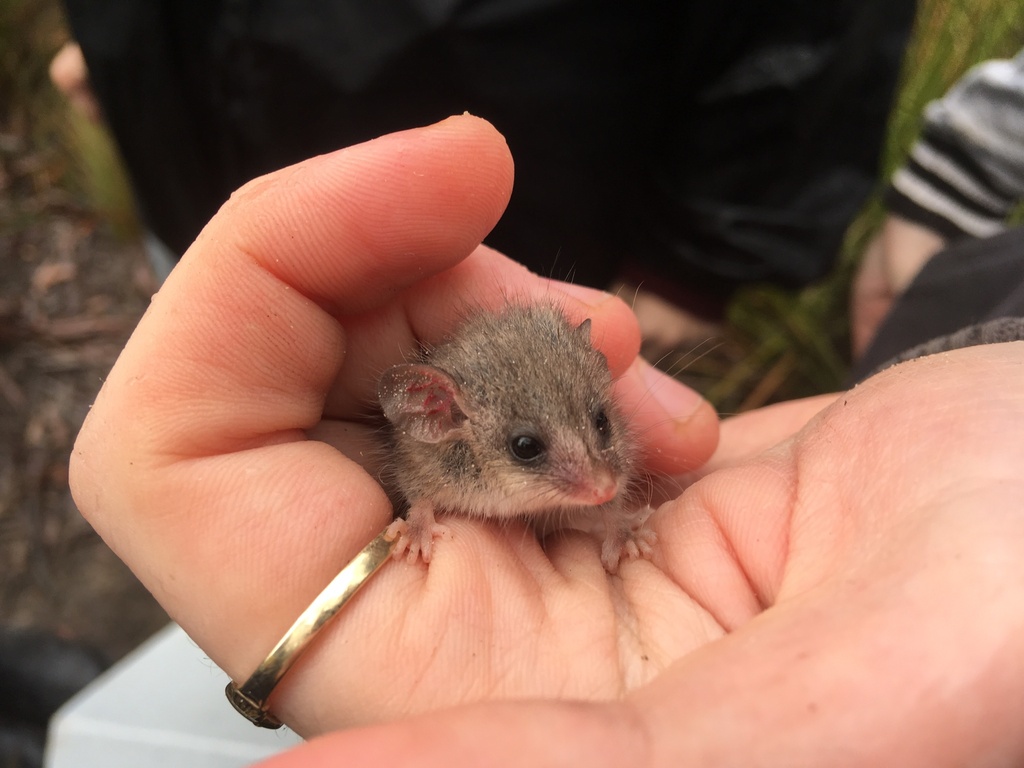
Little Pygmy Possum
Photo © Donna Belder
Photo © Donna Belder — CC BY 4.0 — Source: iNaturalist #211407847The Tasmanian pygmy possum (Cercartetus lepidus), also known as the little pygmy possum or tiny pygmy possum, is the world's smallest possum. It was first described by Oldfield Thomas in 1888, after he identified that a museum specimen labelled as an eastern pygmy possum in fact represented a species then unknown to science. The holotype resides in the Natural History Museum in London. == Description == Although it is a marsupial, the Tasmanian pygmy possum superficially resembles a dormouse, and it is the smallest of all the known species of possum. Adults range from 6.6 to 7.5 centimetres (2.6 to 3.0 in) in head-body length, with a 6 to 7.2 centimetres (2.4 to 2.8 in) tail, and weigh just 7 to 10 grams (0.25 to 0.35 oz). Their fur is soft and thick, and is fawn in colour over most of the body, fading to a pale grey on the underparts. The snout is short with long whiskers, and the eyes are directed forwards and surrounded by slightly darker fur, although without the conspicuous black rings seen on other pygmy possums. The ears are mobile and largely hairless. The tail is prehensile, and thickly furred at the base, which may…
Little Desert National Park
Australia
+200 birds+11 mammals
Across northwestern Victoria's semi-arid interior, sandstone ridges and heathland plateaus rise from red earth in a landscape sculpted by fire and drought rather than water. Little…
VIEW NATIONAL PARKFlinders Chase National Park
Australia
+142 birds+14 mammals
Granite ridges and windswept mallee scrubland define this 1,630-square-kilometre expanse on Kangaroo Island, where ancient rock formations rise abruptly from coastal heathland and woodland mosaics. The…
VIEW NATIONAL PARKNo community photos yet. Log in to add the first one.
No community observations of this species yet.