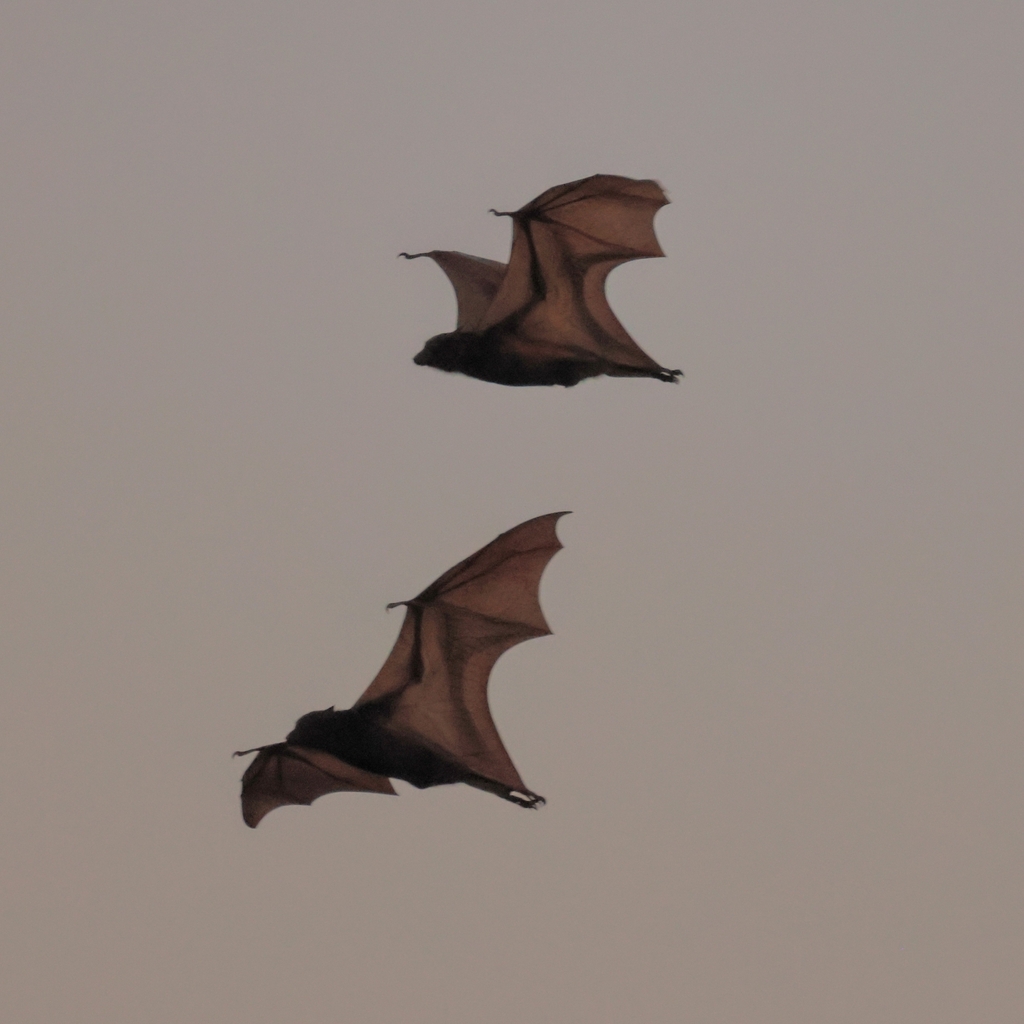
Little Red Flying Fox
Photo © Luke Lythgoe
Photo © Luke Lythgoe — CC BY 4.0 — Source: iNaturalist #250738985Identification
The little red flying fox is Australia's smallest mainland Pteropus species, weighing around 450 grams (about one pound). Its reddish-brown fur and distinctive grey head make it relatively easy to identify in the field. Look for the characteristic creamy-white or pale yellowish patches at the shoulders, and note the pale brown, semi-translucent wing membranes visible in flight. The species lacks a tail—a key feature distinguishing flying-foxes from other Australian bats—and has prominent ears measuring 29 to 40 millimetres. When airborne, the pale wing membranes are particularly striking against darker vegetation.
You can distinguish this species from similar Australian flying-foxes by comparing key features: the grey-headed flying-fox (Pteropus poliocephalus) is greyer overall with darker wings, while the black flying-fox (Pteropus alecto) is considerably larger and uniformly dark. The little red flying fox also produces distinctive abrupt 'yap' sounds accompanied by high-pitched screeches, squeals and twittering—useful for locating camps even when visibility is poor.
Range & Habitat
This species has the largest range of any Australian Pteropus, extending further inland than its relatives across the north and east of the continent. It occupies coastal and sub-coastal regions, but regularly camps and forages across tropical to temperate zones in search of nectar sources. The little red flying fox is more nomadic than other mainland flying-fox species, decamping and roaming widely to track the irregular flowering periods of its preferred food plants.
Roost sites typically feature wet understorey vegetation that provides a temperate microclimate essential for thermoregulation. The bats congregate in massive camps—sometimes numbering tens of thousands, with records of colonies exceeding one hundred thousand individuals. These conspicuous gatherings are often located in tall trees where the combined weight of roosting bats can break branches.
Behaviour & Diet
Little red flying foxes are primarily nectarivorous, feeding on blossoms from Eucalyptus and Corymbia species and playing an important role in their pollination. They also favour the nectar of Melaleuca species and visit cultivated and native fruiting trees. The irregular flowering patterns of these plants drive the species' nomadic lifestyle, forcing camps to relocate frequently in search of adequate food supplies.
This species exhibits a remarkable adaptation for obtaining water during dry periods: they skim the surface of rivers and streams in flight, collecting water onto their fur, which they then lap while airborne. Breeding is timed distinctly, with births occurring in April and May—six months later than other mainland flying-fox species, possibly to avoid exposing newborns to extreme summer heat. Larger camps form during October to November breeding season, then fragment as females establish separate maternity colonies. The species faces predation from sea eagles (which snatch them in flight), pythons at roost sites, and freshwater crocodiles that exploit their water-gathering behaviour.
Best Time & Places to See It
October to November is ideal for observing this species, when breeding camps reach their largest size and are most conspicuous. Larger aggregations also form around roost sites during the daytime, making them relatively easy to locate and observe. Early morning or late afternoon visits to known camp sites offer the best opportunities, particularly as bats become active during these periods.
The species' wide distribution across northern and eastern Australia provides multiple viewing opportunities. Look for camps in areas with suitable wet understorey vegetation and reliable nectar sources. Visiting during late afternoon increases chances of witnessing their remarkable water-gathering behaviour as they visit rivers and streams, though exercise caution near waterways where crocodile predation occurs.
Photography Tips
The pale, semi-translucent wing membranes are a striking photographic feature—backlit images against the sky or vegetation can be particularly effective. During roosting, capture the characteristic head-down posture and the reddish fur contrasting with the grey head and pale shoulder patches. The species' tendency to roost closely together in large groups offers opportunities for context shots showing colony behaviour and the sheer density of animals at camp sites.
For flight photography, shoot during late afternoon when bats become active and light remains good. The water-skimming behaviour is visually dramatic but requires patience and positioning near suitable waterways. Use fast shutter speeds to freeze wing movement. Approach camps cautiously and avoid sudden disturbances, as stressed bats may panic and suffer heat-related mortality—responsible wildlife photography means minimizing impact on these susceptible animals.
Carnarvon National Park
Philadelphia, Australia
+179 birds+17 mammals
Across 15,000 square kilometres of inland Queensland, rugged sandstone plateaus rise above eucalypt woodlands and open grasslands, carved by creeks that have worn deep gorges into…
VIEW NATIONAL PARKKakadu National Park
Kakadu, Australia
+273 birds+46 mammals
Kakadu National Park is Australia’s largest national park and one of the world’s most remarkable protected areas, covering nearly 20,000 square kilometres in the tropical north…
VIEW NATIONAL PARKDaintree National Park
Dedin, Australia
+362 birds+37 mammals
Daintree National Park is one of the world’s oldest and most biologically diverse tropical rainforests, protecting an extraordinary landscape where ancient forests meet the Great Barrier…
VIEW NATIONAL PARKRinyirru National Park
Lakefield, Australia
+258 birds+7 mammals
Where the savanna grasslands of far north Queensland meet seasonal wetlands and eucalypt woodlands, Rinyirru National Park sprawls across more than 12,500 square kilometres of rugged,…
VIEW NATIONAL PARKMorton National Park
Australia
+253 birds+57 mammals
Across nearly 4,800 square kilometers of New South Wales's Southern Tablelands, rugged sandstone plateaus rise above sheltered valleys where cool-climate eucalypt woodland meets grassy heath and…
VIEW NATIONAL PARKBribie Island National Park
Brisbane, Australia
+284 birds+20 mammals
Across tidal flats and shallow waterways north of Brisbane, Bribie Island National Park spreads across nearly four hundred square kilometres of subtropical coastal wilderness—a patchwork of…
VIEW NATIONAL PARKLitchfield National Park
Australia
+175 birds+15 mammals
Where weathered sandstone plateaus rise above the savanna woodlands of Australia's Top End, Litchfield National Park unfolds as a landscape of dramatic contrasts shaped by a…
VIEW NATIONAL PARKNitmiluk National Park
Australia
+186 birds+27 mammals
Dramatic sandstone gorges carved by the Katherine River slice through the tropical savanna of Australia's Top End, creating a landscape where escarpments tower above crystalline pools…
VIEW NATIONAL PARKGreat Sandy National Park
Australia
+306 birds+40 mammals
Where coastal dunes rise inland from the Queensland coastline, Great Sandy National Park encompasses a landscape of remarkable ecological diversity shaped by subtropical humid conditions year-round.…
VIEW NATIONAL PARKWooroonooran National Park
Australia
+240 birds+28 mammals
Where the Great Dividing Range rises sharply inland from Queensland's tropical coast, Wooroonooran National Park encompasses a landscape of steep, forested gorges and cascading waterways carved…
VIEW NATIONAL PARKCape Range National Park
Australia
+159 birds+15 mammals
Where arid limestone ridges plunge toward turquoise waters, Cape Range National Park frames one of Australia's most dramatic desert-ocean interfaces. The park's spine—a stark, weathered range…
VIEW NATIONAL PARKNo community photos yet. Log in to add the first one.
No community observations of this species yet.