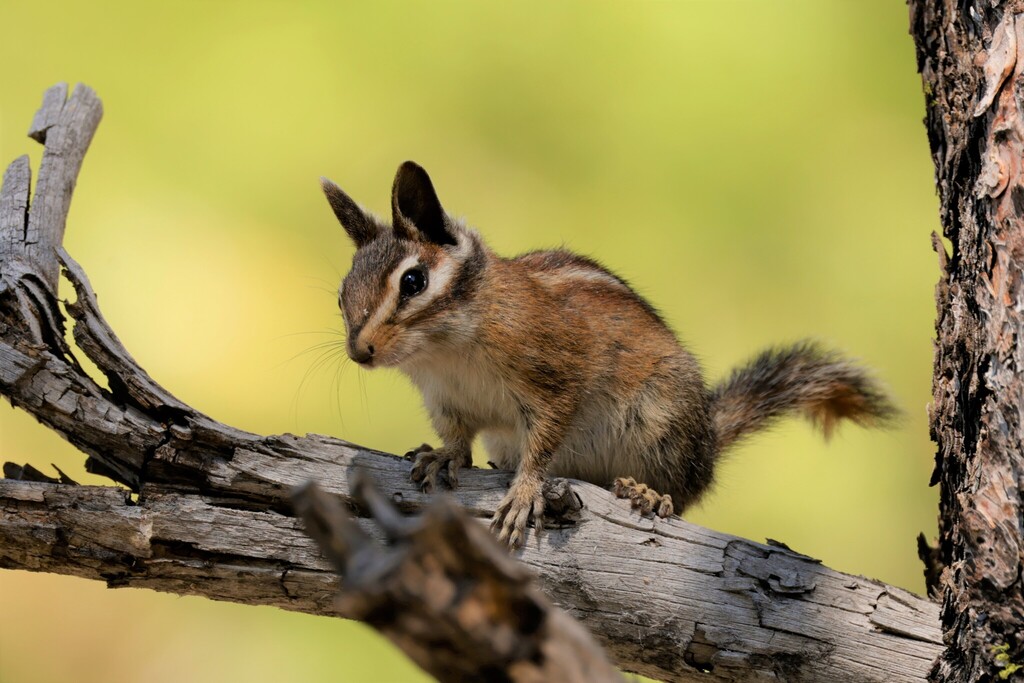
Long-eared Chipmunk
Photo © russnamitz
Photo © russnamitz — CC0 1.0 — Source: iNaturalist photo #534113612Identification
The long-eared chipmunk is a small rodent measuring 23.0–24.5 centimeters in total length, with males weighing 74.1–89.0 grams and females 81.0–105.0 grams. The tail comprises a substantial portion of body length at 8.5–10.1 centimeters. Most distinctive are the species' notably large ears—the longest of any chipmunk species—and striking white patches at the base of both ears. The fur is bright red-brown with five dark dorsal stripes alternating with four pale stripes running the length of the back, providing excellent camouflage in the mountain forest environment.
Range & Habitat
This species is endemic to the central and northern Sierra Nevada mountains of California and Nevada in the United States. Long-eared chipmunks inhabit the coniferous and mixed forests of the high Sierra, where they occupy burrows or tree hollows. They are well-adapted to the alpine and subalpine ecosystems characteristic of this region, relying on the abundant seed crops and forest floor resources found in these montane environments.
Behaviour & Diet
Long-eared chipmunks are diurnal and highly active foragers on the forest floor, searching for fungi, seeds, fruits, flowers, and insects throughout the warmer months. In autumn, they climb conifer trees to harvest seeds directly from cones, demonstrating remarkable agility for their size. These chipmunks hibernate during the winter months from November through March, retreating to ground dens where they remain dormant. They emerge in late spring to breed; mating occurs in late April and May, with young born approximately one month later after the gestation period ends.
Best Time & Places to See It
The optimal period for observing long-eared chipmunks is from late spring through early autumn, when they are most active and visible. Look for them in the central and northern Sierra Nevada at mid to higher elevations where coniferous forests dominate. Early morning hours offer the best viewing opportunities, as these diurnal animals are most active during cooler parts of the day. Careful observation of the forest floor near fallen logs, rock outcrops, and around the bases of conifers will reward patient naturalists with sightings of these charming rodents.
Photography Tips
Photographing long-eared chipmunks requires patience and a keen eye. Position yourself quietly near known foraging areas and wait for natural behavior to unfold. The striking white ear patches and contrasting back stripes make excellent compositional elements; frame shots to highlight these distinctive field marks. Use a macro or telephoto lens to capture fine detail without disturbing the animal. Early morning light filtered through the forest canopy provides ideal conditions for revealing the bright red-brown coloration. Approach slowly and remain still when the chipmunk is in view, as sudden movement will send it fleeing into cover.
Kings Canyon National Park
Lassen Volcanic National Park
Sequoia National Park
Yosemite National Park
Nothing matches these filters.
No community photos yet. Log in to add the first one.
No community observations of this species yet.