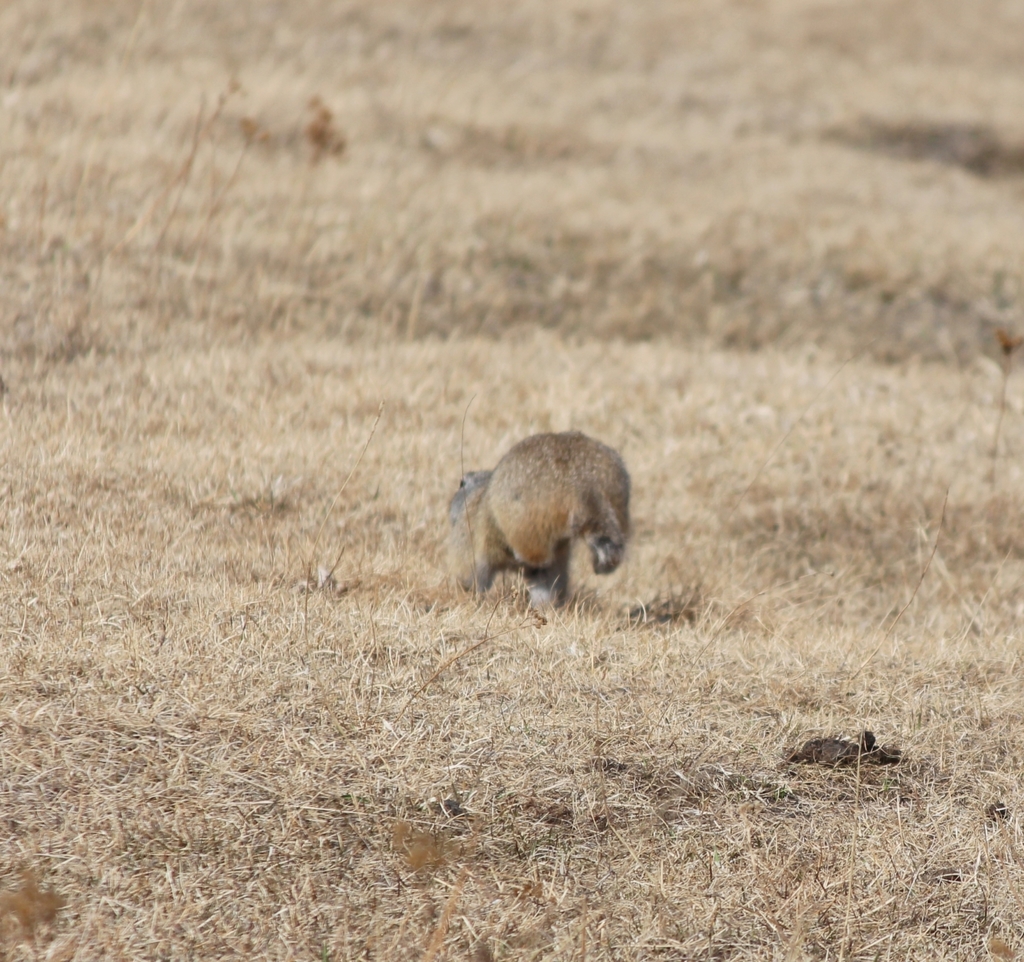
Long-tailed Ground Squirrel
Photo © Юлия
Photo © Юлия — CC BY 4.0 — Source: iNaturalist #73564480Identification
The long-tailed ground squirrel, also known as Eversmann's souslik, is a compact and low-slung rodent with distinctively short legs and a notably long bushy tail. Adults reach body lengths of up to 315 millimetres, with tails extending to 160 millimetres—proportions that give this species its characteristic silhouette. The back is brown with a striking linear pattern of small dark spots, while the underparts are paler ochre-brown with a distinctive reddish tinge along the sides. The tail itself is barred in brown and black, marked with a prominent light edge stripe and a pale tip that makes it highly recognizable in the field.
Range & Habitat
This species inhabits a vast range across Central and East Asia, found in China, Kazakhstan, Mongolia, and Russia. Within this distribution, long-tailed ground squirrels favour submontane steppes, plains, and meadows at elevations up to 3,100 metres. They also occupy the edges of pine forests and birch woods, forest clearings, and agricultural land, ranging from Southern Siberia and the Altai region eastward to Manchuria. Two isolated populations persist in Eastern Siberia—one in southeastern Yakutia and another in the south of the Amur region.
Behaviour & Diet
Long-tailed ground squirrels are highly social animals that live in colonies connected by extensive burrow systems. The complexity of their underground architecture depends on soil type: in light sandy soils, burrows extend to 3 metres deep with a single entrance surrounded by a large mound of soil up to 2 metres in diameter, with underground passages stretching up to 15 metres. In heavier clay soils, burrows are shallower at about 2 metres but spread across 5–7 metres with multiple entrances. These squirrels emerge from hibernation in March, with young born approximately a month later; litters typically contain five to eight pups. Activity peaks during early morning and late afternoon or evening, with the animals retreating underground during midday heat. Their diet comprises green vegetation, seeds, insects, bulbs, and roots; before entering hibernation in October, they store up to 6 kilograms of vegetation and grain within their burrows to sustain them through winter.
Best Time & Places to See It
The best time to observe long-tailed ground squirrels is from March through September, when they are active above ground. Focus your search on steppe habitats, meadows, and agricultural areas across their range in Russia, Kazakhstan, Mongolia, and China. Early morning and late afternoon visits to suitable habitat will yield the most sightings, as the animals are most active during these cooler parts of the day.
Photography Tips
Photograph long-tailed ground squirrels during early morning or late afternoon light, when they are most active and the low angle of the sun enhances detail and texture. Their distinctive barred tail and spotted back pattern are key identifying features worth capturing clearly. Position yourself quietly near colony burrows and wait patiently; the animals are wary and will retreat underground if disturbed. A telephoto lens will help you maintain distance while recording fine details of their pelage and characteristic posture.
Baikal National Park
Ольхонский район, Russia
+184 birds+11 mammals
Where the world's deepest freshwater lake meets ancient Siberian taiga, Baikal National Park sprawls across 66,203 square kilometers of one of Earth's most singular ecosystems. The…
VIEW NATIONAL PARKKhangai Nuruu National Park
Erdenetsogt, Mongolia
+136 birds+7 mammals
Where granite ridges pierce Mongolia's central steppe, alpine meadows give way to dense coniferous forests that climb toward windswept summits. Khangai Nuruu sweeps across 1.2 million…
VIEW NATIONAL PARKGorkhi-Terelj National Park
Ulaanbaatar, Mongolia
+137 birds+5 mammals
Where granite monoliths rise abruptly from rolling steppe grasslands, Gorkhi-Terelj National Park unfolds across the landscape north of Ulaanbaatar, a sanctuary where forest and alpine meadow…
VIEW NATIONAL PARKAltai Tavan Bogd National Park
Tsengel, Mongolia
+146 birds+3 mammals
Where the Altai Mountains rise in jagged defiance along Mongolia's western frontier, the terrain transforms into a realm of alpine tundra, rocky plateaus, and glacier-carved valleys…
VIEW NATIONAL PARKHustai National Park
Altanbulag, Mongolia
+198 birds+16 mammals
Where the steppe rolls endlessly beneath vast Mongolian skies, Hustai National Park preserves one of Central Asia's most dynamic grassland ecosystems. Rolling hills and open prairie…
VIEW NATIONAL PARKKhoridol Saridag National Park
Khatgal, Mongolia
+164 birds+6 mammals
Where granite peaks thrust skyward across Mongolia's remote southeastern reaches, a landscape of raw geological drama unfolds. Deep river gorges carved through ancient stone create a…
VIEW NATIONAL PARKNo community photos yet. Log in to add the first one.
No community observations of this species yet.