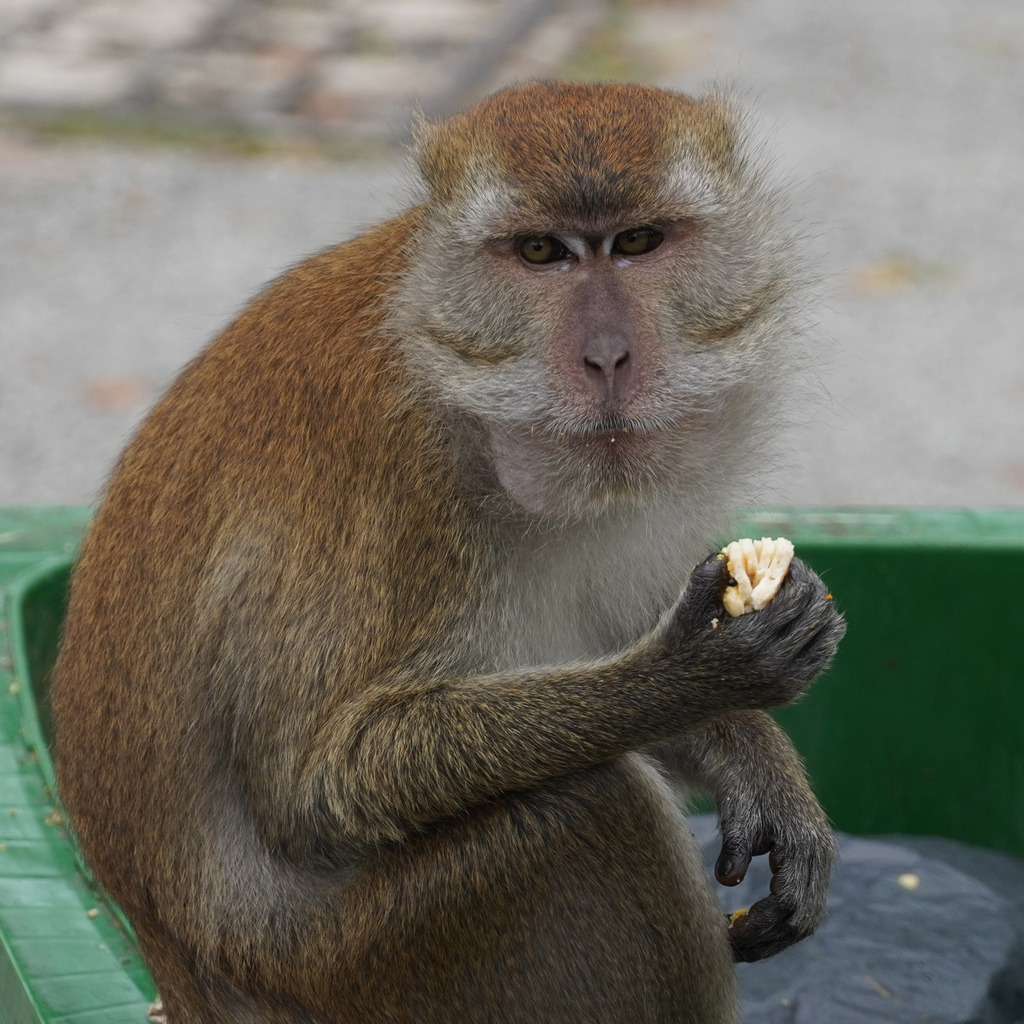
Long-tailed Macaque
Photo © nbasargin
Photo © nbasargin — CC BY 4.0 — Source: iNaturalist #152537818Identification
The long-tailed macaque is named for its distinctive tail, which equals the combined length of the head and body. This medium-sized primate is highly adaptable in appearance across its range, with ten recognized subspecies showing variation in coloration and size. The species is also known as the crab-eating macaque, referring to its foraging behaviour on beaches, and the cynomolgus monkey, a name commonly used in laboratory contexts.
Range & Habitat
Native to Southeast Asia, the long-tailed macaque has the most extensive range of any macaque species. The primary subspecies, M.f. fascicularis, is found across Indonesia, Malaysia, the Philippines, Thailand, Cambodia, Singapore, and Vietnam. Another significant subspecies, M.f. aurea, inhabits Myanmar, Laos, and parts of Thailand near the Myanmar border. Additional subspecies occupy isolated islands including the Nicobar Islands of India and various Indonesian island groups.
As a synanthropic species, the long-tailed macaque thrives in close proximity to human settlements and in secondary forests. This remarkable adaptability to disturbed habitats and human-modified landscapes sets it apart from many other primate species and allows it to persist in diverse environmental contexts across its range.
Behaviour & Diet
Long-tailed macaques are omnivorous and frugivorous, feeding on a varied diet that includes fruits and other food sources. They live in matrilineal groups ranging from 10 to 85 individuals, with a social structure where females remain in their natal groups throughout their lives while males emigrate at puberty. This female-centered society is characteristic of many macaque species.
Remarkably, the long-tailed macaque is the only Old World monkey known to use stone tools in daily foraging activities. In some tourist locations, these intelligent primates engage in robbing and bartering behaviour, demonstrating their cognitive flexibility and opportunistic nature. Their intelligence and adaptability have made them subjects of both cultural reverence and conflict with human communities.
Best Time & Places to See It
The widespread distribution of long-tailed macaques across Southeast Asia offers numerous opportunities for wildlife viewing. Their preference for secondary forests and areas near human settlements means they are often encountered in accessible locations rather than remote primary forests. Throughout their range in Indonesia, Malaysia, Thailand, Vietnam, and Cambodia, observant travellers are likely to encounter these macaques, particularly in areas combining natural habitat with human activity.
Photography Tips
The long-tailed macaque's distinctive tail and expressive face make compelling photographic subjects. Their activity in secondary forests and human-influenced landscapes often provides better accessibility and lighting than deep forest primates. However, photographers should maintain respectful distance and avoid encouraging the robbing behaviour observed at some tourist sites, as this can reinforce problematic interactions and contribute to conservation challenges the species currently faces.
Hat Noppharat Thara-Mu Ko Phi Phi National Park
Ao Nang, Thailand
+253 birds+9 mammals
Where limestone karsts rise dramatically from turquoise waters, Hat Noppharat Thara-Mu Ko Phi Phi National Park unfolds across a mosaic of beach, mangrove forest, and island…
VIEW NATIONAL PARKKhao Yai National Park
Prachantakham District, Thailand
+377 birds+46 mammals
Evergreen dipterocarp forest blankets the rolling terrain of this national park in eastern Thailand, where limestone hills rise abruptly from the forest floor and seasonal streams…
VIEW NATIONAL PARKKhao Laem Ya-Mu Ko Samet National Park
Mueang Rayong District, Thailand
+159 birds+3 mammals
Where limestone hills meet the Gulf of Thailand, Khao Laem Ya–Mu Ko Samet National Park stitches together a mosaic of terrestrial and marine worlds that few…
VIEW NATIONAL PARKBako National Park
Kuching, Malaysia
+210 birds+17 mammals
Weathered sandstone cliffs rise dramatically from the South China Sea, their ochre faces sculpted by millennia of wind and tide into a landscape of extraordinary geological…
VIEW NATIONAL PARKKuching Wetlands National Park
Kuching, Malaysia
+103 birds+4 mammals
Where brackish waters meet mangrove stilts and freshwater swamps blend into coastal mudflats, one of Southeast Asia's most dynamic wetland ecosystems unfolds across Sarawak's northwestern coast.…
VIEW NATIONAL PARKTaman Negara National Park
Kampong Samas, Malaysia
+393 birds+48 mammals
Where ancient rainforest meets limestone peaks, one of Southeast Asia's oldest protected wilderness preserves sprawls across 4,343 square kilometers of primordial landscape. Dipterocarp giants tower overhead,…
VIEW NATIONAL PARKGunung Mulu National Park
Long Seridan, Malaysia
+280 birds+39 mammals
Where granite monoliths pierce the rainforest canopy of Sarawak, an ancient limestone karst landscape reveals one of Southeast Asia's most biodiverse strongholds. Soaring peaks cloaked in…
VIEW NATIONAL PARKTaman Nasional Meru Betiri
Jember, Indonesia
+93 birds+1 mammals
Across East Java's southeastern coast, where the Indian Ocean meets a landscape of volcanic soils and monsoon-fed forests, sprawls a national park that epitomizes the ecological…
VIEW NATIONAL PARKWest Bali National Park
Gerokgak, Indonesia
+240 birds+8 mammals
Across West Bali's northwestern reaches, where the Indian Ocean meets volcanic slopes and limestone cliffs plunge toward turquoise shallows, sprawls a protected realm of roughly 325…
VIEW NATIONAL PARKGunung Ciremai National Park
Majalengka, Indonesia
+116 birds+1 mammals
Volcanic slopes rise sharply from West Java's interior, where Gunung Ciremai's 3,078-metre summit dominates a landscape carved by geological upheaval and shaped by equatorial monsoon rainfall.…
VIEW NATIONAL PARKGunung Merbabu National Park
Magelang, Indonesia
+61 birds+2 mammals
Where volcanic slopes rise sharply from the plateau of Central Java, Gunung Merbabu National Park encompasses nearly 200 square kilometers of montane forest that transitions through…
VIEW NATIONAL PARKMount Merapi National Park
Hargobinangun, Indonesia
+150 birds+3 mammals
Where the volcanic slopes of central Java rise into mist and montane forest, Mount Merapi National Park guards one of Indonesia's most dynamic landscapes. Spanning roughly…
VIEW NATIONAL PARKSembilang National Park
Banyuasin, Indonesia
+56 birds+3 mammals
Where tidal mangroves grade into freshwater swamp forest and the Musi River delta spreads across more than 7,000 square kilometres, Sembilang National Park represents one of…
VIEW NATIONAL PARKWay Kambas National Park
Lampung Timur, Indonesia
+237 birds+20 mammals
Across the low swamplands of eastern Lampung, where freshwater wetlands merge into tidal mangrove forests along the Sunda Strait, sprawls one of Sumatra's most vital sanctuaries.…
VIEW NATIONAL PARKKomodo National Park
Komodo, Indonesia
+155 birds+14 mammals
Where volcanic peaks rise dramatically from turquoise waters, a primordial landscape unfolds across three main islands and countless smaller ones scattered throughout the Lesser Sunda archipelago.…
VIEW NATIONAL PARKNo community photos yet. Log in to add the first one.