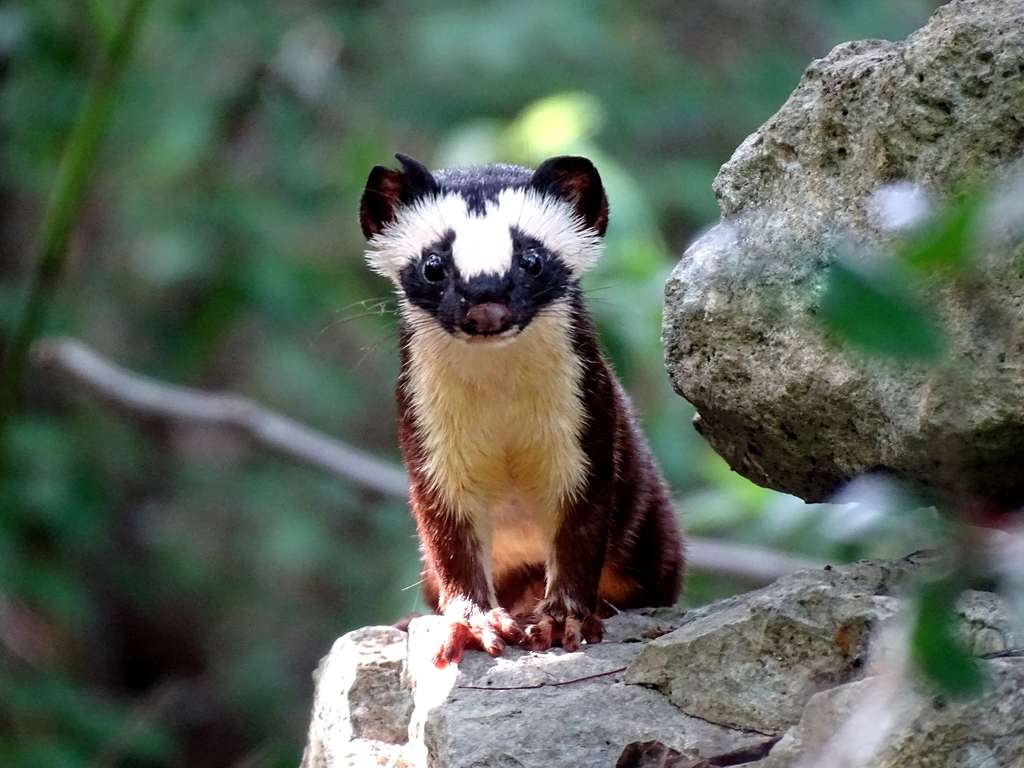
Long-tailed Weasel
Photo © Alexis López Hernández
Photo © Alexis López Hernández — CC BY 4.0 — Source: iNaturalist photo #154469560Identification
The long-tailed weasel is one of the larger weasels in North America, with a distinctly elongated body and relatively short legs. Body length ranges from 11 to 22 inches, with a tail measuring an additional 3 to 6 inches—the tail comprising 40–70% of the head and body length. Males are substantially larger than females, with males weighing between 3 and 9 ounces and females being about 10–15% smaller. The species is visually similar to the short-tailed weasel or stoat, though they are distinct species.
Colouration varies seasonally and geographically. In summer, the dorsal fur is brown with whitish underparts tinged with yellowish or buffy brown from chin to groin. The tail has a distinctive black tip that persists year-round. In northern areas during winter, the fur becomes white, sometimes with yellow tints, though the black tail tip remains. Long-tailed weasels in Florida and the southwestern US may display white or yellowish facial markings. The eyes are black in daylight but glow bright emerald green when caught in a spotlight at night.
Range & habitat
Long-tailed weasels are found throughout North, Central, and South America. They inhabit a variety of environments, including coniferous and deciduous forests in mixed successional stages, open woodlands, and shrublands, ranging from sea level to alpine meadows. They typically avoid dry desert habitats and agricultural fields, instead favouring forest patches, fencerows, and drainage ditches. They make their homes in underground burrows of other small mammals, demonstrating a preference for habitats that offer optimal cover for both protection and hunting.
The species exhibits scale-dependent habitat selection and is susceptible to habitat fragmentation. Solitary and territorial, long-tailed weasels maintain home ranges estimated between 10–20 hectares (25–50 acres), with typical densities of 1 weasel per square kilometre, though populations can reach as high as 7 weasels per square kilometre in optimal conditions.
Behaviour & diet
Long-tailed weasels are solitary animals that prefer to maintain distance from members of their own species. Their elongated body shape is an evolutionary adaptation that maximizes hunting efficiency, particularly for pursuing prey into underground burrows and tunnels. The species possesses well-developed anal scent glands that produce a strong, musky odour, which they use to mark territory by dragging and rubbing their bodies over surfaces. When startled or threatened, they employ this scent as a defensive deterrent against predators.
The long-tailed weasel undergoes two annual moults: one in autumn (October to mid-November) and one in spring (March–April), each lasting approximately 3–4 weeks. These moults are governed by day length and regulated by the pituitary gland. Unlike the stoat, their close relative, long-tailed weasels have naked soles in summer, though these become differently adapted in winter.
Best time & places to see it
Long-tailed weasels are most likely to be encountered in forested areas, wooded shrublands, and around forest patches interspersed with open areas. Search along fencerows and drainage ditches, particularly in regions offering a mix of forest cover and open ground. Their solitary nature and preference for concealed habitats make them challenging to observe. Early morning and dusk may offer the best opportunities, as these are typical activity periods for small mustelids.
Travellers should focus on accessible forest edges and transitional habitats rather than deep forest interiors or open agricultural fields. Their presence may be indicated by tracks, scat, or scent markings along regularly used trails and territorial boundaries.
Photography tips
Photographing long-tailed weasels requires patience and stealth, given their small size and shy disposition. Position yourself quietly near suitable habitat—forest edges, fencerows, and drainage ditches—and wait for the animal to emerge. Early morning or late afternoon light will reveal the rich brown tones of their summer coat or the striking white winter fur against dark backgrounds.
A memorable photographic opportunity presents itself at night: if caught by spotlight, the long-tailed weasel's eyes glow a bright emerald green, creating a distinctive and striking image. This unusual eye shine can be an effective way to locate and photograph the species after dark. A telephoto lens is essential for maintaining distance and avoiding disturbance to this solitary and wary animal.
Banff National Park
Improvement District No. 9, Canada
+264 birds+33 mammals
Where the Canadian Rockies thrust skyward in a cathedral of limestone and ice, Banff National Park preserves a wilderness of astounding vertical drama. Glacier-carved valleys cradle…
VIEW NATIONAL PARKJasper National Park
Improvement District No. 12, Canada
+235 birds+34 mammals
Where the Canadian Rockies rise in dramatic succession across western Alberta, Jasper National Park spans over 11,000 square kilometres of subalpine and alpine terrain, glaciated valleys,…
VIEW NATIONAL PARKIndiana Dunes National Park
Porter, United States
+304 birds+15 mammals
Along the southern shore of Lake Michigan, where glacial geology meets temperate woodland and open water, sprawls a landscape of extraordinary ecological complexity. The dunes themselves—massive…
VIEW NATIONAL PARKZion National Park
Washington County, United States
+244 birds+30 mammals
Towering sandstone cliffs in shades of crimson, rust, and cream rise abruptly from the Virgin River's winding canyon floor, their sculpted faces bearing witness to millions…
VIEW NATIONAL PARKGreat Smoky Mountains National Park
Sevier County, United States
+244 birds+40 mammals
Where the southern Appalachian ridgeline reaches its most densely forested expression, over 4,200 square kilometres of temperate woodland rise and fall across Tennessee and North Carolina,…
VIEW NATIONAL PARKGrand Teton National Park
Teton County, United States
+247 birds+38 mammals
Where the Teton Range tears skyward in a dramatic escarpment above the Snake River valley, nearly 2,550 square kilometers of montane wilderness unfolds across Teton County,…
VIEW NATIONAL PARKYellowstone National Park
Park County, United States
+253 birds+43 mammals
Across nearly 11,400 square kilometres of the Rocky Mountain plateau, geothermal fury and pristine wilderness converge in one of Earth's most dynamic landscapes. Hot springs, geysers…
VIEW NATIONAL PARKBlack Canyon of the Gunnison National Park
Montrose County, United States
+169 birds+13 mammals
Where the Gunnison River has carved one of North America's steepest and most dramatic canyons, ancient metamorphic rock walls plunge nearly 2,000 feet in places, creating…
VIEW NATIONAL PARKRocky Mountain National Park
Larimer County, United States
+259 birds+33 mammals
Where granite peaks rise above 12,000 feet and alpine tundra gives way to subalpine forest, Rocky Mountain National Park spans the Continental Divide across nearly 1,600…
VIEW NATIONAL PARKSequoia National Park
Tulare County, United States
+187 birds+27 mammals
Granite peaks rising above 3,600 meters dominate the southern Sierra Nevada, where Sequoia National Park sprawls across one of North America's most vertically compressed wilderness zones.…
VIEW NATIONAL PARKKings Canyon National Park
Fresno County, United States
+186 birds+20 mammals
Where granite peaks fracture the Sierra Nevada skyline and the Kings River has carved one of North America's most dramatic canyons, a landscape of extreme relief…
VIEW NATIONAL PARKCajas National Park
Cuenca, Ecuador
+190 birds+7 mammals
High in the Andes above Cuenca, where elevation ranges from 3,100 to 4,200 metres, the páramo landscape dominates—a windswept realm of cushion plants, alpine grasses, and…
VIEW NATIONAL PARKWaterton Lakes National Park
Improvement District No. 04, Canada
+252 birds+31 mammals
Where the Continental Divide plunges toward the prairies of Alberta, glacier-carved valleys and emerald lakes pierce a landscape where montane forest meets alpine tundra. Waterton Lakes…
VIEW NATIONAL PARKCuyahoga Valley National Park
Brecksville, United States
+255 birds+27 mammals
Where the Cuyahoga River carves through a glaciated landscape of Ohio, the valley reveals a temperate deciduous forest ecosystem shaped by four distinct seasons and reliable…
VIEW NATIONAL PARKGlacier National Park
United States
+246 birds+39 mammals
Where jagged peaks pierce a subarctic sky and glacial valleys carve through ancient rock, Glacier National Park spans the spine of the Northern Rockies along Montana's…
VIEW NATIONAL PARKShenandoah National Park
Page County, United States
+243 birds+31 mammals
Ridges of ancient quartzite rise above the Shenandoah Valley floor, their slopes dressed in a mosaic of oak and hickory forest that yields to cove hardwoods…
VIEW NATIONAL PARKBosque del Apache National Wildlife Refuge
Socorro County, United States
+345 birds+17 mammals
Where the Rio Grande emerges from its desert canyon in central New Mexico, a narrow ribbon of riparian woodland defies the arid landscape that surrounds it.…
VIEW WILDLIFE SANCTUARYLaguna Atascosa National Wildlife Refuge
Cameron County, United States
+365 birds+19 mammals
Where coastal prairie meets shallow lagoon along the southernmost tip of Texas, Laguna Atascosa National Wildlife Sanctuary sprawls across a landscape sculpted by salt spray and…
VIEW WILDLIFE SANCTUARYMalheur National Wildlife Refuge
Harney County, United States
+309 birds+24 mammals
Across the high desert plateau of southeastern Oregon, where sagebrush scrubland stretches toward distant ridgelines under an enormous sky, lies a sanctuary shaped by water in…
VIEW WILDLIFE SANCTUARYSan Luis National Wildlife Refuge
Merced County, United States
+219 birds+14 mammals
Across the floor of California's San Joaquin Valley, where semi-arid grasslands meet shallow seasonal wetlands, San Luis National Wildlife Sanctuary preserves a critical mosaic of habitats…
VIEW WILDLIFE SANCTUARYBear River Migratory Bird Refuge
Box Elder County, United States
+254 birds+9 mammals
Where the Bear River winds through the semi-arid basin country of northwestern Utah, a sprawling wildlife sanctuary transforms the high desert into a haven for migratory…
VIEW WILDLIFE SANCTUARYNational Elk Refuge
Jackson, United States
+230 birds+27 mammals
Where the sagebrush flats of northwestern Wyoming rise toward the Gros Ventre Mountains, winter transforms the landscape into a realm of survival and spectacle. The National…
VIEW WILDLIFE SANCTUARYNo community photos yet. Log in to add the first one.
No community observations of this species yet.