Skip to content
ATLAS
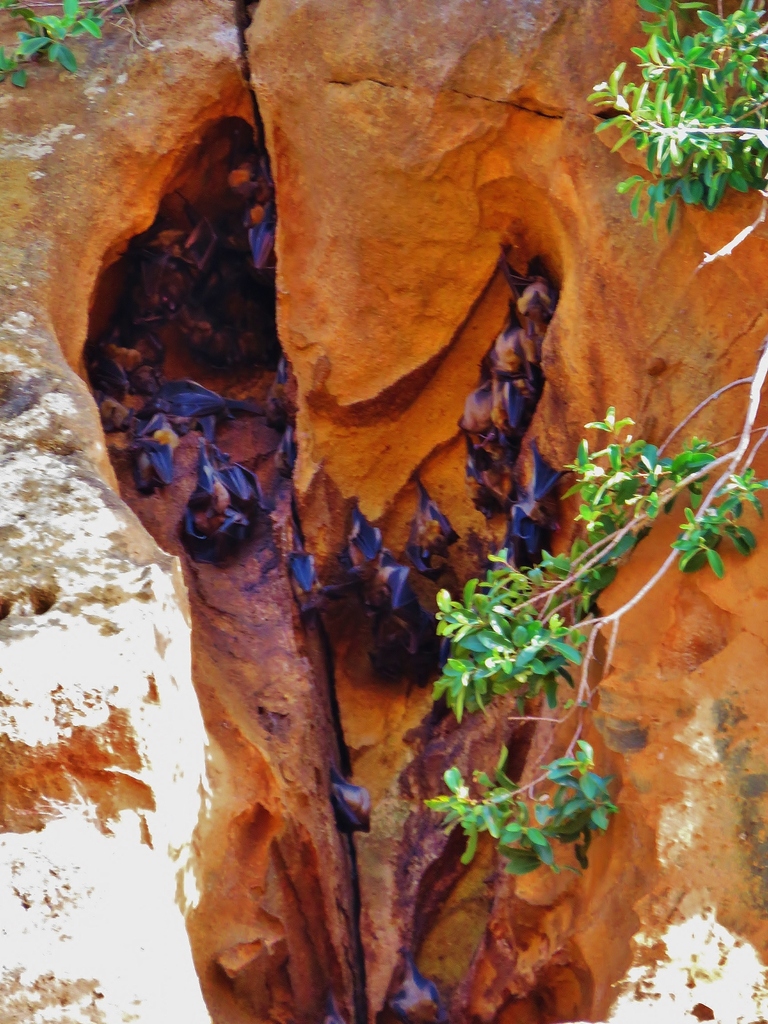
Madagascan Straw-colored Fruit Bat

Madagascan Straw-colored Fruit Bat

Eidolon dupreanum
Photo © n_armstrongPhoto © n_armstrong — CC0 1.0 — Source: iNaturalist #137598537
ABOUT

The Madagascan fruit bat (Eidolon dupreanum) is a species of bat in the family Pteropodidae. It is endemic to Madagascar and is listed as "Vulnerable" by the IUCN because it is hunted as bushmeat. == Distribution and habitat == Eidolon dupreanum is named after the Governor of Réunion from 1864 to 1869, Marie Jules Dupré, for the help he gave to scientific researchers. The Madagascan fruit bat is found both around the coastal plain and in the inland high plateau. It has not been recorded in some areas but that is likely to be because it has not been observed rather than that it is absent from these areas. It requires suitable rock fissures and caves in which to roost during the day. Colony size varies between about ten and five hundred individuals. == Biology == Examination of the droppings from the Madagascan fruit bat show that it mainly consumes fruit but also feeds on the flowers of Eucalyptus spp. It was found to fly as far as 5 kilometres (3.1 mi) to reach trees of Polyscias spp. while largely neglecting the guava trees Psidium near its roost. Seeds smaller than about 7 mm (0.3 in) in diameter were swallowed.…

HOTSPOTS
Sort by
National Park

Ankarana National Park

Madagascar
+90 birds+10 mammals
National Park

Tsingy de Bemaraha National Park

Begara·Madagascar
+81 birds+10 mammals

Nothing matches these filters.

Where to see & photograph the Madagascan Straw-colored Fruit Bat →
COMMUNITY
Share your photos of Madagascan Straw-colored Fruit Bat Inspire other photographers and contribute to the atlas.
Drag your photos here or select a file from your device JPG, PNG or WebP · Up to 10 photos of 25 MB

Your photo, your rights. Always credited to you.

Sort by

No community photos yet. Log in to add the first one.

0 Observed by
0 Hotspots reported
0 Countries

No community observations of this species yet.

Wild Atlas Guide

  • About
  • Contact
  • Privacy Policy
  • Terms of Use
  • Send Feedback

Community

  • Submit a Hotspot
  • Operators Directory
  • Add your business
  • Business Terms
© 2026 Wild Atlas Guide — Content & data compilation protected.
Privacy Policy · Cookie settings · Copyright & data use

Contact Us

We'd love to hear from you. We'll reply as soon as possible.

Send Feedback

Found an error? Have a suggestion? We read every message.

Submit a hotspot Add your business
Sign in
MENU
Sign in

or

Enter your username or email and we'll send you a link to reset your password.

or

Biological profile

Madagascan Straw-colored Fruit Bat

A compact view of how this species lives, moves and responds to its environment.

The species at a glance

Select a card to explore the details.

Movement
Does it remain in the same area?
Only part of the population migrates
How does it move?
Directional MigrationLocal Ranging
Does it always follow the same route?
It uses several different routes
Can its movements be anticipated?
Yes, its movements tend to repeat
Do its movements change with the seasons?
Yes, they follow a seasonal cycle
Do all populations follow the same calendar?
No, different populations follow different calendars
Variations between populations
Resident · Southern Hemisphere · Resident FractionComplete Migrant · Southern Hemisphere · Migrant Fraction
Activity
When is it active?
Active at different times by day and nightMost active around dawn and duskMainly active by dayMainly active at night
Does it have inactive periods?
No known inactive period
How to detect it
Is it easy to find?
Usually easy to find
How can you detect it?
AcousticVisual
Does it tend to hide?
It usually remains visible
Do you need a specific technique?
Usually not
Which seasonal signs help?
Aggregation
Habitat
Which environment does it live in?
AerialTerrestrial
Which places does it prefer?
Forest
Can it adapt to different habitats?
It tolerates some variety of habitats
At what level of the habitat does it move?
AerialCanopy
Feeding
What kind of food does it eat?
Frugivore
How does it get its food?
Generalist SearchGleaning
Social life
Does it usually live alone or in a group?
It usually lives in groups
Does it gather at certain times?
Feeding
Reproduction
How does it breed?
Colonial
Where does it breed?
Tree
Key moments in its annual cycle
Birth · Annual Cycle Consistent
Spatial ecology
Does it defend a territory?
No, it does not usually defend a territory
How far does it usually travel?
Across a whole region
In which major regions does it live?
Afrotropical
Environmental response
Does its calendar change from place to place?
Yes, it responds to local conditions
Which factors change its calendar?
Food Pulse
Which conditions influence its behaviour?
Food Availability · Movement
Sensitivity
Is it affected by human disturbance?
Observe it calmly and keep your distance
When does it need the most space?
Roost
Global profile. Local behaviour and timing may vary.
Discover
Book
AllBirdsMammalsCountriesHotspotsHidesExperiencesOperators

Before you choose a photo

Please confirm the photo rights and credit terms first.

Read the photo rights and credit terms

I'm the author of this photo or hold the rights to it, and I keep full ownership. I grant Wild Atlas Guide a free, non-exclusive licence to display it on the site and in Wild Atlas Guide's own channels, including social media, always credited to me by my display name or the Instagram handle I choose to provide. I confirm it does not reveal a sensitive wildlife location or a recognisable person without their permission. I can withdraw future social use for this photo or ask for it to be removed at any time.

Please accept the photo rights and credit terms to continue.

Add your photo

    Uploading…

    We use cookies to measure traffic and improve Wild Atlas Guide. You decide. Privacy policy