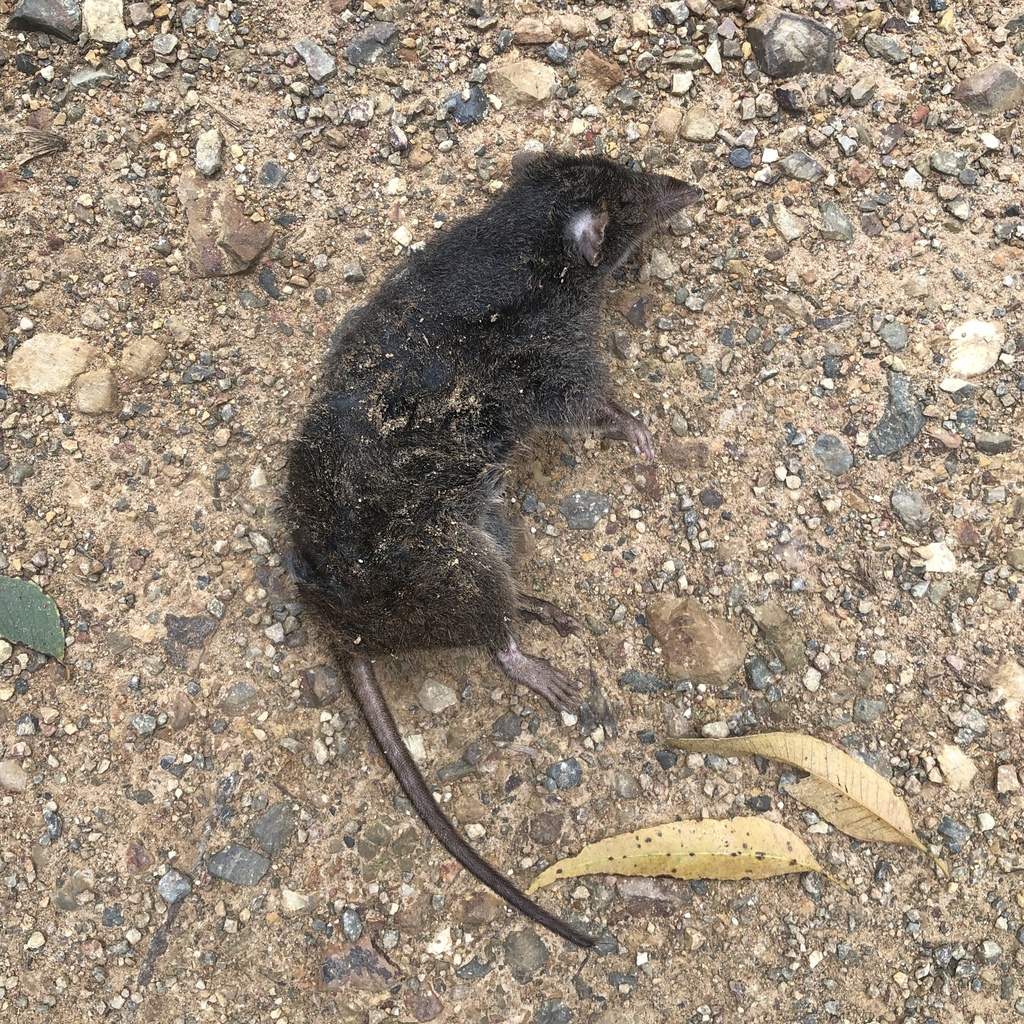
Mainland Dusky Antechinus
Photo © James K. Douch
Photo © James K. Douch — CC BY-SA 4.0 — Source: iNaturalist #216763471Identification
The Mainland Dusky Antechinus is a small, carnivorous marsupial that can be easily confused with several related species. Adults typically measure around 20–27 cm in total length, including a moderately furred tail, and weigh between 170–400 grams, with males noticeably larger than females. The fur is generally dark grey to dusky brown on the back, with a paler cream or grey underside. Key identification features include relatively large, dark eyes, small rounded ears, and a pointed snout. Unlike some congeners, the Mainland Dusky Antechinus has relatively uniform coloration without pronounced spotting, though some individuals may show faint lighter patches. The tail is slightly darker than the body and thinner than in some other Antechinus species.
Range & Habitat
The Mainland Dusky Antechinus is endemic to south-eastern Australia, primarily found in Victoria and far south-eastern New South Wales. Its range is discontinuous, with isolated populations occupying suitable pockets of habitat across this region. The species favours cool, wet, sclerophyll forests and similar vegetation with dense understorey structure. It prefers areas with plenty of fallen logs, leaf litter, and dense ground cover—habitats that provide shelter and abundant invertebrate prey. Unlike some antechinus species adapted to more arid regions, the Mainland Dusky Antechinus typically occurs in higher-rainfall areas and tends to favour lower to middle elevations, though it can be found in suitable montane forest.
Behaviour & Diet
This is a nocturnal and largely solitary species, spending daylight hours sheltering in tree hollows, fallen logs, or dense vegetation. Mainland Dusky Antechinus are highly carnivorous, feeding primarily on small arthropods including insects, spiders, and other invertebrates found in leaf litter and on vegetation. They forage by hunting through the forest floor and climbing actively through low vegetation and fallen timber. Males are notably more aggressive during the breeding season, and the species exhibits the characteristic 'big bang' reproduction pattern found in many antechinus species, where males exhaust themselves during an intense mating period. This physiological strategy means that most males do not survive to a second breeding season, making females the primary overwinter survivors.
Best Time & Places to See It
The Mainland Dusky Antechinus is nocturnal and cryptic, making it challenging to observe. The best opportunities come during warm, wet nights when invertebrate activity is highest and the animals are most active. Spring and early summer (September to November) offer reasonable chances, particularly after rainfall. The species is most readily encountered in protected forest reserves in eastern Victoria and southern New South Wales where suitable habitat remains relatively intact. Searching around fallen logs and dense ground vegetation with a torch offers the best prospects, though patience and luck are essential. Night-time spotlighting walks in suitable forest reserves may yield sightings.
Photography Tips
Photographing the Mainland Dusky Antechinus requires specialist night photography techniques, including a reliable headlamp or torch and a camera capable of high ISO performance. Given the animal's small size and nocturnal habits, a macro lens is valuable for capturing fine detail. Red light rather than white light is less likely to startle the animal. Move slowly and deliberately through appropriate habitat, pausing frequently to scan logs and vegetation. Since the species is cryptic and easily disturbed, approaching any observed individual requires extreme caution to avoid driving it into deeper cover. Early morning hours when animals may still be active offer marginally better light conditions than deepest night.
Wilsons Promontory National Park
Australia
+210 birds+21 mammals
Where granite headlands plunge toward Bass Strait, Wilson's Promontory National Park sprawls across nearly 1,300 square kilometers of southeastern Victoria's most rugged coastal wilderness. The park's…
VIEW NATIONAL PARKBlue Mountains National Park
Australia
+220 birds+43 mammals
Dramatic sandstone cliffs rise in tiers across this mountainous plateau west of Sydney, their rust-coloured faces weathered into amphitheatres and gorges where eucalyptus forest clings to…
VIEW NATIONAL PARKBen Boyd National Park
Eden, Australia
+255 birds+47 mammals
Where the temperate forests of the far south coast meet towering sea cliffs, Ben Boyd National Park unveils one of New South Wales' most dramatic coastal…
VIEW NATIONAL PARKGrampians National Park
Australia
+214 birds+18 mammals
Where sandstone ridges rise above the Western District of Victoria, Grampians National Park unfolds across rolling terrain sculpted by ancient geology and sustained by a temperate…
VIEW NATIONAL PARKGreat Otway National Park
Australia
+255 birds+42 mammals
Temperate rainforest and wet eucalyptus woodland cloak the ridges and gullies of Victoria's Great Otway National Park, where persistent moisture and mild year-round temperatures sustain a…
VIEW NATIONAL PARKNo community photos yet. Log in to add the first one.
No community observations of this species yet.