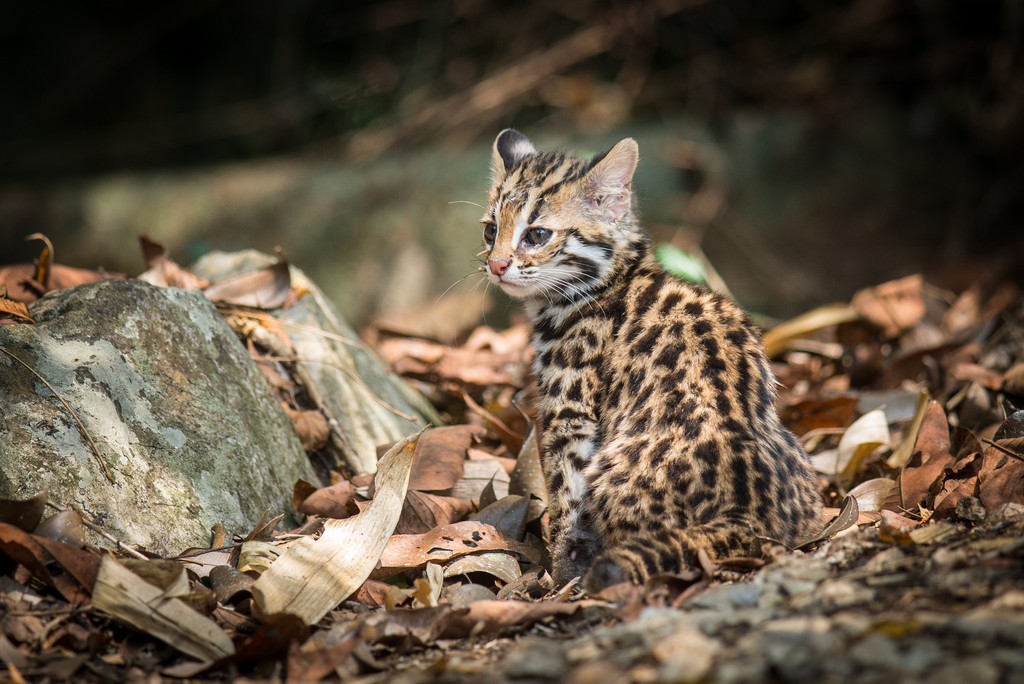
Mainland Leopard Cat
Photo © Utain Pummarin
Photo © Utain Pummarin — CC BY 4.0 — Source: iNaturalist photo #81345749Identification
The leopard cat is a small, slender wild cat about the size of a domestic cat but with longer legs and distinctive webbing between its toes. Its tawny coat is marked with dark spots of varying sizes across the body and limbs, with two to four rows of elongated spots running along the back. Two prominent dark stripes run from the eyes to the ears, accompanied by smaller white streaks from the eyes toward the nose. The moderately long, rounded ears are black with central white spots, while the tail—about half the head-body length—is spotted with indistinct rings near its black tip. The chest and belly are white, providing contrast to the spotted upperparts.
Colouration varies considerably across the species' range: southern populations display yellowish-brown fur, while northern populations are pale silver-grey. In tropical regions, leopard cats typically weigh 0.55–3.8 kg with shoulder heights around 41 cm, but northern populations can weigh up to 7.1 kg and measure considerably larger, reflecting seasonal weight gain before winter.
Range & Habitat
Native to continental South, Southeast, and East Asia, the leopard cat inhabits a remarkable diversity of forest types, from tropical evergreen rainforests to subtropical deciduous and coniferous forests. The species displays exceptional altitudinal range, occurring from lowlands to elevations of 4,474 m in the Himalayas. This broad distribution and habitat flexibility has ensured its listing as Least Concern on the IUCN Red List since 2002, though habitat loss and hunting pose localized threats.
Behaviour & Diet
These small carnivores are specialized hunters, though specific dietary details are not extensively documented in field observations. Their webbed toes suggest adaptation to wetland hunting, likely pursuing small prey typical of forest floor and aquatic edge habitats across their range. The species' survival across such diverse ecosystems—from tropical lowlands to high-altitude mountain forests—indicates remarkable behavioral flexibility and adaptability to varied prey availability.
Best Time & Places to See It
Finding leopard cats requires patience and knowledge of local populations. The species occurs widely across its range from South through Southeast to East Asia, but specific productivity hotspots depend on local habitat quality and protection status. Visitors should consult with local naturalists and protected area guides familiar with recent sightings, as the species' nocturnal and elusive nature makes encounters unpredictable even in suitable habitat.
Photography Tips
The leopard cat's small size, cryptic coloration, and nocturnal habits present significant photographic challenges. Camera traps positioned along forest trails and near water sources may yield images, though patience and multiple cameras increase success rates. The distinctive facial markings—the eye-to-ear stripes and white facial streaks—are key identifying features worth capturing. Early dawn and dusk periods offer the best natural light opportunities when these cats may be active.
Banke National Park
Bardiya National Park
Giant Panda National Park
Kaeng Krachan National Park
Kaziranga National Park
Khao Yai National Park
Northeast China Tiger and Leopard National Park
Taman Negara National Park
Nothing matches these filters.
No community photos yet. Log in to add the first one.
No community observations of this species yet.