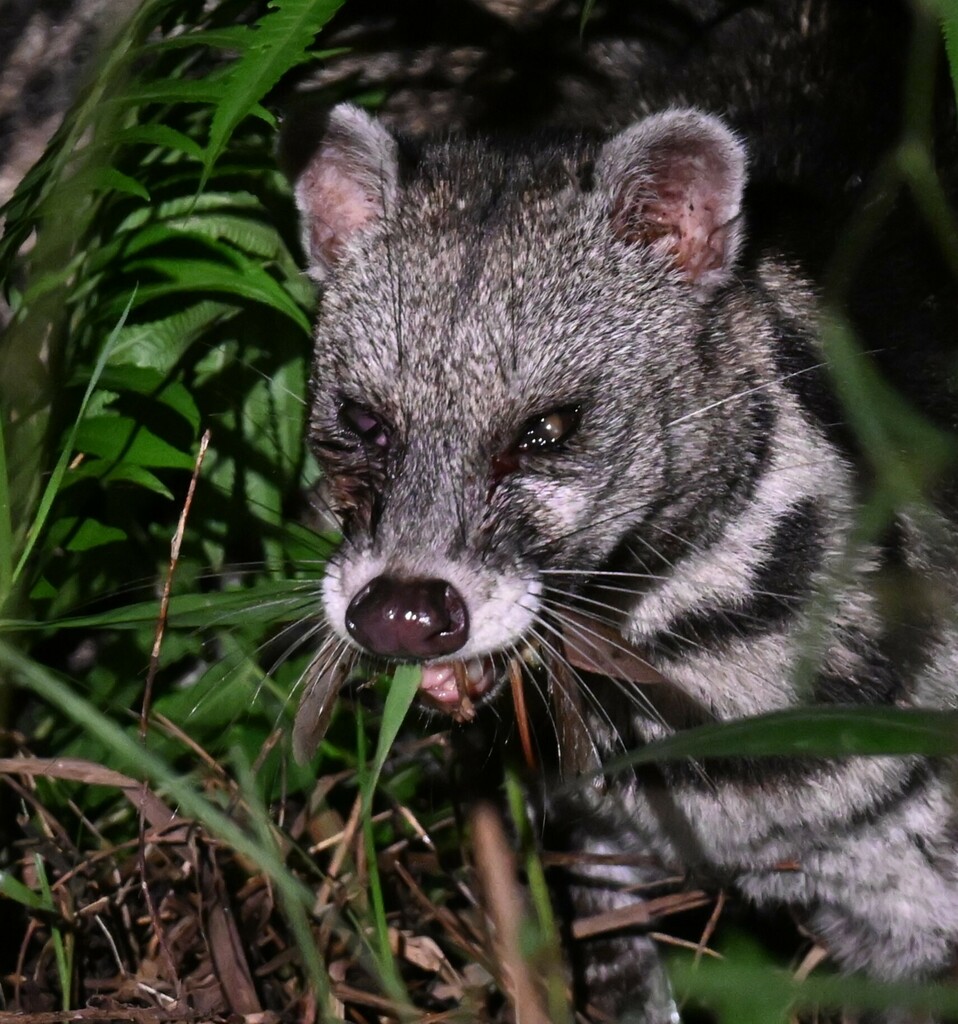
Malay Civet
Photo © Chrissy McClarren and Andy Reago
Photo © Chrissy McClarren and Andy Reago — CC0 1.0 — Source: iNaturalist #253901059The Malayan civet (Viverra tangalunga), also known as the Malay civet and Oriental civet, is a viverrid native to the Malay Peninsula and the islands of Sumatra, Bangka, Borneo, the Riau Archipelago, and the Philippines. It is listed as "Least Concern" by IUCN as it is a relatively widely distributed, appears to be tolerant of degraded habitats, and occurs in a number of protected areas. == Taxonomy == Viverra tangalunga was the scientific name proposed by John Edward Gray in 1832 for a spotted zoological specimen. == Characteristics == The Malay civet's tail is black above and ringed on the lower side. == Distribution and habitat == The historical range of the Malay civet includes Indonesia, Malaysia, Brunei, the Philippines and Singapore. In Malaysia, it occurs in Borneo, Banggi Island, Langkawi Island, Penang Island and in Peninsular Malaysia. It also occurs in Sumatra. It was introduced to Sulawesi and the Maluku Islands. Museum records indicate that the Malay civet also occurred on the Indonesian islands of Java, Bawal and Telok Pai, and on the Philippine island Leyte. In 2012, an individual was photographed in Singapore. The Malay civet population in the Philippines may have originated in Borneo and colonized Palawan…
Taman Negara National Park
Kampong Samas, Malaysia
+393 birds+48 mammals
Where ancient rainforest meets limestone peaks, one of Southeast Asia's oldest protected wilderness preserves sprawls across 4,343 square kilometers of primordial landscape. Dipterocarp giants tower overhead,…
VIEW NATIONAL PARKWay Kambas National Park
Lampung Timur, Indonesia
+237 birds+20 mammals
Across the low swamplands of eastern Lampung, where freshwater wetlands merge into tidal mangrove forests along the Sunda Strait, sprawls one of Sumatra's most vital sanctuaries.…
VIEW NATIONAL PARKNo community photos yet. Log in to add the first one.
No community observations of this species yet.