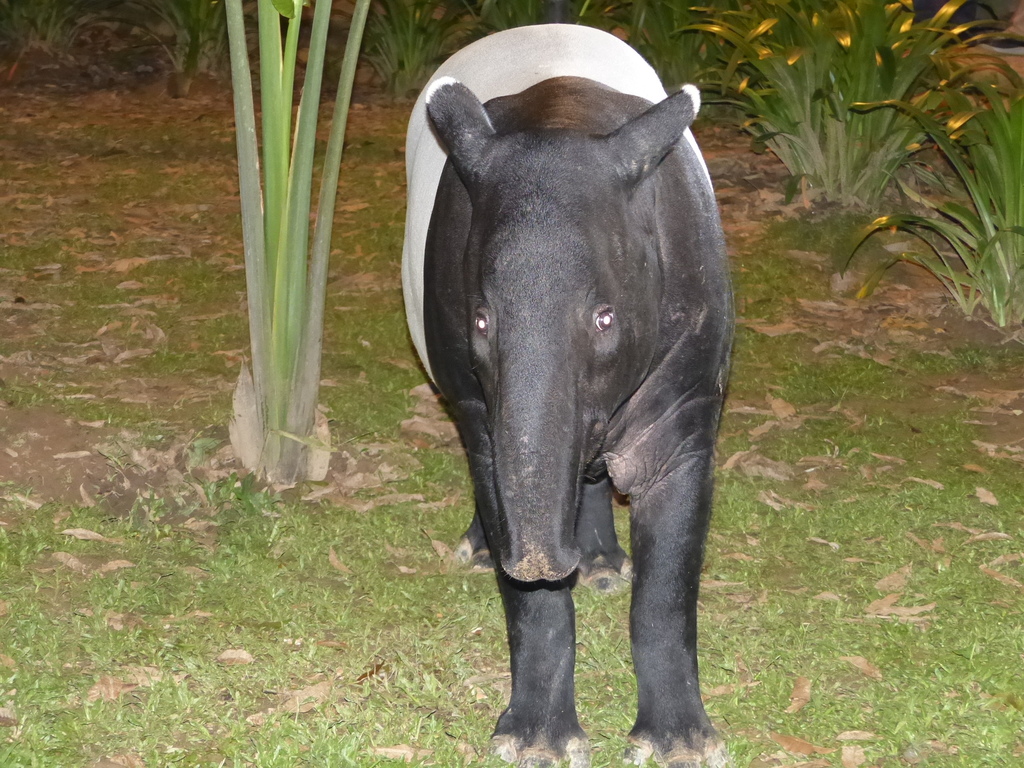
Malayan Tapir
Photo © Sarka Masova
Photo © Sarka Masova — CC BY 4.0 — Source: iNaturalist #46492499The Malayan tapir (Tapirus indicus), also called Asian tapir, Asiatic tapir, oriental tapir, Indian tapir, piebald tapir, or black-and-white tapir, is the only living tapir species outside of the Americas. It is native to Southeast Asia from the Malay Peninsula to Sumatra. It has been listed as Endangered on the IUCN Red List since 2008, as the population is estimated to comprise fewer than 2,500 mature individuals. == Taxonomy == The scientific name Tapirus indicus was proposed by Anselme Gaëtan Desmarest in 1819 who referred to a tapir described by Pierre-Médard Diard. Tapirus indicus brevetianus was coined by a Dutch zoologist in 1926 who described a black Malayan tapir from Sumatra that had been sent to Rotterdam Zoo in the early 1920s. Phylogenetic analyses of 13 Malayan tapirs showed that the species is monophyletic. It was placed in the genus Acrocodia by Colin Groves and Peter Grubb in 2011. However, a comparison of mitochondrial DNA of 16 perissodactyl species revealed that the Malayan tapir forms a sister group together with the Tapirus species native to the Americas. It was the first Tapirus species that genetically diverged from the group, estimated about 25 million years ago in the Late Oligocene. ==…
No community photos yet. Log in to add the first one.
No community observations of this species yet.