Identification
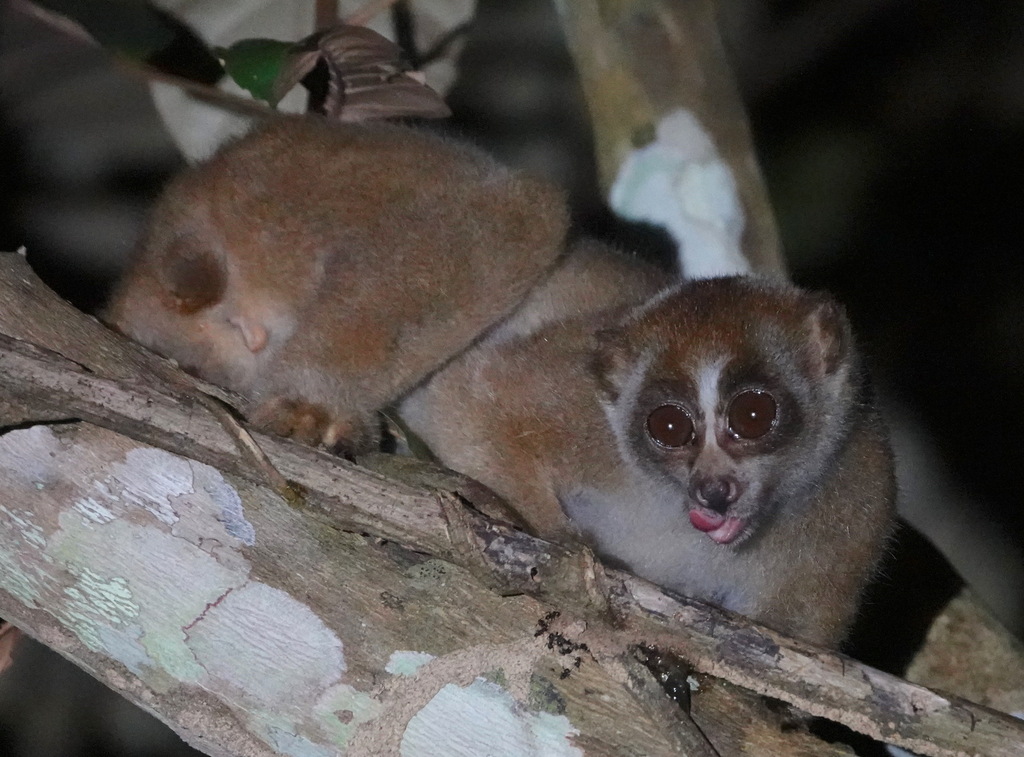
The Malaysian slow loris, also known as the Sunda slow loris or greater slow loris, is a small, nocturnal primate measuring 27 to 38 cm from head to tail and weighing between 599 and 685 grams. Like all slow lorises, it possesses distinctive features including a wet nose, a round head, and large forward-facing eyes adapted for night vision. Its small ears are largely hidden within its thick fur, and it has a notably flat face and a vestigial tail. These physical adaptations make the slow loris instantly recognizable among Southeast Asian primates.
Range & Habitat
The Sunda slow loris is native to Indonesia, West Malaysia, southern Thailand, and Singapore. It is a highly specialized forest dweller that typically occurs in evergreen forests, showing a strong preference for rainforests with continuous, dense canopies. The species' name references the Sunda Islands, a group of islands in the western Malay Archipelago where it naturally occurs. Unfortunately, its habitat has suffered severe loss across its range, fragmenting populations and restricting the species to increasingly isolated forest patches.
Behaviour & Diet
The Malaysian slow loris is a solitary, nocturnal and arboreal species with an extremely low metabolic rate compared to other mammals of similar size. Observations show that individuals spend only about 8% of their active time near other lorises, emphasizing their predominantly solitary nature. During the day, they sleep curled into a ball in hidden parts of trees, often on branches, twigs, palm fronds, or lianas well above ground level.
These primates are omnivorous, feeding on sap, floral nectar, fruit, and arthropods. They have a specialized feeding behavior of licking wounds in trees to access gum and sap exudates. The species exhibits monogamous mating, with offspring remaining with their parents. Females are polyoestrous and typically give birth to a single young after a gestation period of 192 days. Young lorises disperse between 16 and 27 months, generally once they reach sexual maturity.
Best Time & Places to See It
As a strictly nocturnal species, the Malaysian slow loris is only active during darkness, making night walks in suitable rainforest habitat the best opportunity to encounter them. Look in evergreen forests with continuous, dense canopies in Malaysia, southern Thailand, Indonesia, or Singapore. Early evening or late night surveys of the forest canopy offer the best chances of observation, though their solitary, cryptic nature means sightings remain relatively uncommon even in appropriate habitat.
Photography Tips
Photographing the Malaysian slow loris presents significant challenges due to its strictly nocturnal behavior and preference for dense canopy cover. A headlamp or red-filtered light will help locate individuals without disturbing them excessively. Use high ISO settings and fast lenses to work in low-light conditions, and consider bringing a telephoto lens to maintain distance from this endangered, stress-sensitive species. Move slowly and quietly through the forest at night, scanning the canopy and understory carefully, and always prioritize the animal's welfare over obtaining the shot.
Taman Negara National Park
Kampong Samas, Malaysia
+393 birds+48 mammals
Where ancient rainforest meets limestone peaks, one of Southeast Asia's oldest protected wilderness preserves sprawls across 4,343 square kilometers of primordial landscape. Dipterocarp giants tower overhead,…
VIEW NATIONAL PARKKerinci Seblat National Park
Kerinci, Indonesia
+228 birds+16 mammals
Across nearly 67,000 square kilometres of Sumatra's spine, a mountainous realm of equatorial rainforest rises from steaming lowlands to volcanic peaks shrouded in cloud. Kerinci Seblat…
VIEW NATIONAL PARKWay Kambas National Park
Lampung Timur, Indonesia
+237 birds+20 mammals
Across the low swamplands of eastern Lampung, where freshwater wetlands merge into tidal mangrove forests along the Sunda Strait, sprawls one of Sumatra's most vital sanctuaries.…
VIEW NATIONAL PARKNo community photos yet. Log in to add the first one.
No community observations of this species yet.