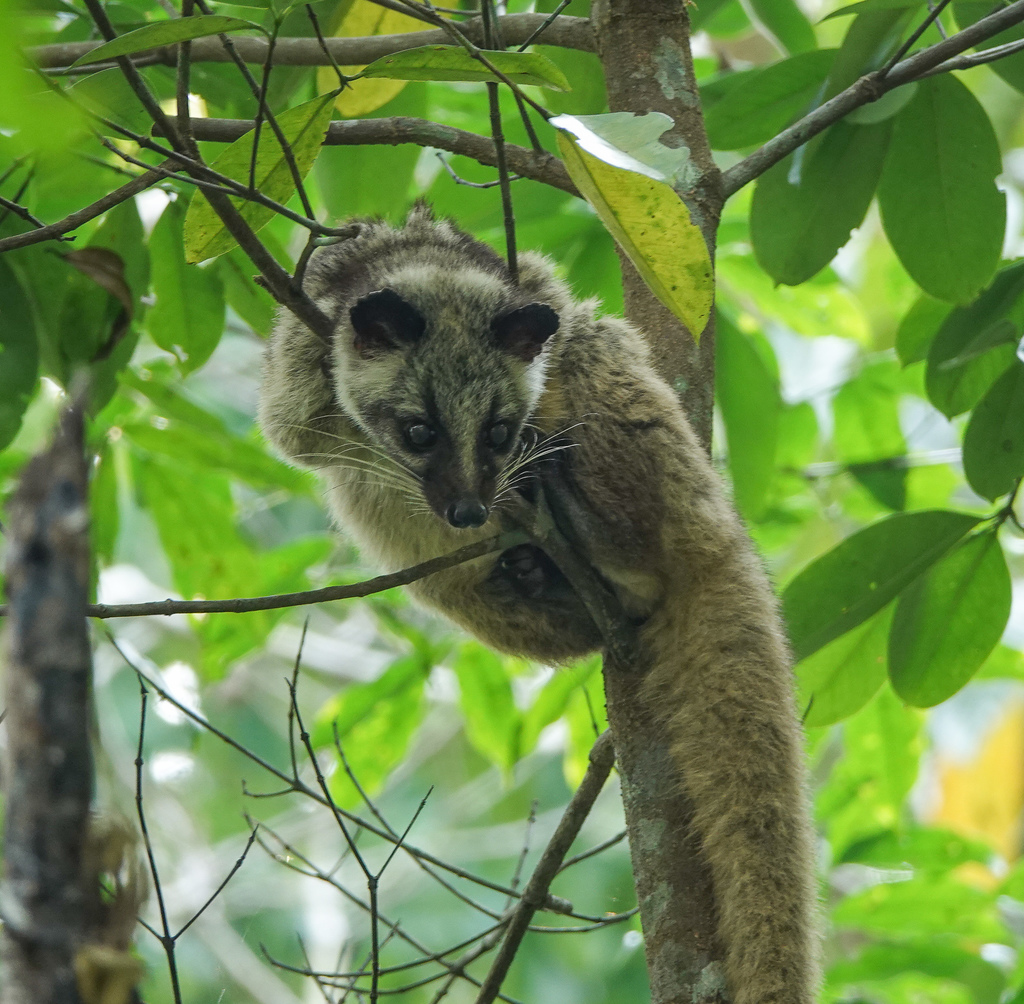
Masked Palm Civet
Photo © Rejoice Gassah
Photo © Rejoice Gassah — CC BY 4.0 — Source: iNaturalist #47591774Identification
The masked palm civet is a small, distinctly marked viverrid with a striking facial pattern that gives it both its common name and alternative names: gem-faced civet and Himalayan palm civet. Its most recognizable feature is the prominent white facial mask that extends across the forehead, around the eyes, and down the back of the neck, stopping just under the shoulder blades. The white markings include well-defined patches above and below the eyes, white lips, chin, and throat, and in some individuals, distinctive white "sideburn" stripes curving up from the throat.
The body fur is grayish to ochraceous (yellowish-brown), contrasting sharply with the black head, shoulders, and neck, and blackish-brown tail and feet. Unlike other palm civets, this species has no spots or stripes. Adults typically measure 50–60 cm in body length with a tail of 40–50 cm, weighing 3–5 kg, though some individuals are lighter or heavier. The tail comprises more than two-thirds the length of the head and body combined.
Range & Habitat
The masked palm civet is native to a vast region spanning the Indian subcontinent and Southeast Asia. Its range extends from the northern Indian subcontinent and Himalayas eastward across Bhutan, Bangladesh, Myanmar, Thailand, Peninsular Malaysia, Laos, Cambodia, Vietnam, and China, with populations also present in Borneo, Sumatra, Taiwan, and the Andaman and Nicobar Islands. It has been introduced to Japan on at least two separate occasions, with populations arriving from Taiwan.
This adaptable species inhabits both evergreen and deciduous forests and can tolerate some degree of habitat modification. It also occurs in fragmented forest habitats, though at reduced density compared to intact forests. Its tolerance of disturbed habitats contributes to its widespread distribution and stable conservation status.
Behaviour & Diet
The masked palm civet is primarily nocturnal, typically solitary, and occasionally active during daylight hours. It is partly arboreal, moving through forest canopies and understory in search of food. When threatened, it employs a distinctive defense mechanism, spraying a secretion from its anal gland to deter predators.
As an omnivore, this species has a varied and seasonally flexible diet. It feeds on small mammals such as rats and birds, as well as fruits including figs, mangoes, and bananas. Scat analysis has revealed that it also consumes leaves, mollusks, arthropods, and bark, with snakes and frogs forming a minor dietary component. Diet composition varies between seasons and geographic locations.
Best Time & Places to See It
The masked palm civet's nocturnal habits make it challenging to observe. Night drives, spotlight searches, and nocturnal forest walks offer the best opportunities for encounters, particularly in protected forest areas throughout its range. Given its wide distribution across the Indian subcontinent, Southeast Asia, and parts of China, numerous protected areas within these regions provide suitable habitat.
The species occurs in many officially protected areas and is listed as Least Concern by the IUCN, with presumed large populations unlikely to be declining. Protection status varies by location—it is legally protected in Malaysia and China, but not in Thailand and Nepal. The Indian population appears on CITES Appendix III.
Photography Tips
Photographing masked palm civets requires patience and a commitment to nocturnal fieldwork. Thermal imaging or night-vision equipment can aid in locating these elusive animals after dark. A camera capable of high ISO performance with fast lenses is essential for capturing detail in low-light conditions without excessive flash disturbance.
The animal's distinctive facial markings are its most photogenic feature—position yourself to capture the white mask and eye patches clearly. Since the species is partly arboreal and may be encountered in trees or on the ground, be prepared to photograph from various angles. Use a spotlight or red light to locate the animal first, then approach carefully to avoid alarming it, as a startled civet will deploy its defensive anal gland secretion.
Giant Panda National Park
Mianyang, China
+447 birds+47 mammals
Where the eastern slopes of China's Sichuan plateau descend into cloud-wrapped valleys, one of Asia's most biodiverse landscapes unfolds across more than 350,000 square kilometres. This…
VIEW NATIONAL PARKKerinci Seblat National Park
Kerinci, Indonesia
+228 birds+16 mammals
Across nearly 67,000 square kilometres of Sumatra's spine, a mountainous realm of equatorial rainforest rises from steaming lowlands to volcanic peaks shrouded in cloud. Kerinci Seblat…
VIEW NATIONAL PARKNo community photos yet. Log in to add the first one.
No community observations of this species yet.