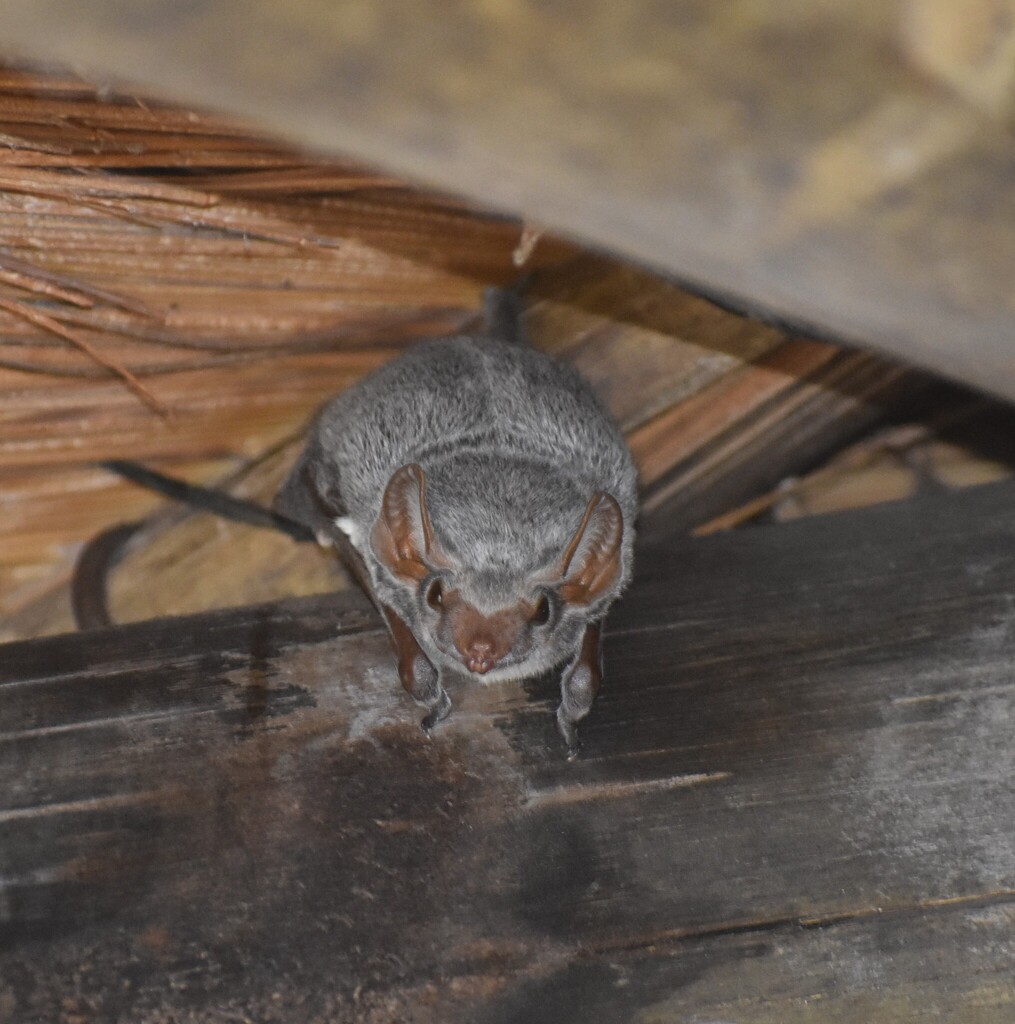
Mauritian Tomb Bat
Photo © Justin Ponder
Photo © Justin Ponder — CC BY 4.0 — Source: iNaturalist #266732142The Mauritian tomb bat (Taphozous mauritianus) is a species of sac-winged bat in the family Emballonuridae that is found in central and southern Africa and Madagascar. It was first described in 1818 by Étienne Geoffroy Saint-Hilaire, and is characterized by an all-white ventral surface, grizzled dorsal coloration, and conical face. It has exceptionally good eyesight, a trait which is common in old world bats and enables it to find roosting locations. It has adapted itself to a wide range of habitats including subarid scrub to semi-tropical savanna and can be found throughout much of Africa south of the Sahara, including many of the surrounding islands. They often seek out refuge in cool dry areas. Mauritian tomb bats help control pest populations, including insects that carry human diseases. These bats tend to be nocturnal hunters and their normal prey consists of moths, butterflies, and termites. Not prone to large-scale roosting, T. mauritianus is most often spotted on the sides of buildings or on the trunks of trees in groups of around five individuals. They breed on average once or twice a year and rear usually one pup, though twins are occasionally reported. They usually deposit their hungry offspring in areas where…
Serengeti National Park
Tanzania
+558 birds+57 mammals
Across Tanzania's northern plateau, where volcanic soils meet acacia woodland and open grassland, unfolds one of Earth's most dynamic ecosystems. The Serengeti National Park sprawls across…
VIEW NATIONAL PARKMapungubwe National Park
Musina Local Municipality, South Africa
+358 birds+29 mammals
Where the Limpopo River cuts through sandstone ridges at the convergence of South Africa, Botswana, and Zimbabwe, Mapungubwe National Park preserves a landscape of profound ecological…
VIEW NATIONAL PARKKidepo Valley National Park
Uganda
+478 birds+24 mammals
Where the Narus and Kidepo rivers carve through northeastern Uganda's semi-arid lowlands, a landscape of sparse acacia woodland, grassland, and riverine thickets creates one of East…
VIEW NATIONAL PARKMurchison Falls National Park
Uganda
+608 birds+33 mammals
Where the Victoria Nile compresses through a narrow gorge and explodes across a 45-meter precipice, the landscape speaks in thunder. Murchison Falls National Park sprawls across…
VIEW NATIONAL PARKTarangire National Park
Tanzania
+527 birds+50 mammals
Acacia woodland and grassland sweep across the Manyara Region where the Tarangire River carves through low hills and volcanic soils, creating one of East Africa's most…
VIEW NATIONAL PARKNgorongoro Conservation Area
Tanzania
+626 birds+55 mammals
Volcanic calderas and open grassland dominate this high plateau in northern Tanzania, where the landscape rises above 2,000 metres and ancient geological forces have shaped both…
VIEW WILDLIFE MANAGEMENT AREAQueen Elizabeth National Park
Uganda
+672 birds+30 mammals
Across the southwestern escarpment of Uganda, where the Western Rift Valley descends through ancient volcanic terrain, Queen Elizabeth National Park sprawls across more than 8,300 square…
VIEW NATIONAL PARKPilanesberg National Park
Moses Kotane Local Municipality, South Africa
+364 birds+49 mammals
Granite peaks and volcanic ridges rise unexpectedly from the savanna floor across this 734-square-kilometre expanse in the North West province, creating a landscape of profound ecological…
VIEW NATIONAL PARKKruger National Park
Ba-Phalaborwa Local Municipality, South Africa
+540 birds+91 mammals
Across the low-lying savanna of northeastern South Africa unfolds one of Africa's largest and most ecologically intact protected areas, where acacia woodlands merge into mopane scrub…
VIEW NATIONAL PARKIthala Game Reserve
uPhongolo Local Municipality, South Africa
+328 birds+26 mammals
Rolling thornbush savanna and acacia woodland dominate the landscape of this 494-square-kilometre national park in KwaZulu-Natal's uPhongolo Local Municipality, where granite outcrops punctuate grassland plateaus and…
VIEW NATIONAL PARKNo community photos yet. Log in to add the first one.
No community observations of this species yet.